CHEM 548: Materials Chemistry

Lecture 17: Band Structures of Graphene, Primitive Cubic, and FCC Crystals

Mon 11/02/2026 · Meeting 19

Reading: Woodward, Karen, Evans, and Vogt, Solid State Materials Chemistry
Ch. 6 §6.4.2, §§6.5–6.6

Learning Objectives: Graphene

By the end of this lecture, you will be able to:

  • Construct reciprocal lattice vectors for non-orthogonal hexagonal systems and identify the hexagonal first Brillouin zone
  • Locate special k-points (Gamma, M, K, K’) in hexagonal Brillouin zones and convert between reciprocal lattice and Cartesian coordinates
  • Distinguish sigma and pi band contributions in graphene and apply orbital orthogonality at high-symmetry points
  • Predict bonding character of π orbitals at Gamma, M, and K points using phase relationship analysis
  • Explain semi-metallic behavior, Dirac points, and linear dispersion as unique features of graphene’s electronic structure

Reciprocal Space: 2D Hexagonal Lattice
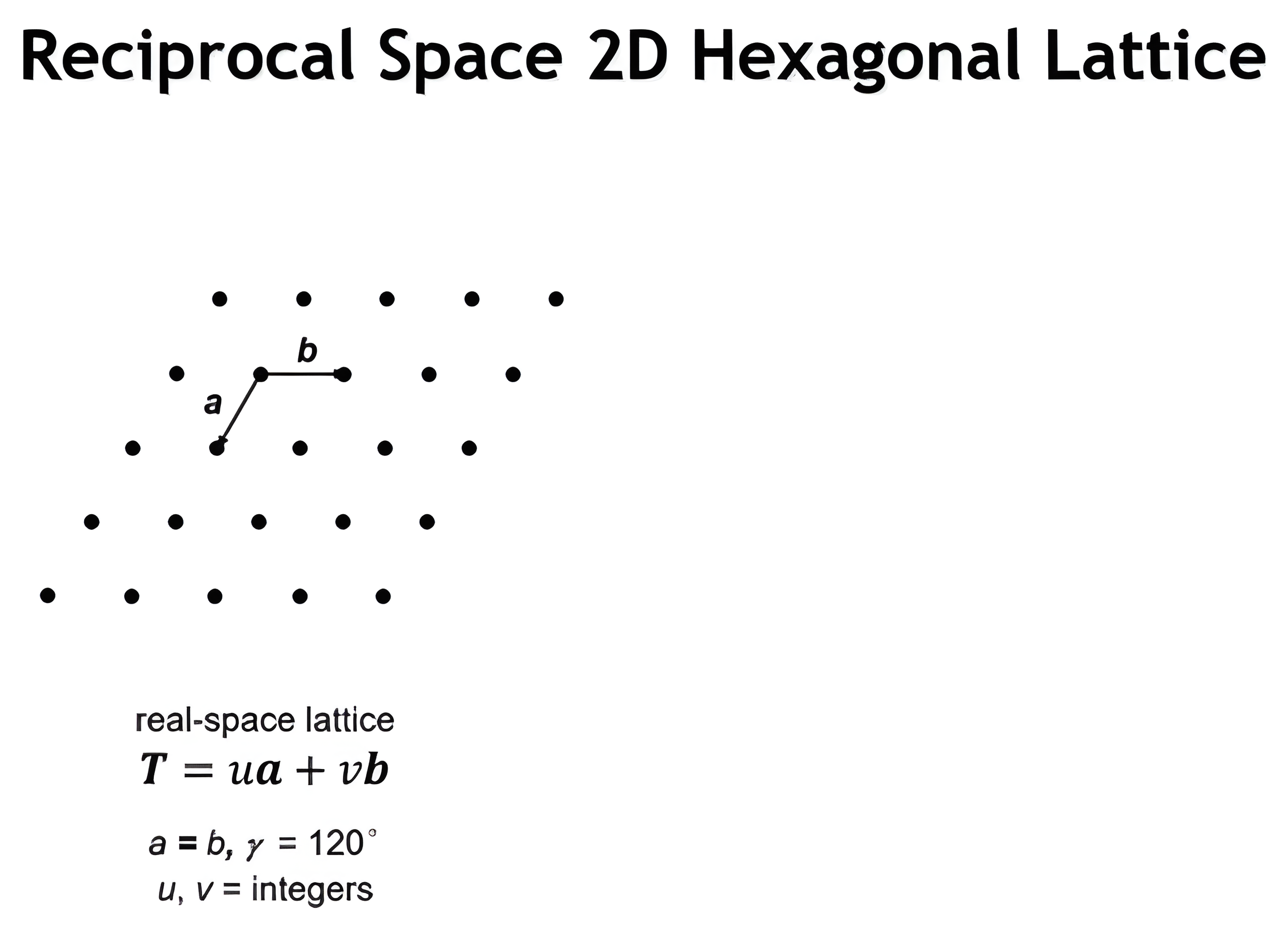
Real-space 2D hexagonal lattice with vectors a and b of equal length at 120 degrees and the translation T equals u a plus v b; a click adds the reciprocal-vector criteria with a-star perpendicular to b and b-star perpendicular to a.

The Reciprocal Lattice and First Brillouin Zone
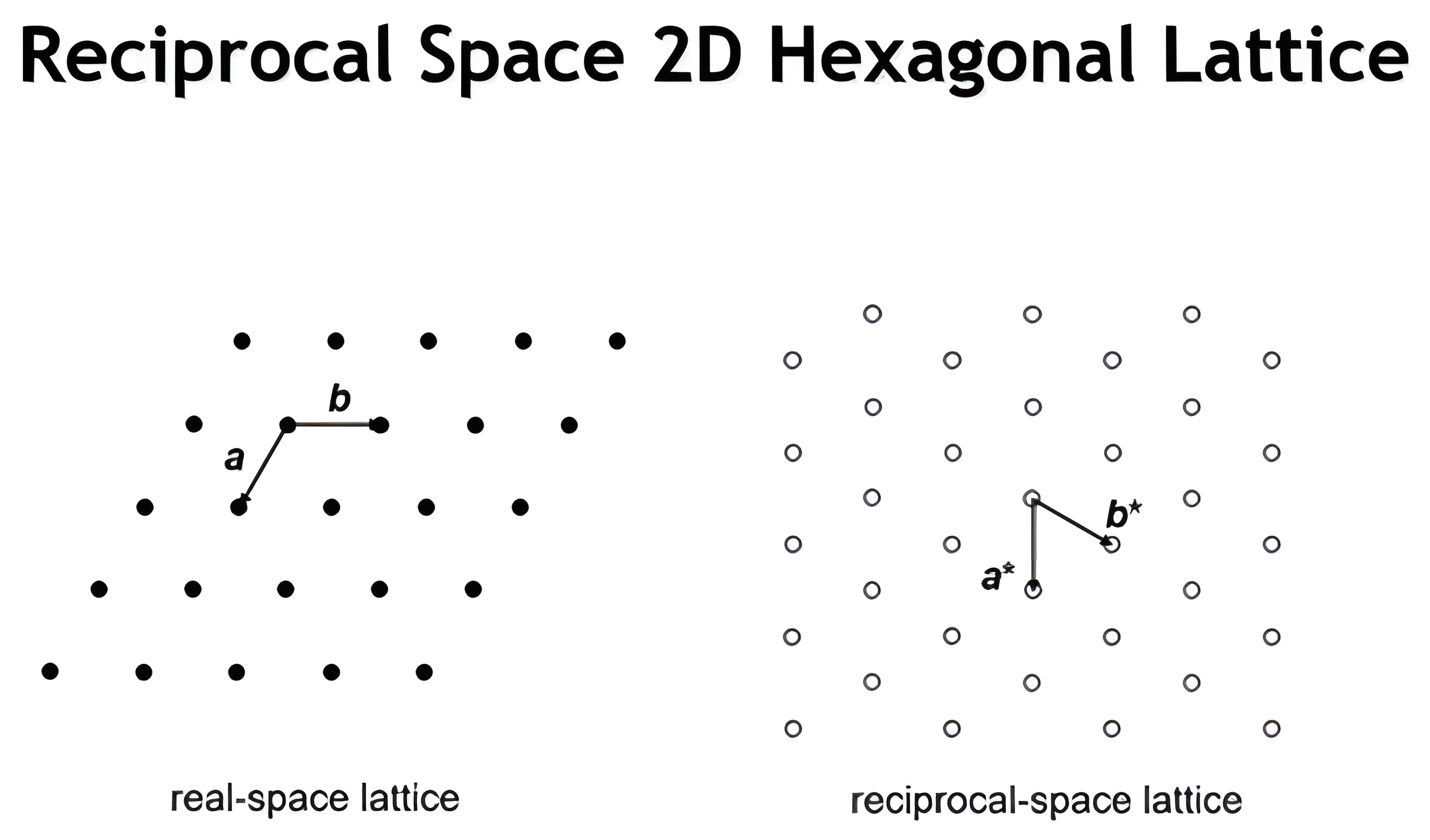
Real-space and reciprocal-space hexagonal lattices side by side; a click adds the Cartesian vector formulas and shades the hexagonal first Brillouin zone around a reciprocal lattice point.

Special Points in a 2D Hexagonal Lattice
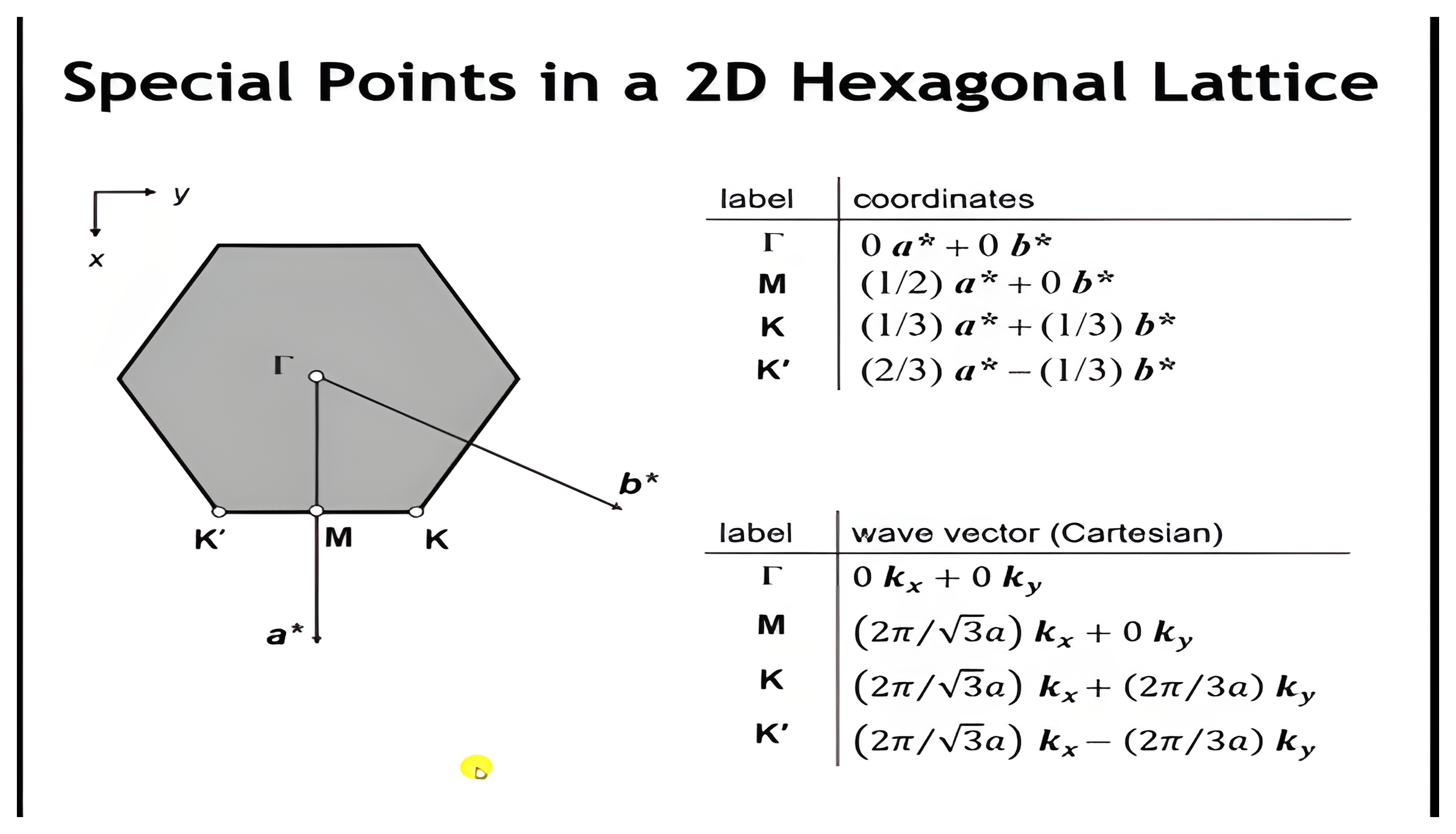
The hexagonal first Brillouin zone with the special points Gamma, M, K, and K-prime labeled, and tables giving their coordinates in reciprocal lattice vectors and Cartesian wave vectors.

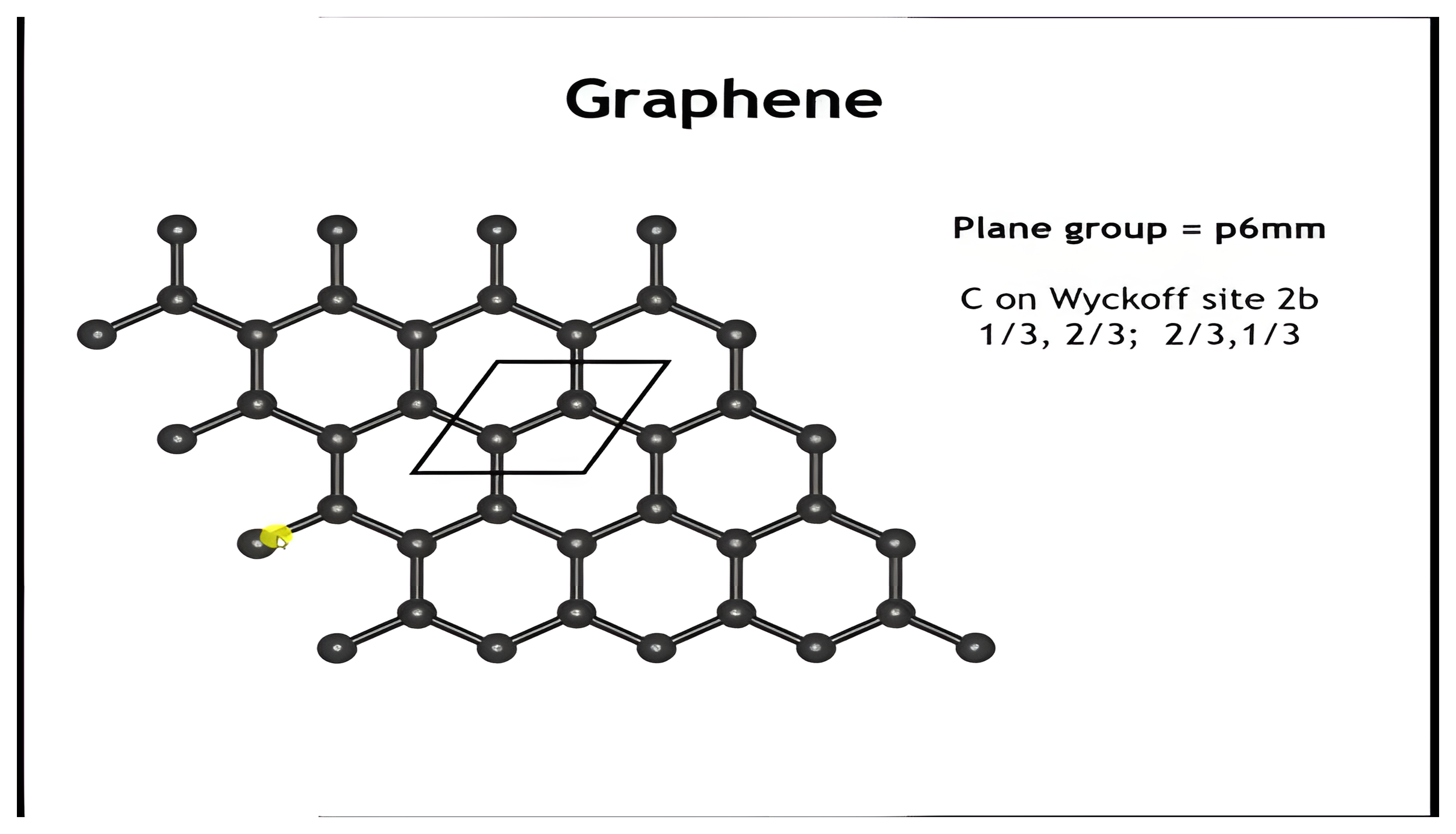
Graphene

The graphene honeycomb structure with a rhombus unit cell outlined; plane group p6mm with carbon on Wyckoff site 2b at one-third two-thirds and two-thirds one-third.

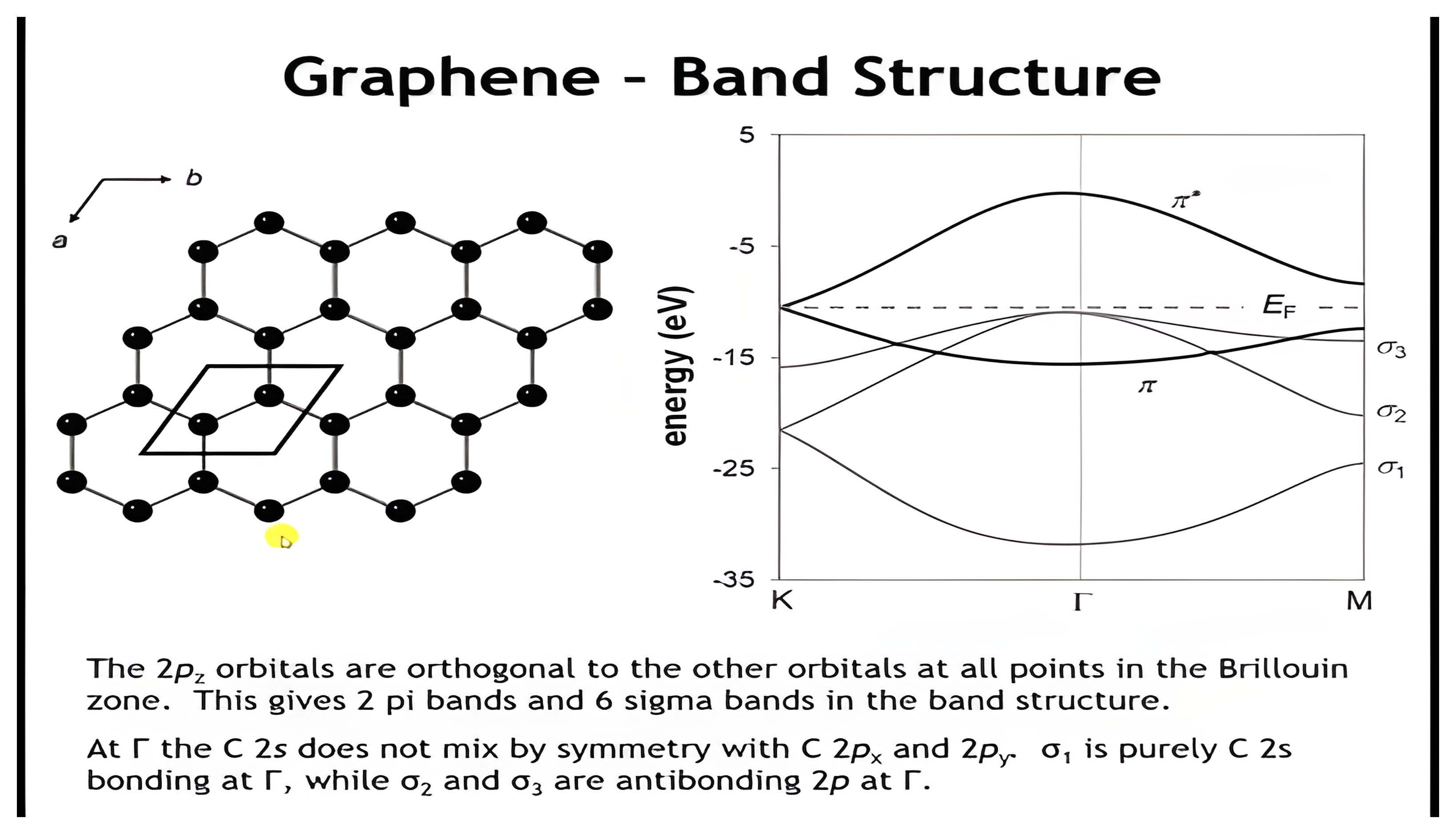
Graphene: Band Structure

Graphene band structure along K, Gamma, M with pi and pi-star bands crossing the Fermi level and three sigma bands below; the honeycomb lattice with unit cell is shown at left.

Graphene π Crystal Orbitals at Γ, M, and K
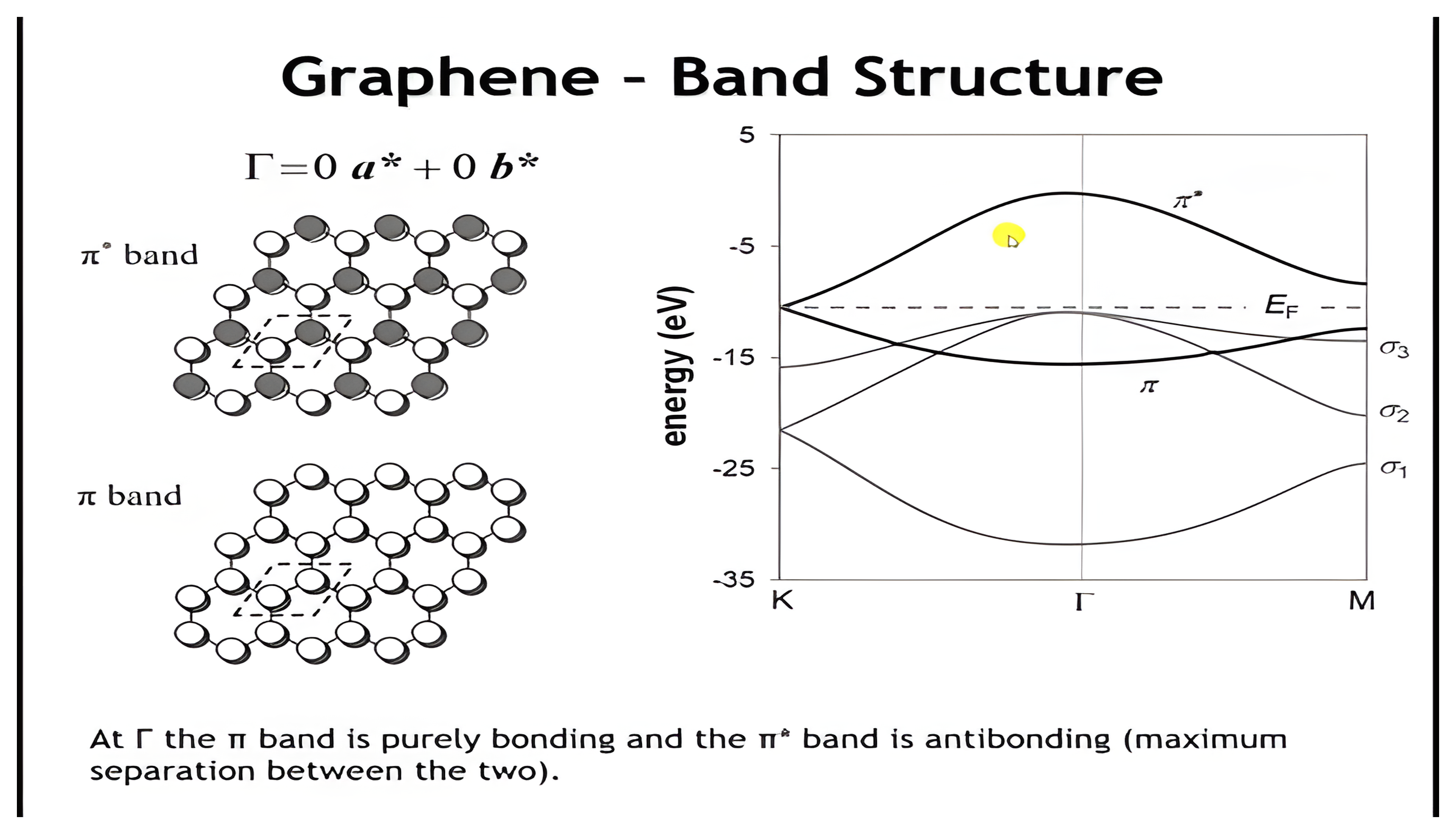
The pi and pi-star crystal orbitals of graphene drawn at the Gamma point beside the band structure; clicks advance the same pictures to the M point and then the K point where the bands touch.

Dirac Points and Semi-Metallic Graphene
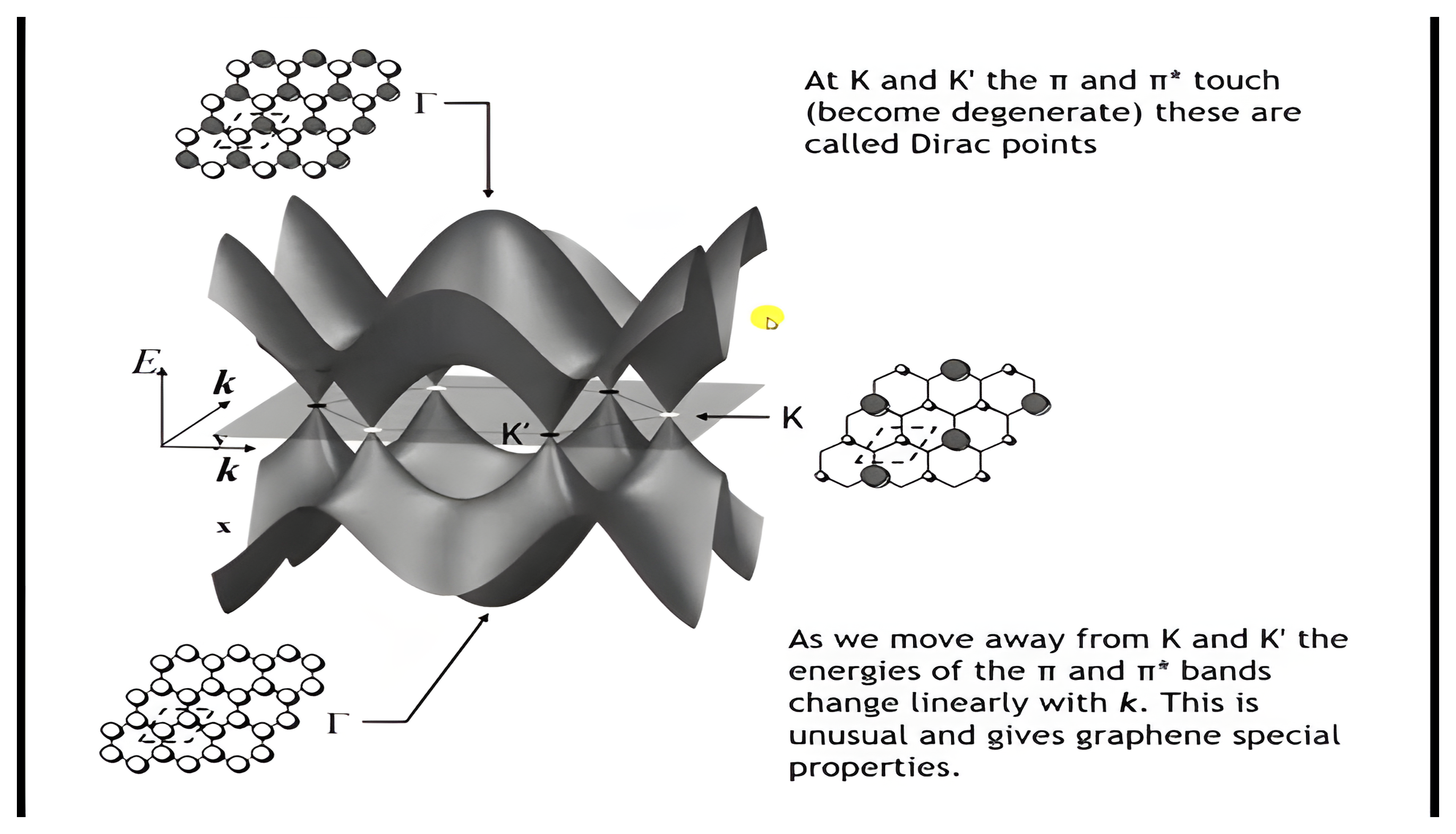
Three-dimensional plot of graphene's pi and pi-star bands over the Brillouin zone, touching at six Dirac points on the zone boundary at K and K-prime.

Check Your Understanding: π and π* Orbitals
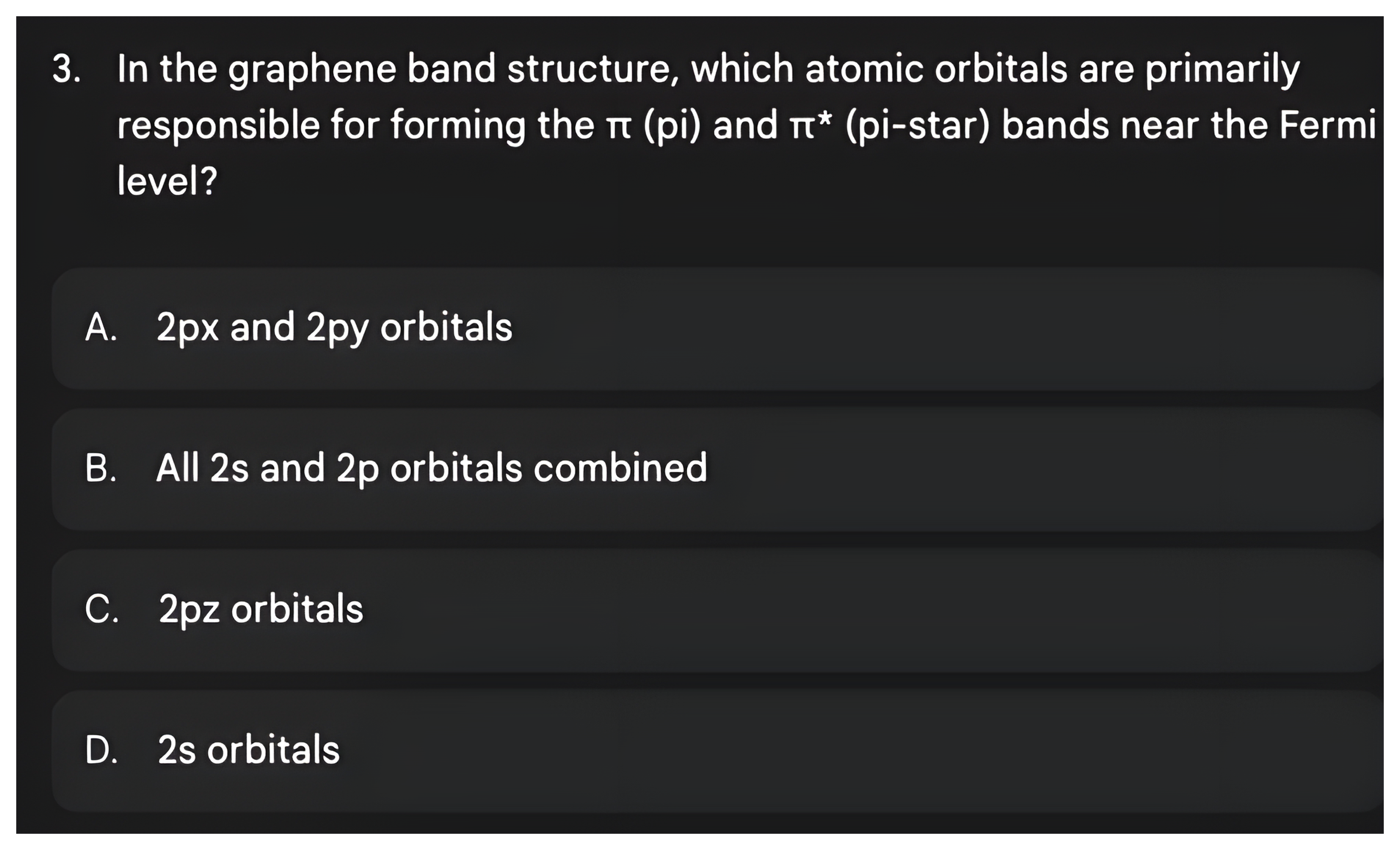
Question 3 asking which atomic orbitals primarily form the pi and pi-star bands of graphene near the Fermi level, then its answer: the 2pz orbitals.

Check Your Understanding: Graphene's Unit Cell
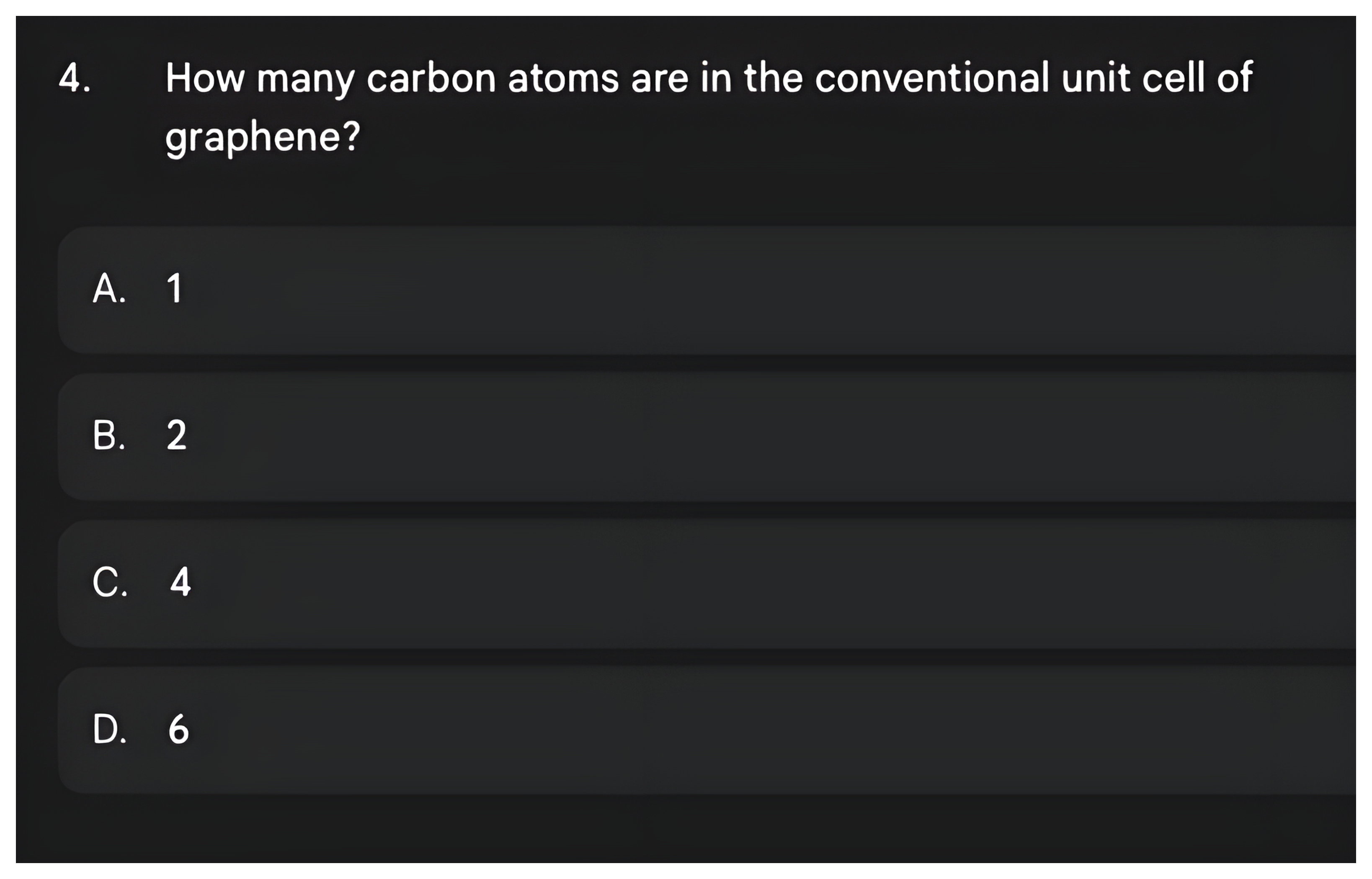
Question 4 asking how many carbon atoms are in the conventional unit cell of graphene, then its answer: two.

Check Your Understanding: Where the Bands Touch
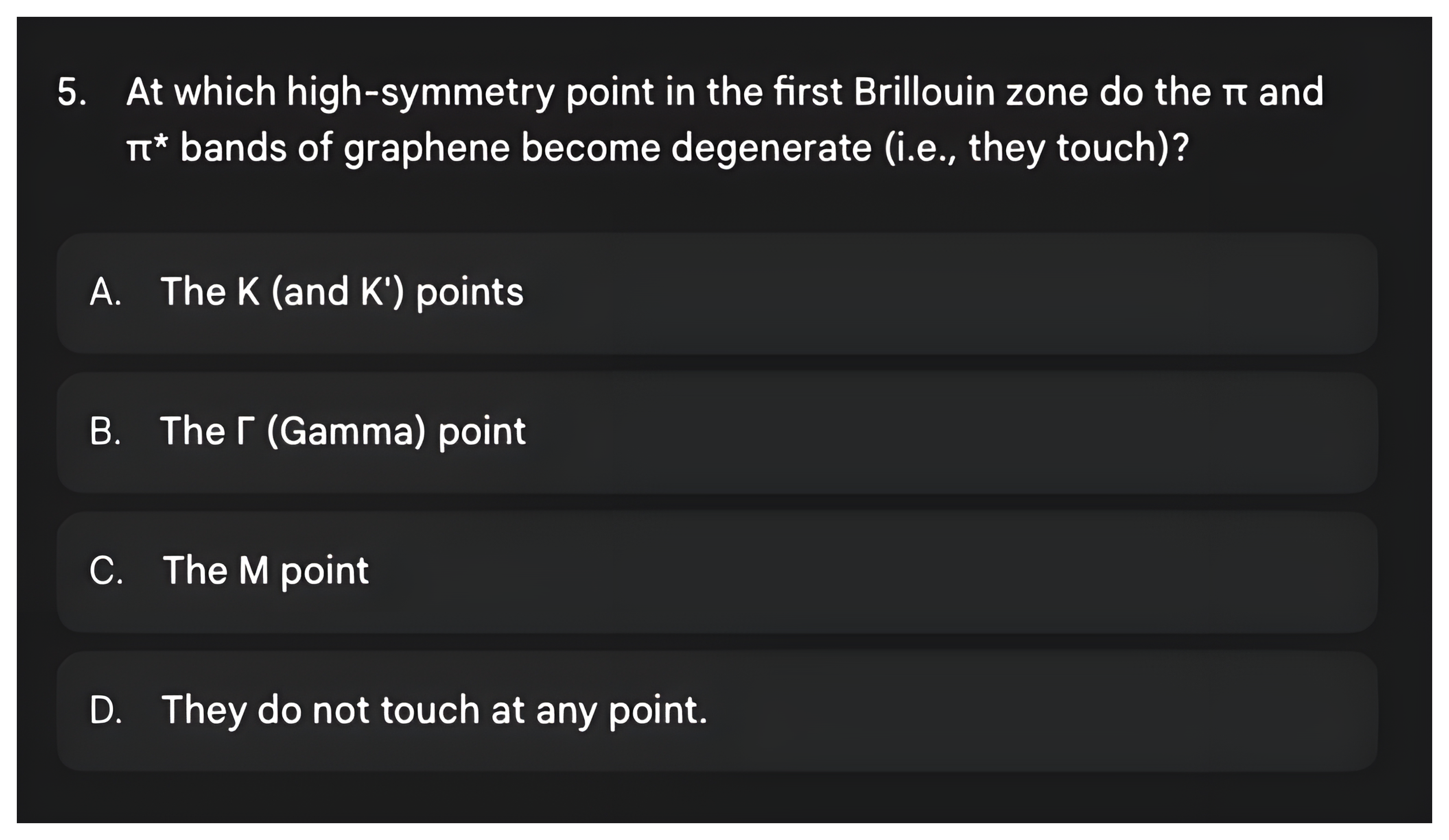
Question 5 asking at which high-symmetry point the pi and pi-star bands of graphene become degenerate, then its answer: the K and K-prime points.

Check Your Understanding: The π Band at Γ
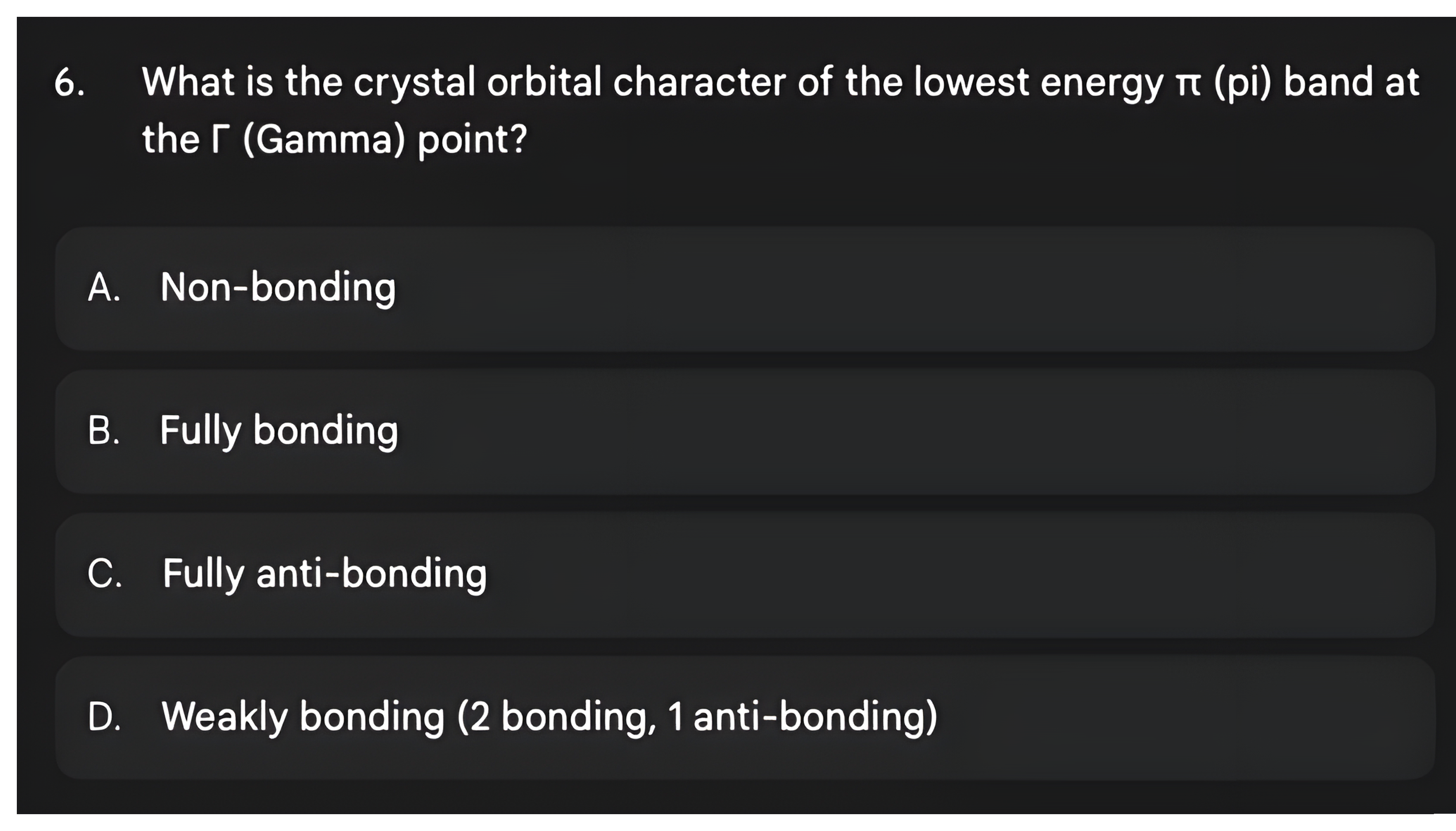
Question 6 asking for the crystal orbital character of the lowest energy pi band at the Gamma point, then its answer: fully bonding.

Learning Objectives: 3D Band Structures

By the end of this lecture, you will be able to:

  • Construct 3D reciprocal lattice vectors using cross products and identify special k-points (Gamma, X, M, R) in primitive cubic Brillouin zones
  • Predict band dispersion for s and p orbitals by analyzing nearest-neighbor bonding patterns at high-symmetry points
  • Explain how p-orbital directionality causes band splitting and determines which bands remain degenerate at specific k-points
  • Apply sigma and pi overlap analysis to rationalize subtle energy variations between k-points
  • Predict Peierls distortions in half-filled p-band systems and calculate Fermi level positions from valence electron count

Reciprocal Space Vectors in 3D
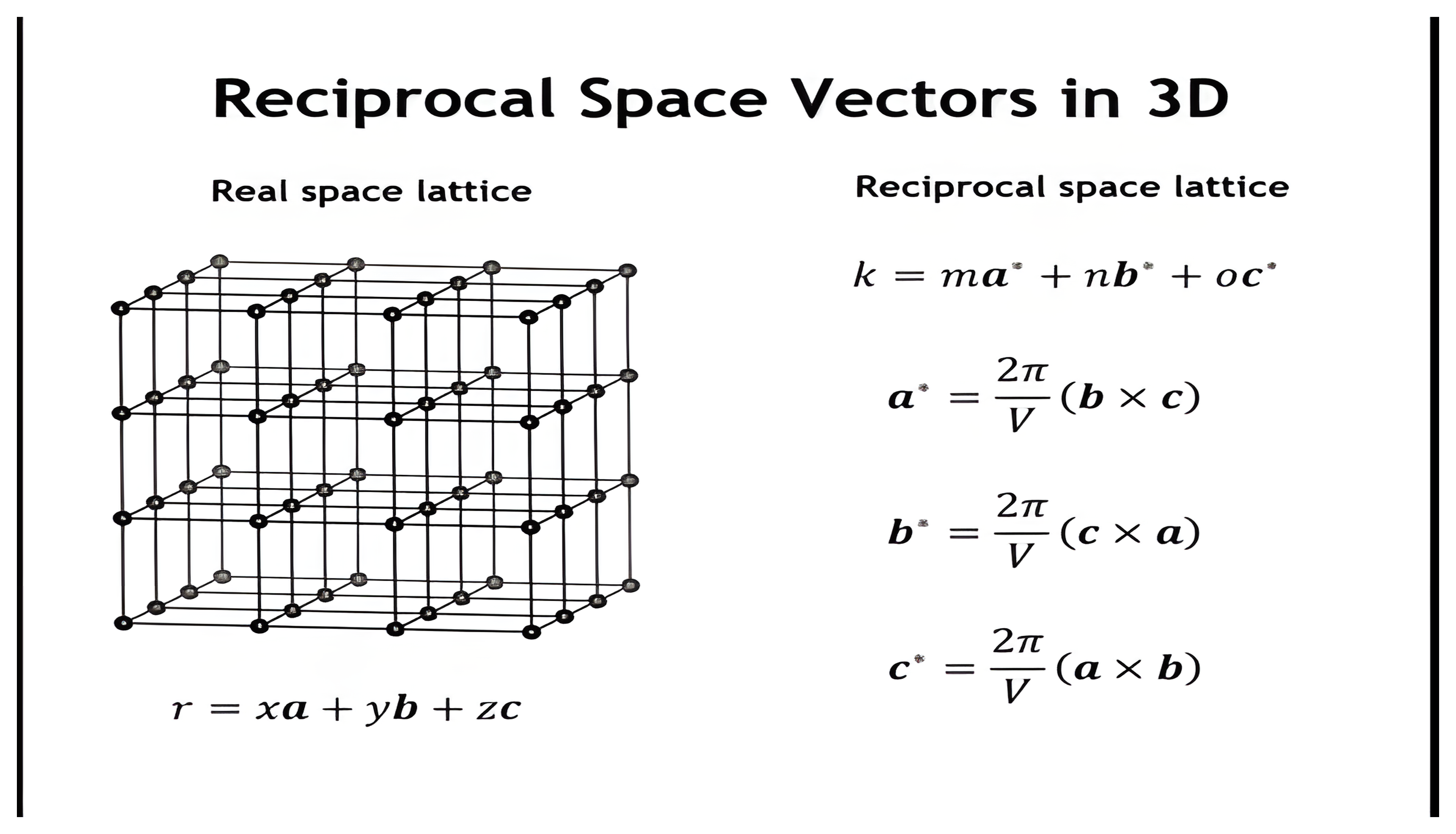
A 3D primitive cubic real-space lattice beside the reciprocal-space definitions: a-star equals two pi over V times b cross c, and cyclic formulas for b-star and c-star.

First Brillouin Zone: Primitive Cubic
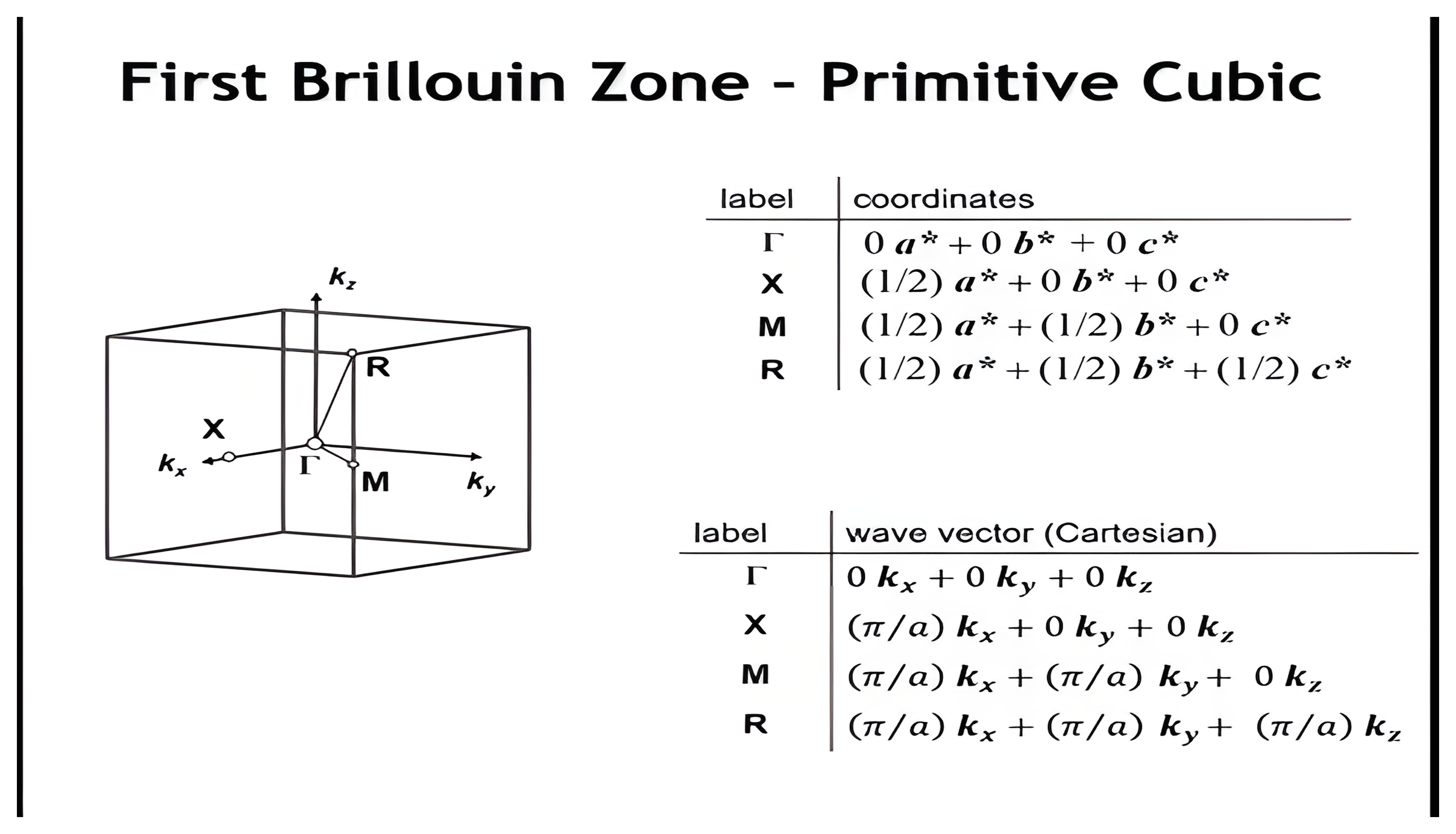
The cubic first Brillouin zone of a primitive cubic lattice with special points Gamma, X, M, and R labeled, and tables of their coordinates and Cartesian wave vectors.

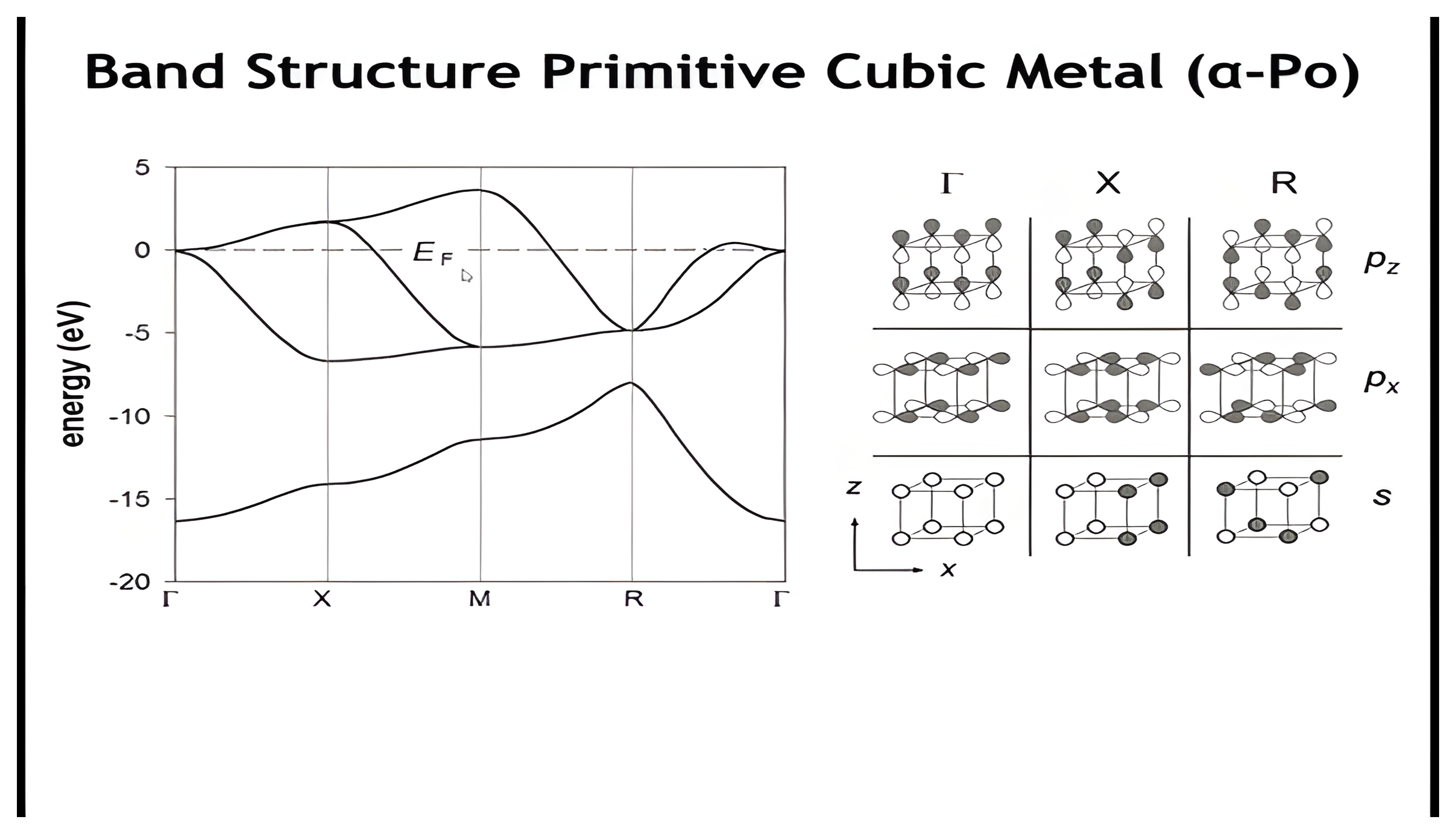
Band Structure of a Primitive Cubic Metal (α-Po): the 6s Band
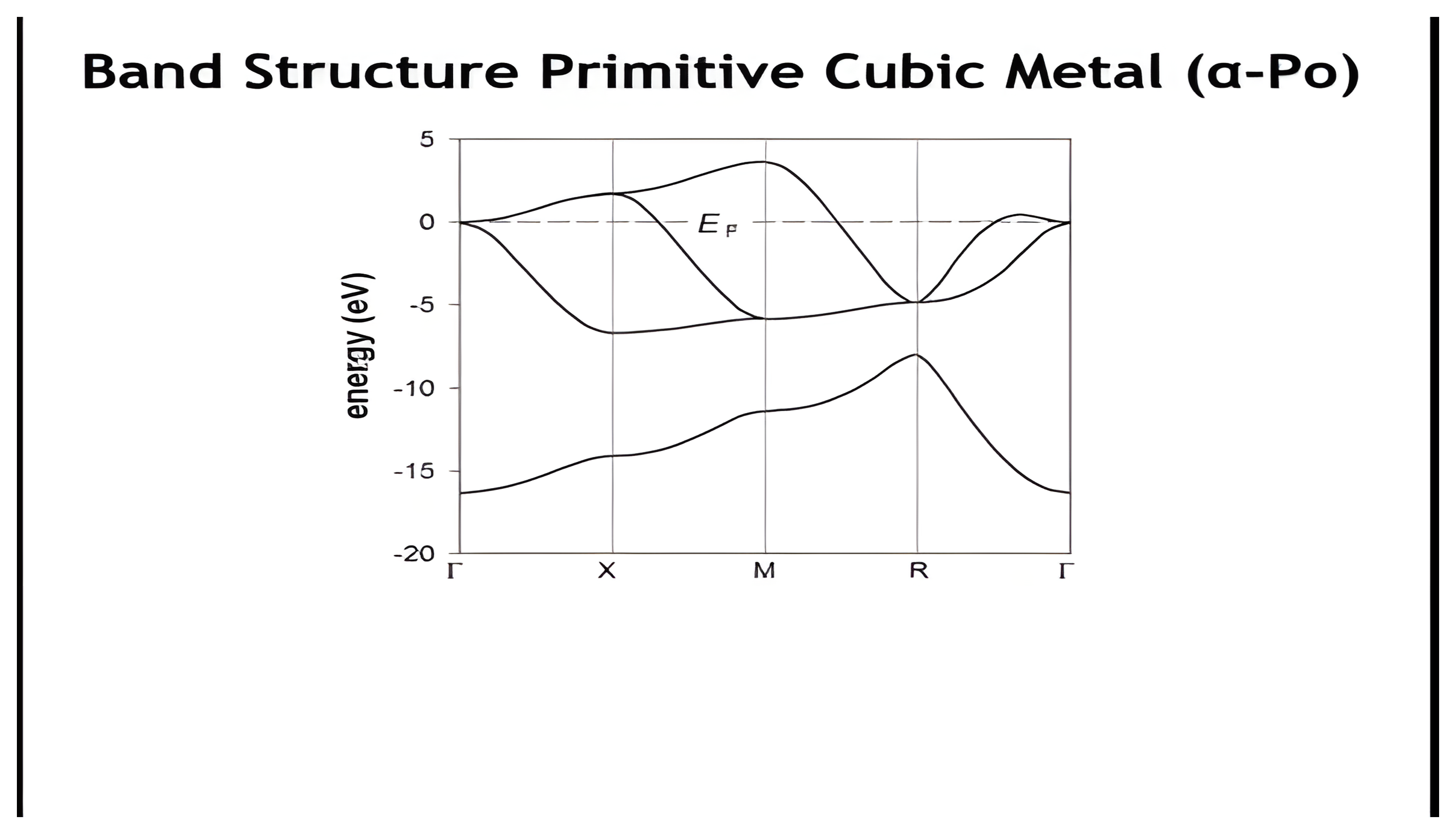
Calculated band structure of alpha-polonium along Gamma, X, M, R, Gamma with four bands; clicks add 6s crystal-orbital pictures at Gamma, X, M, and R below the plot.

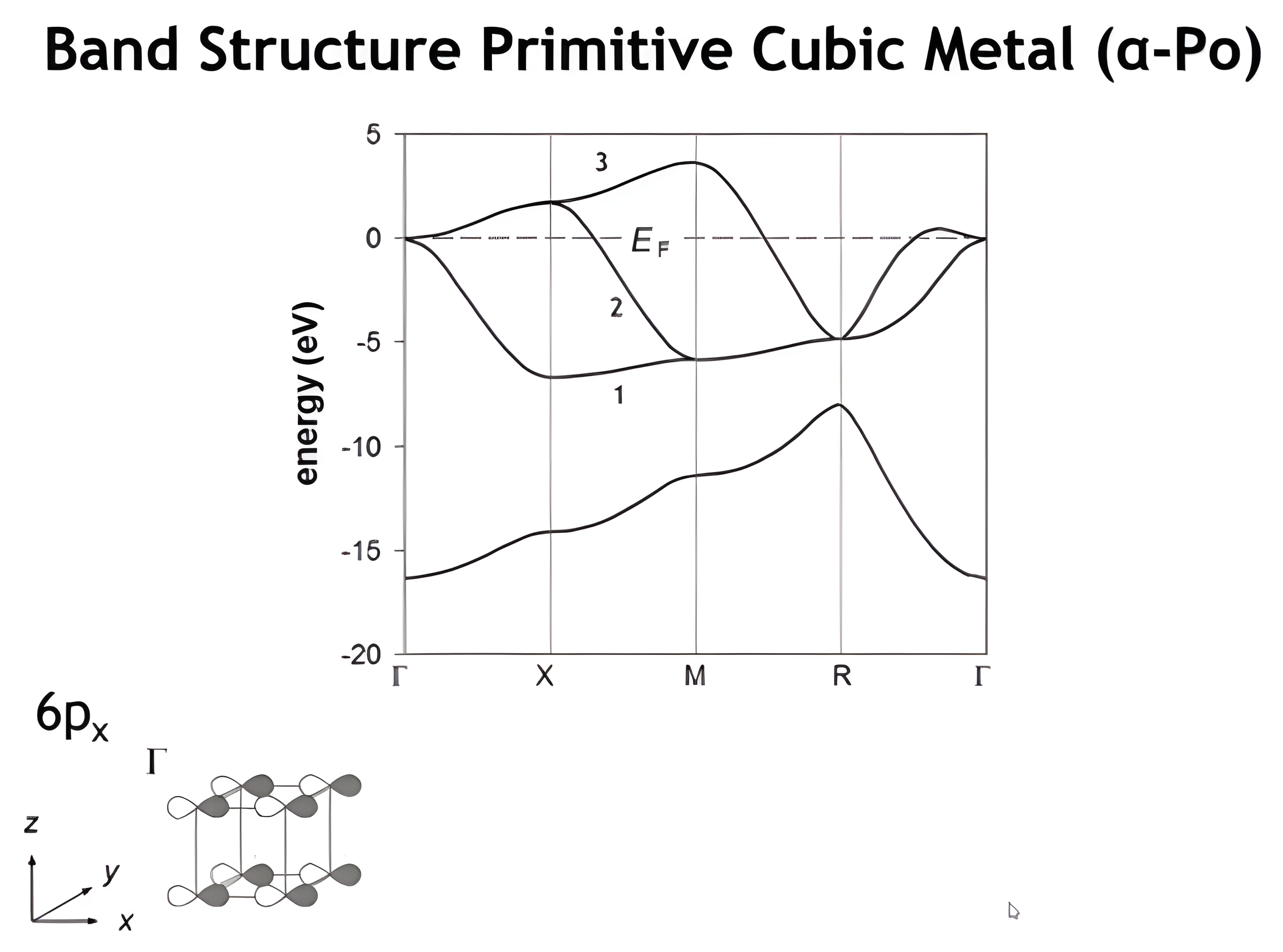
The $6p_x$ Band

Alpha-polonium band structure with the 6px crystal orbital drawn at Gamma; clicks add the 6px pictures at X, M, and R showing sigma bonding turn on at X.

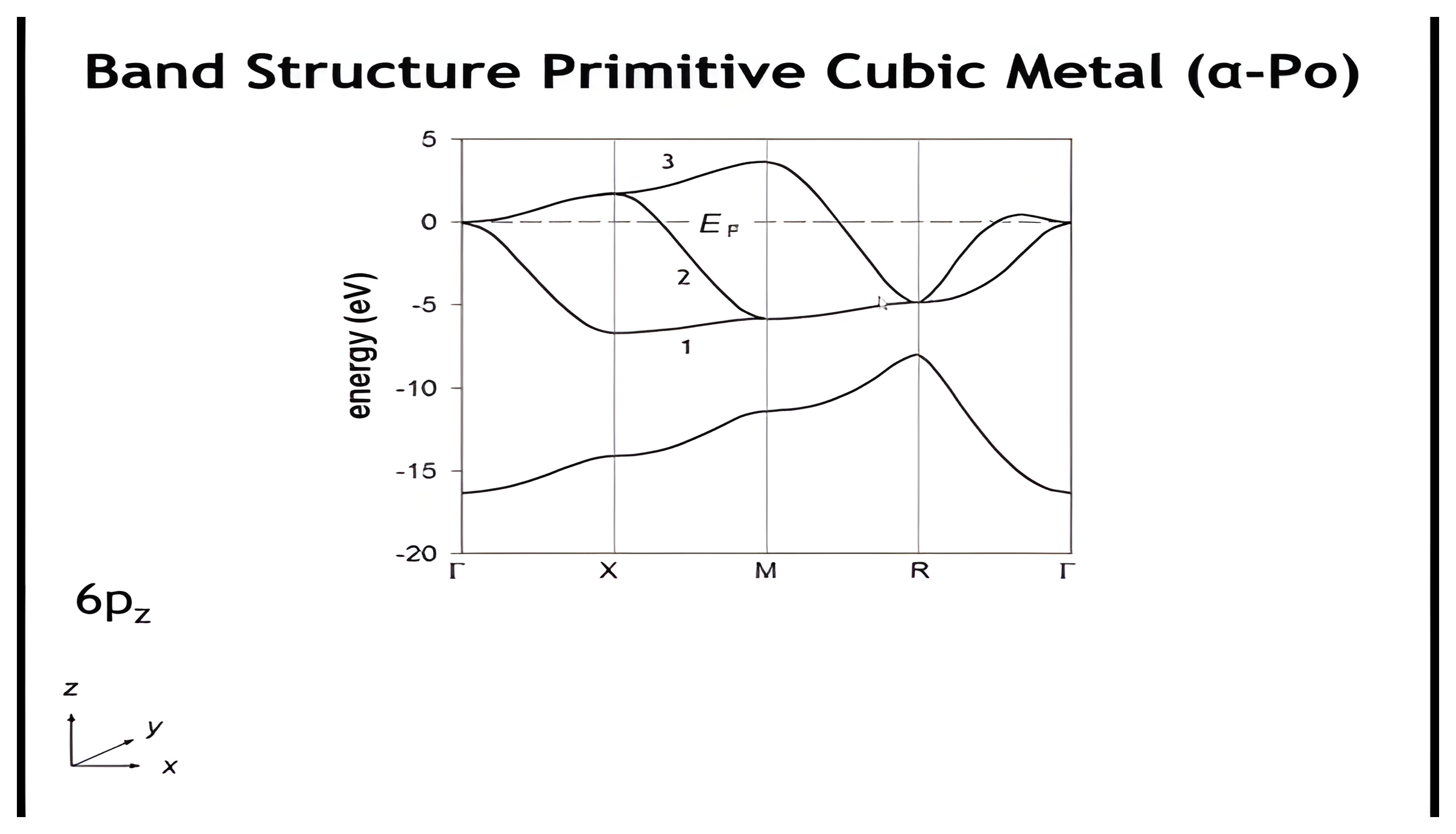
The $6p_z$ Band

Alpha-polonium band structure labeled 6pz; clicks add the 6pz crystal-orbital pictures at Gamma, X, M, and R showing sigma antibonding persist until R.

Assembling Polonium's Band Structure

Alpha-polonium band structure beside a grid of crystal-orbital pictures for the pz, px, and s bands at Gamma, X, and R.

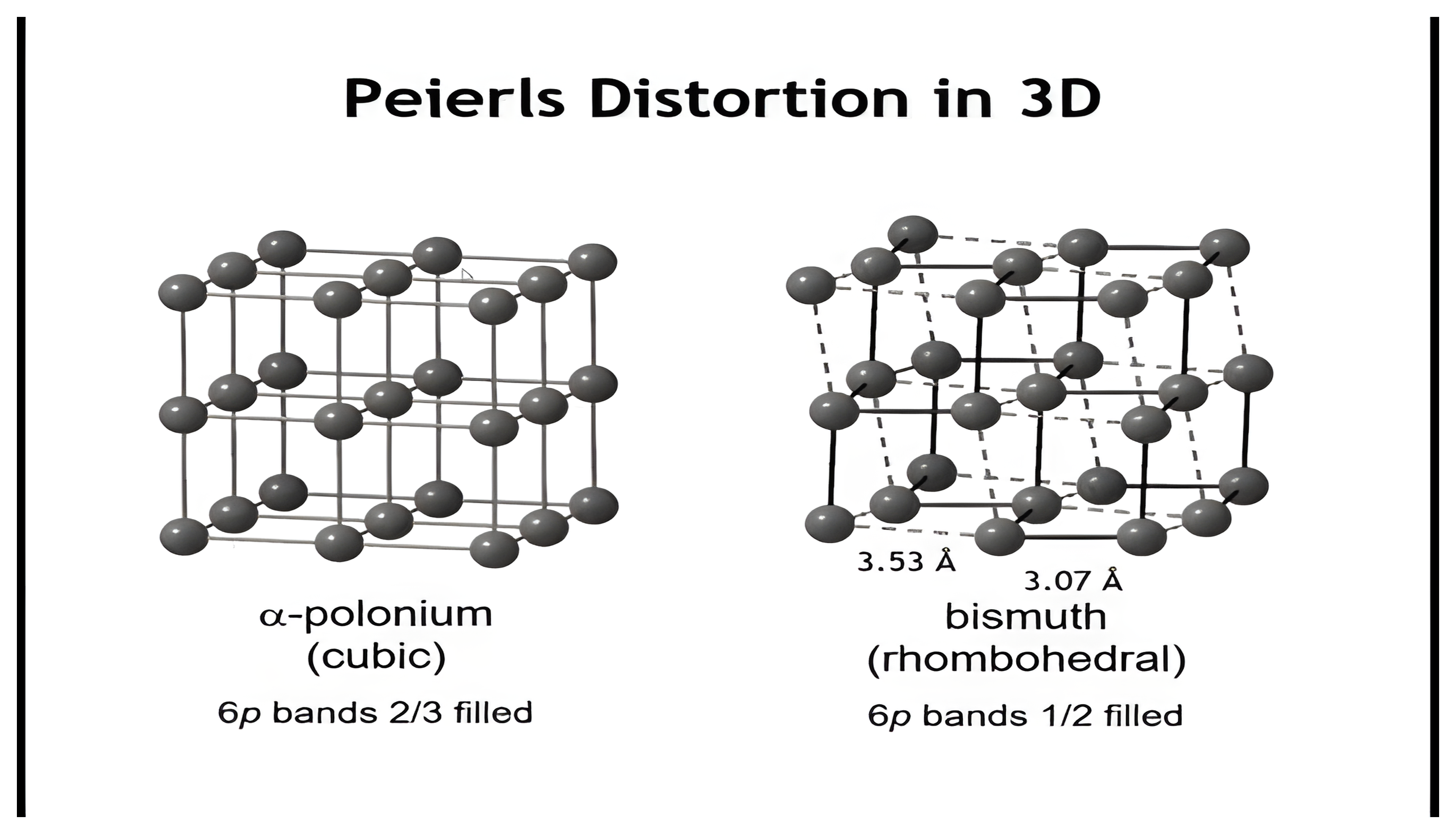
Peierls Distortion in 3D

Cubic alpha-polonium with 6p bands two-thirds filled beside rhombohedral bismuth with 6p bands half filled, three short bonds at 3.07 angstroms and three long bonds at 3.53 angstroms.

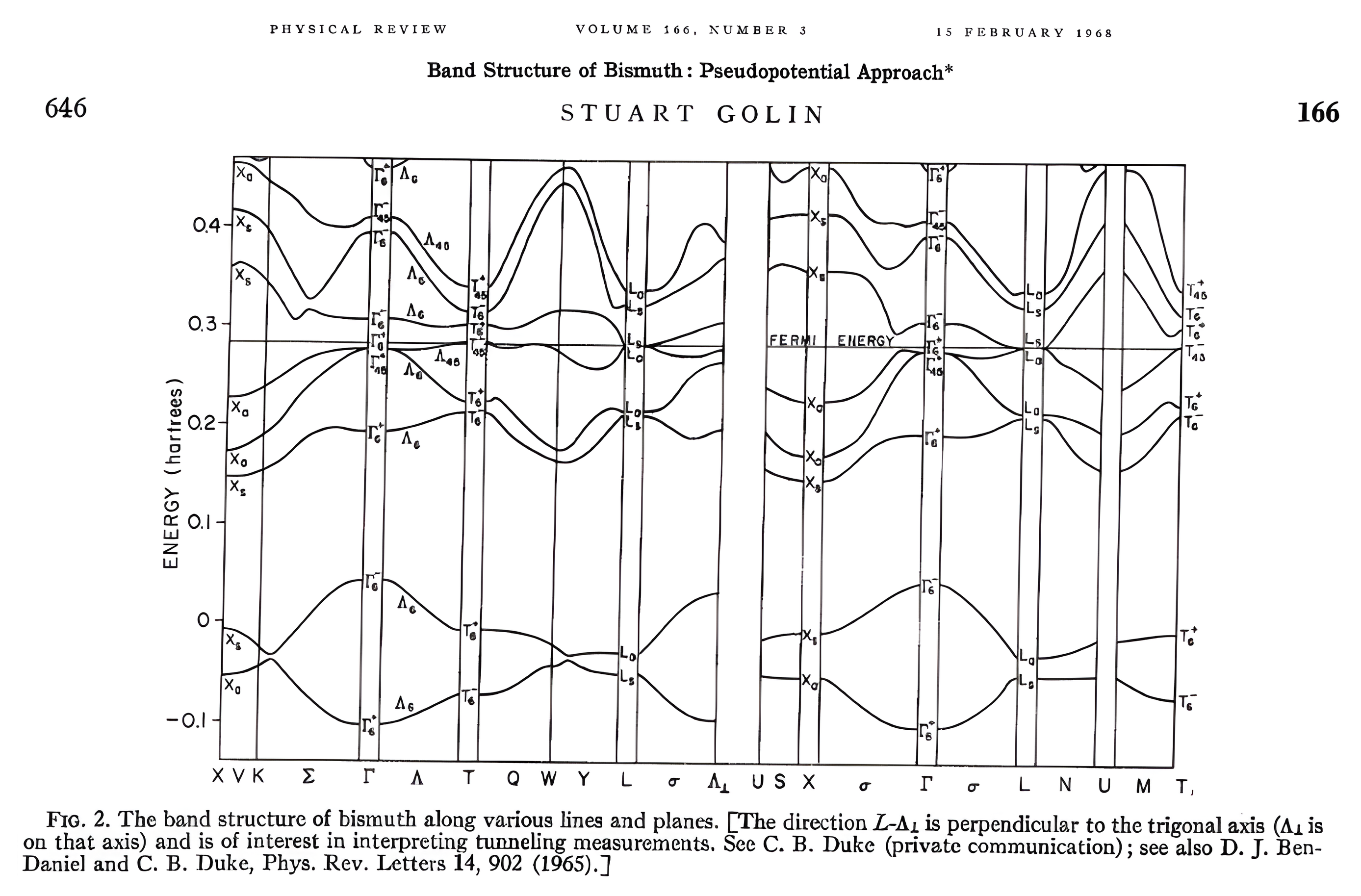
The Band Structure of Bismuth

Published band structure of bismuth from a pseudopotential calculation, showing split bands and a gap opening at the Fermi energy along several symmetry lines.

Check Your Understanding: The 6s Band
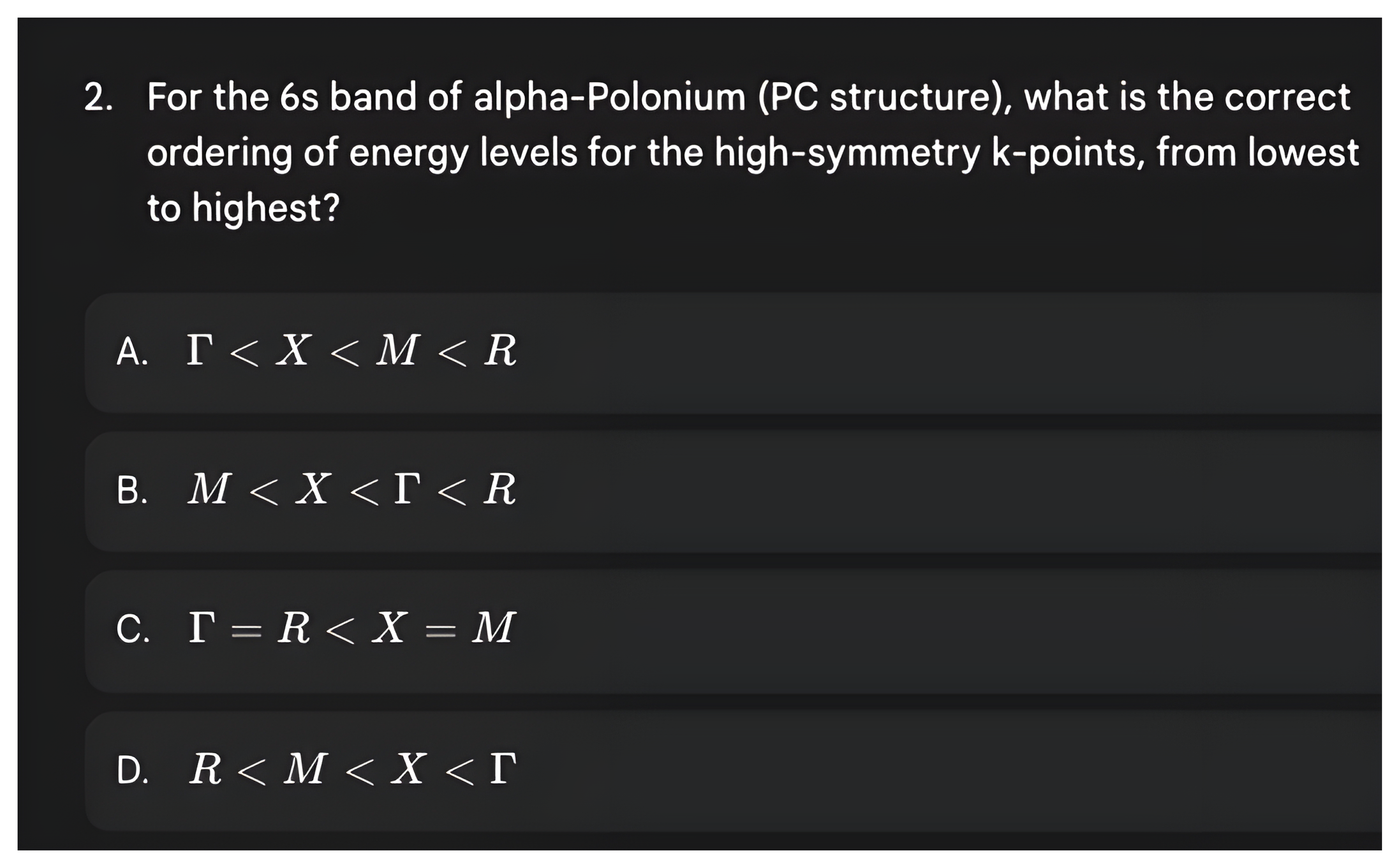
Question 2 asking for the energy ordering of the alpha-polonium 6s band at the high-symmetry k-points, then its answer: Gamma below X below M below R.

Check Your Understanding: Identifying the $6p_x$ Band
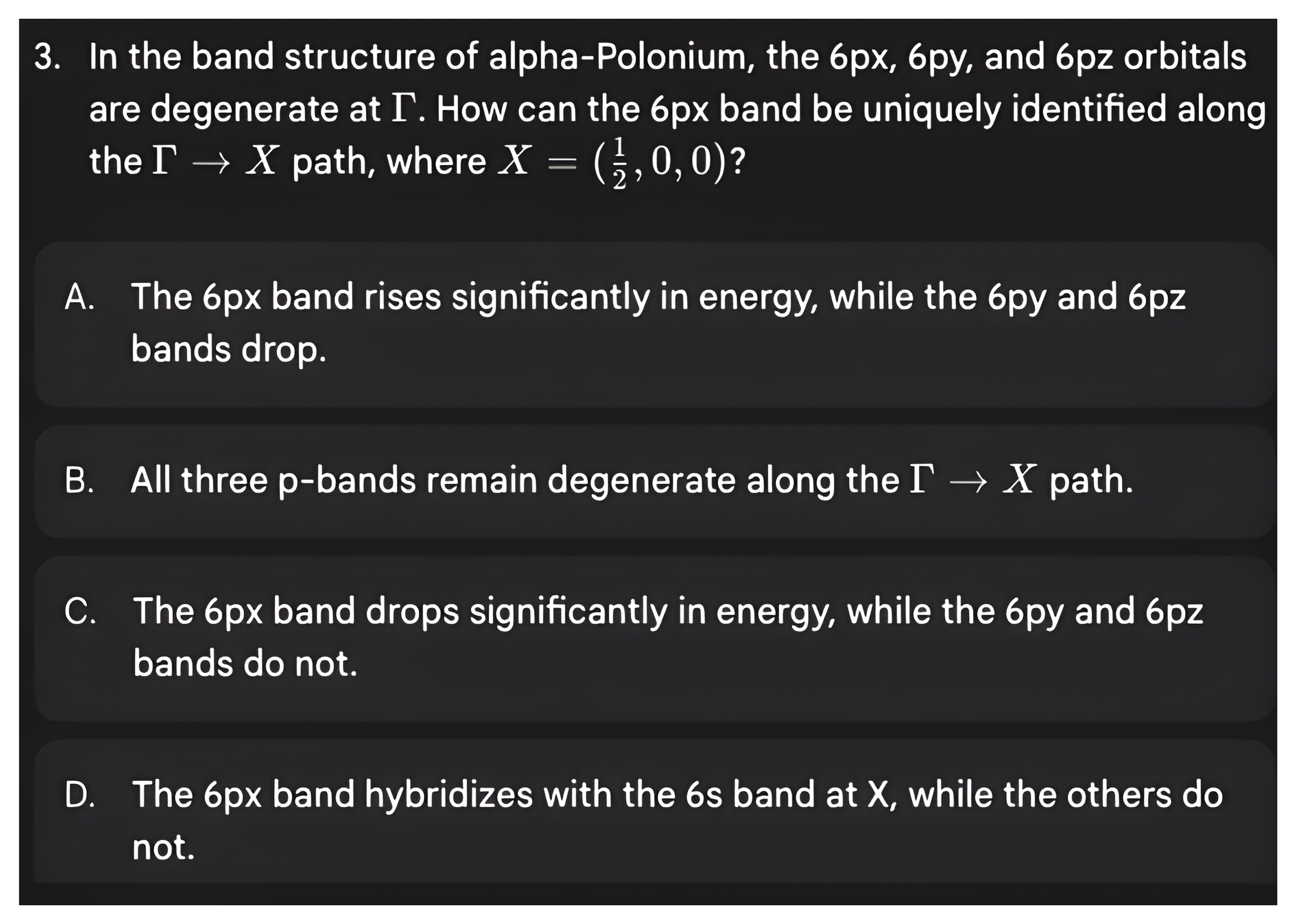
Question 3 asking how the 6px band can be uniquely identified along the Gamma to X path, then its answer: the 6px band drops significantly in energy while 6py and 6pz do not.

Learning Objectives: FCC Band Structures

Band Structures of Face-Centered Cubic Crystals

  • Understand the first Brillouin zone structure for face-centered cubic lattices
  • Analyze the electronic band structure of FCC metals using aluminum as a representative example
  • Examine band structures of diamond structure materials (carbon, silicon, germanium)
  • Distinguish between valence bands, conduction bands, and band gaps in semiconductors
  • Explain the progression from insulator to semiconductor to metal down Group 14 elements
  • Understand how orbital overlap influences bonding/anti-bonding states and metallic vs semiconducting behavior

Electronic Band Structures | Materials Science & Chemistry

First Brillouin Zone: Face-Centered Cubic
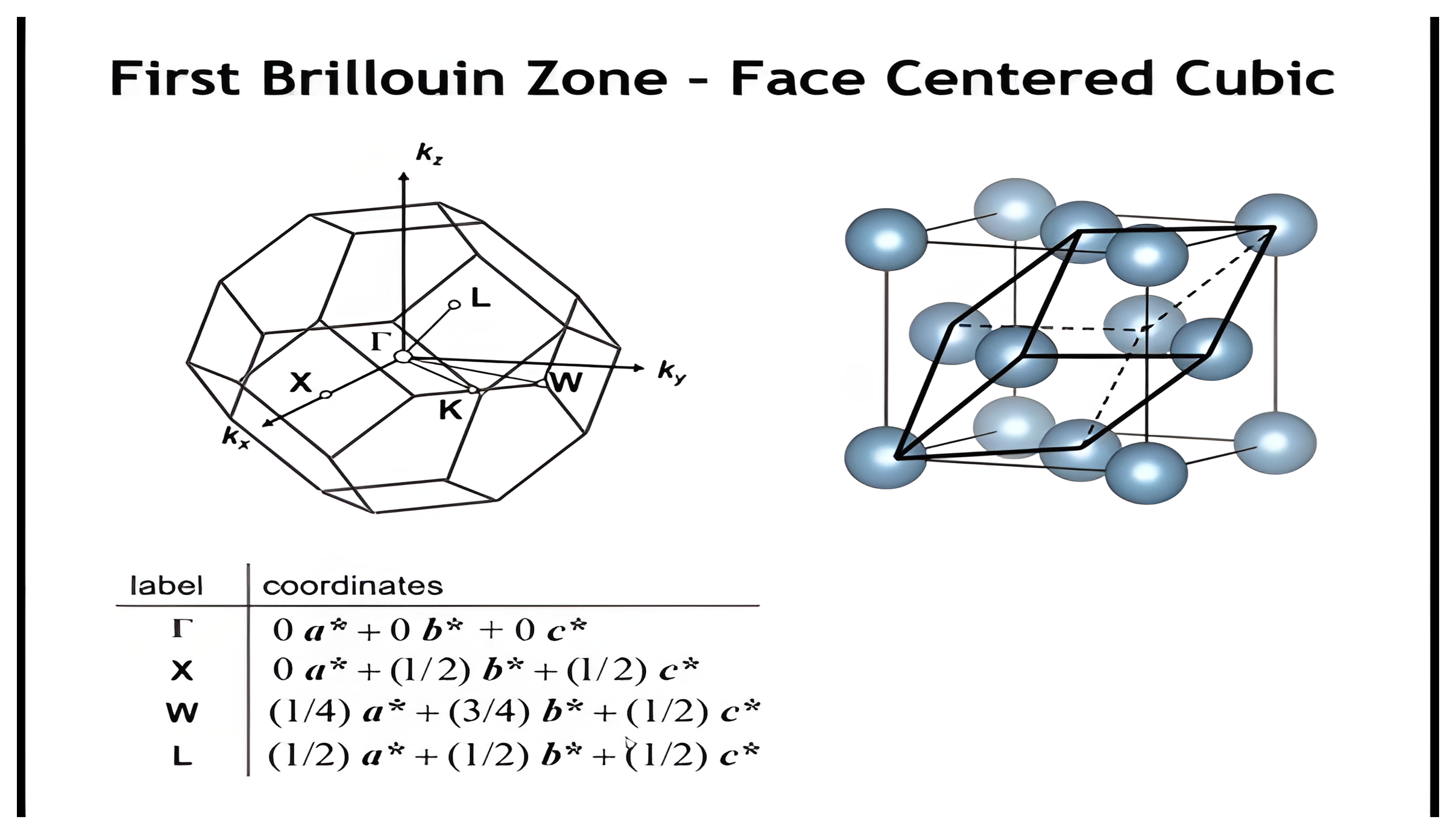
The truncated-octahedron first Brillouin zone of the FCC lattice with points Gamma, X, W, K, and L, beside the FCC cell with its rhombohedral primitive cell outlined.

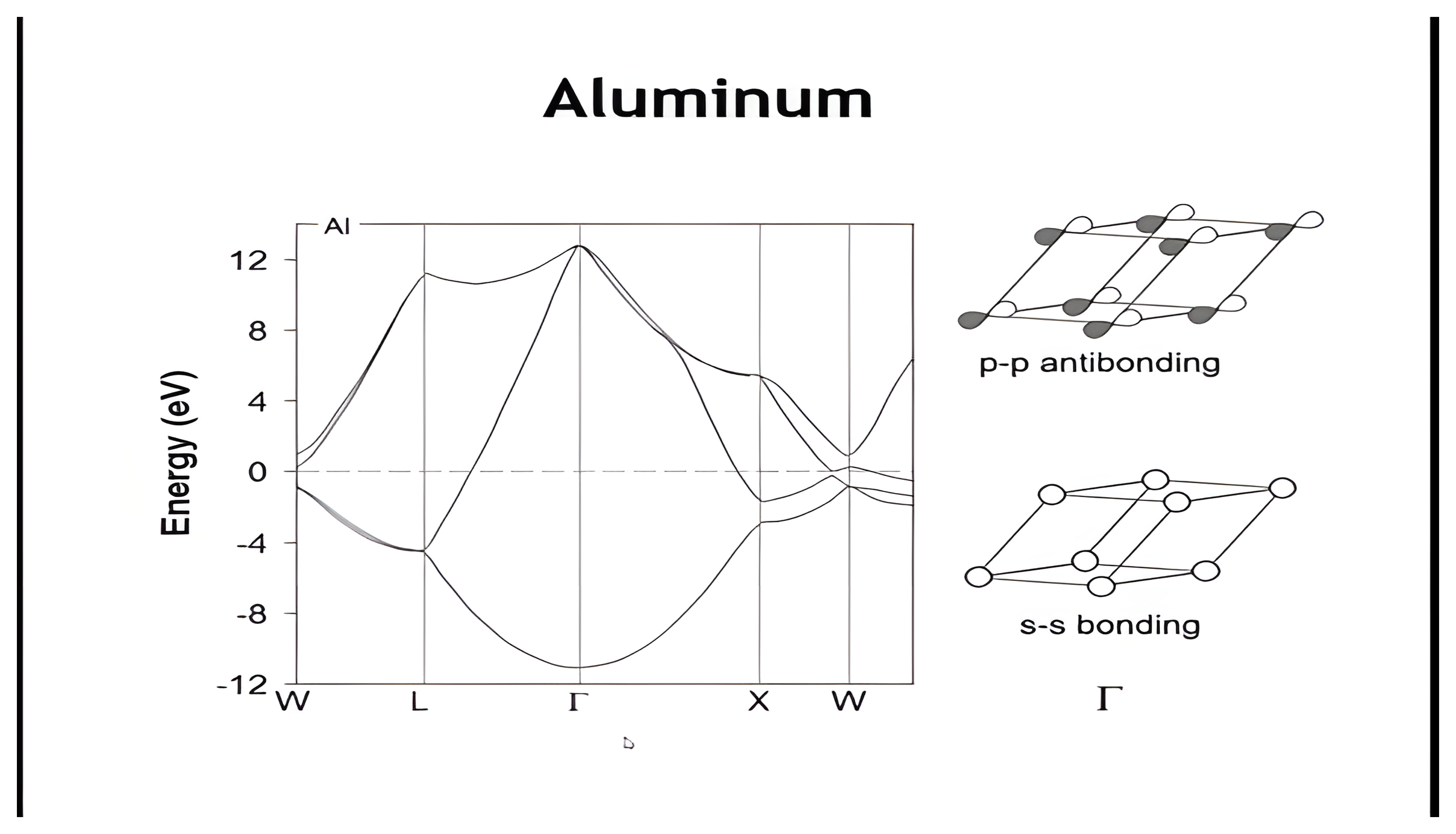
Aluminum

Aluminum band structure along W, L, Gamma, X, W with wide bands crossing the Fermi level, beside the s-s bonding and p-p antibonding crystal orbitals at Gamma.

Diamond

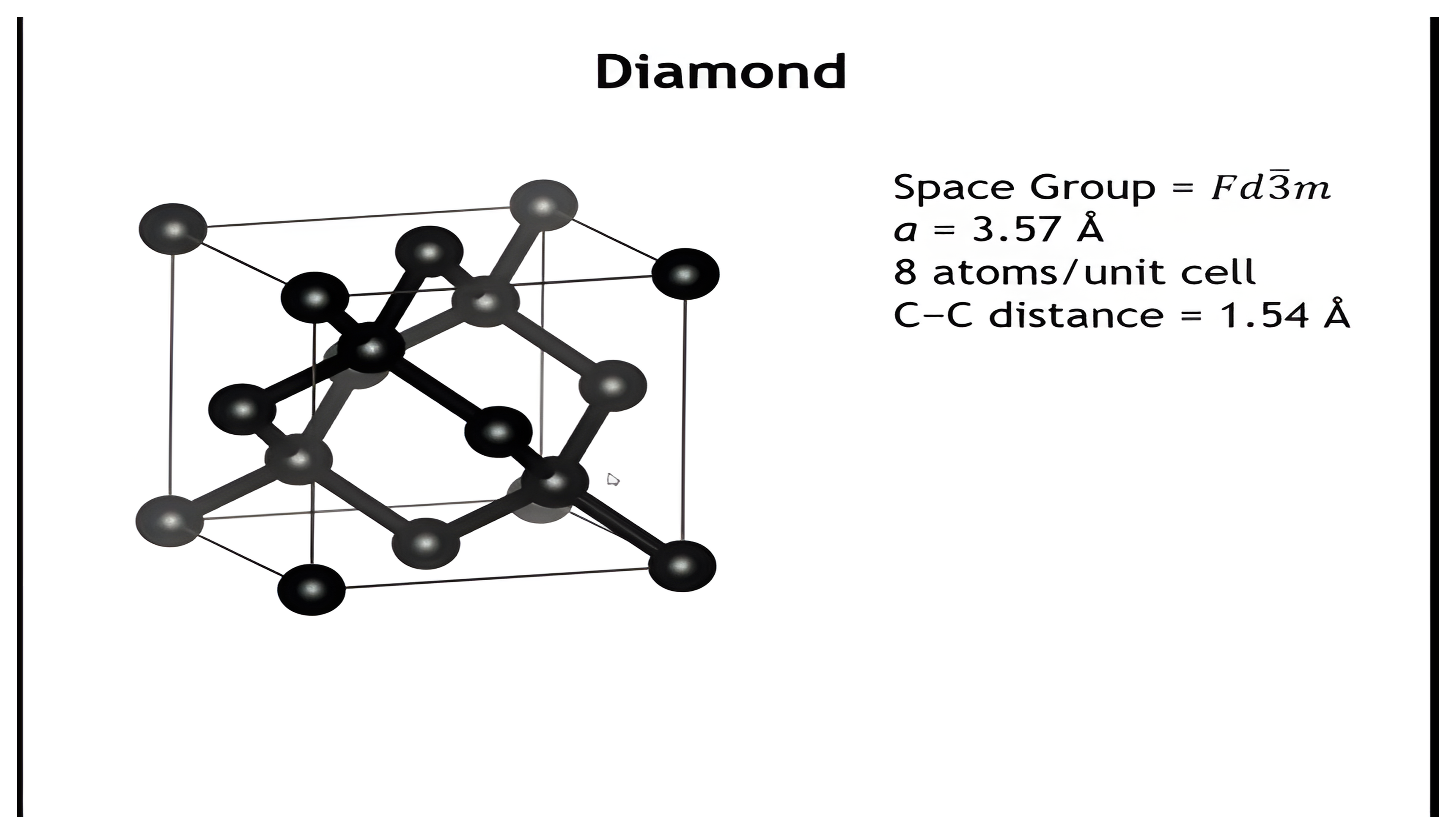
The diamond structure: space group F d -3 m, a equals 3.57 angstroms, eight atoms per unit cell, carbon-carbon distance 1.54 angstroms.

Diamond: Band Structure

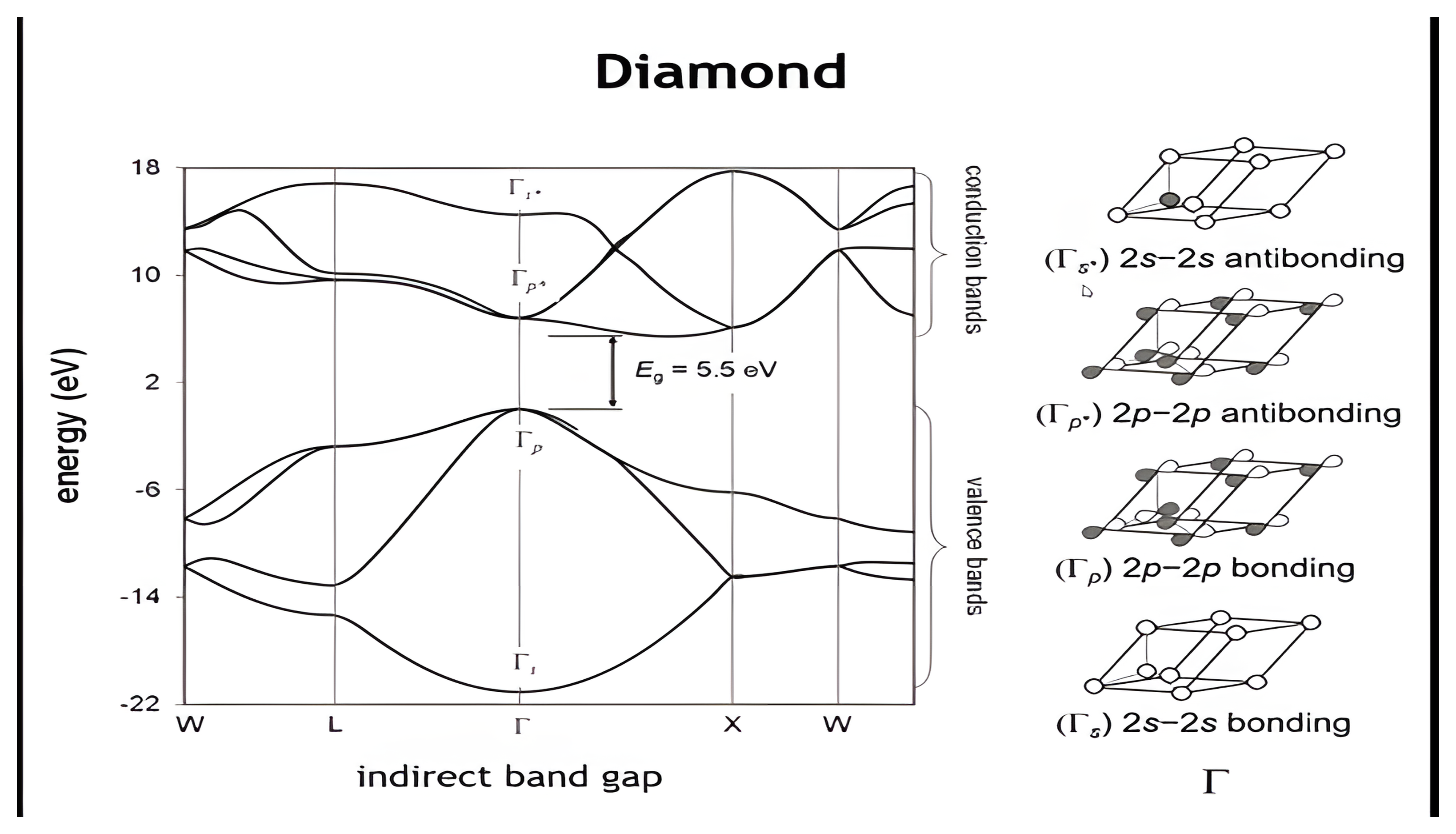
Diamond band structure with four filled valence bands and four empty conduction bands separated by a 5.5 eV indirect gap, beside the bonding and antibonding crystal orbitals at Gamma.

Diamond-like Group 14 Elements

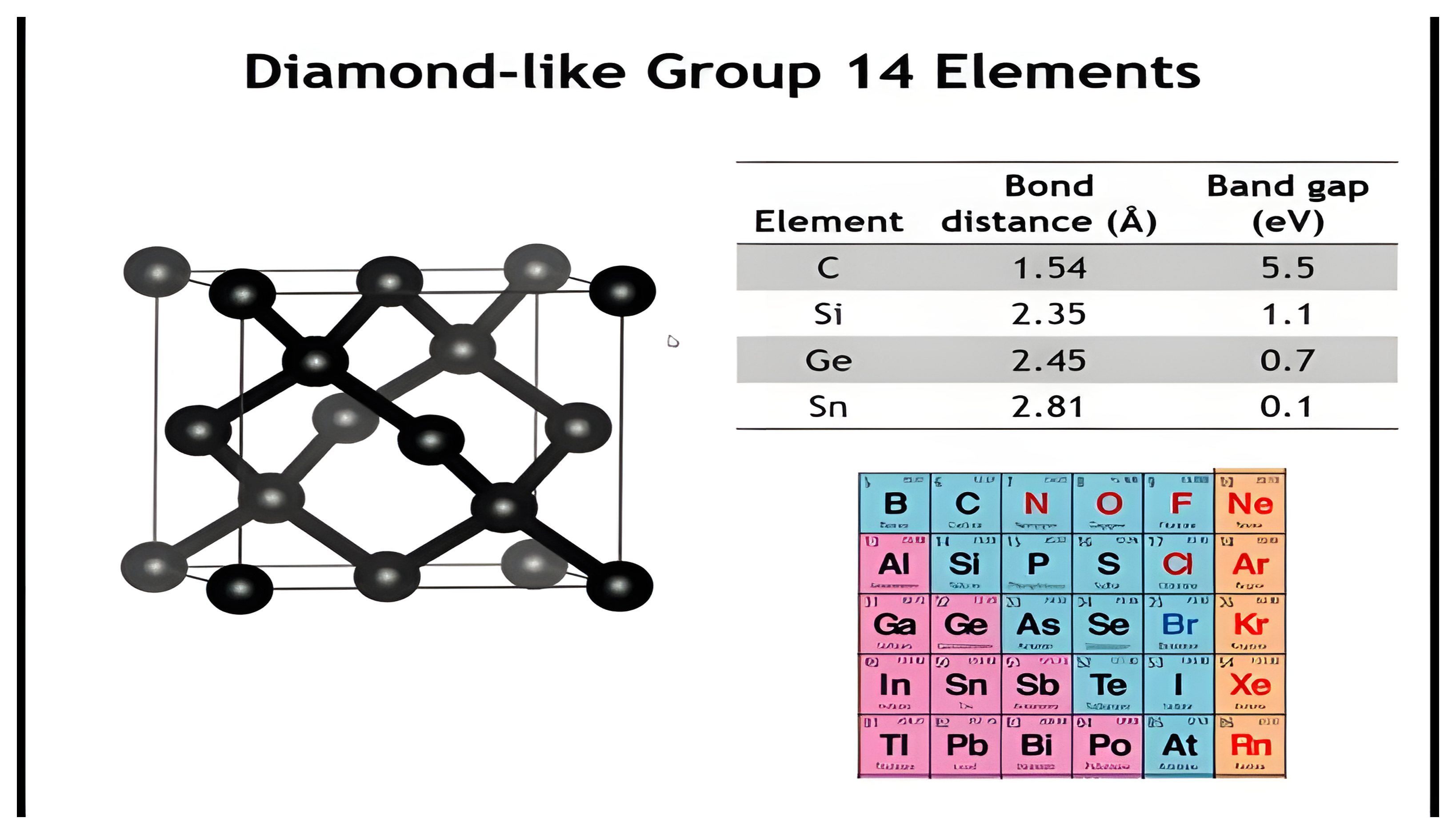
The diamond structure beside a table of Group 14 elements showing bond distance growing from 1.54 to 2.81 angstroms and band gap shrinking from 5.5 to 0.1 eV, with a p-block periodic table.

Silicon and Germanium

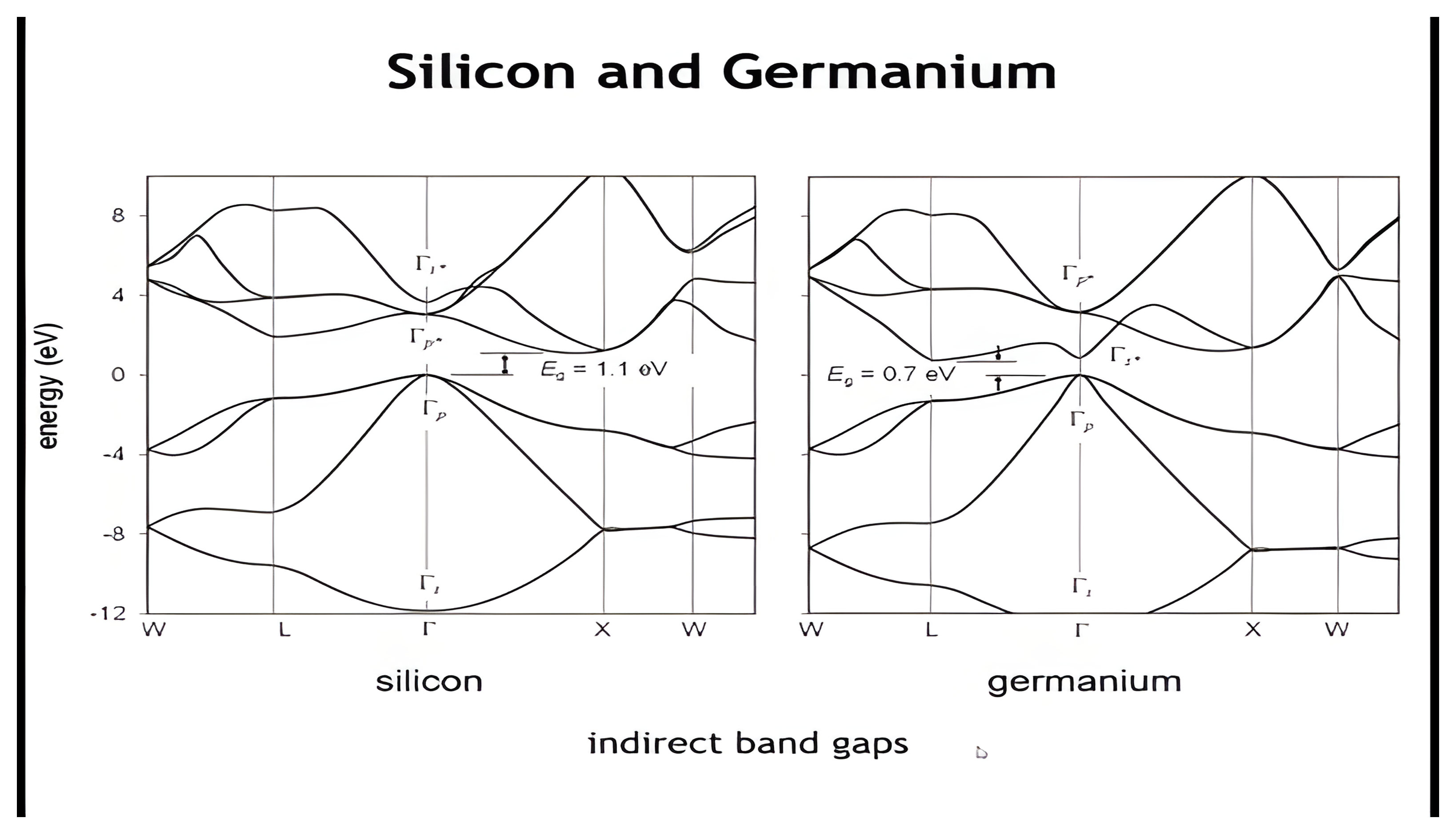
Band structures of silicon and germanium, both with indirect band gaps of 1.1 and 0.7 eV.

Check Your Understanding: Why Aluminum Is a Metal
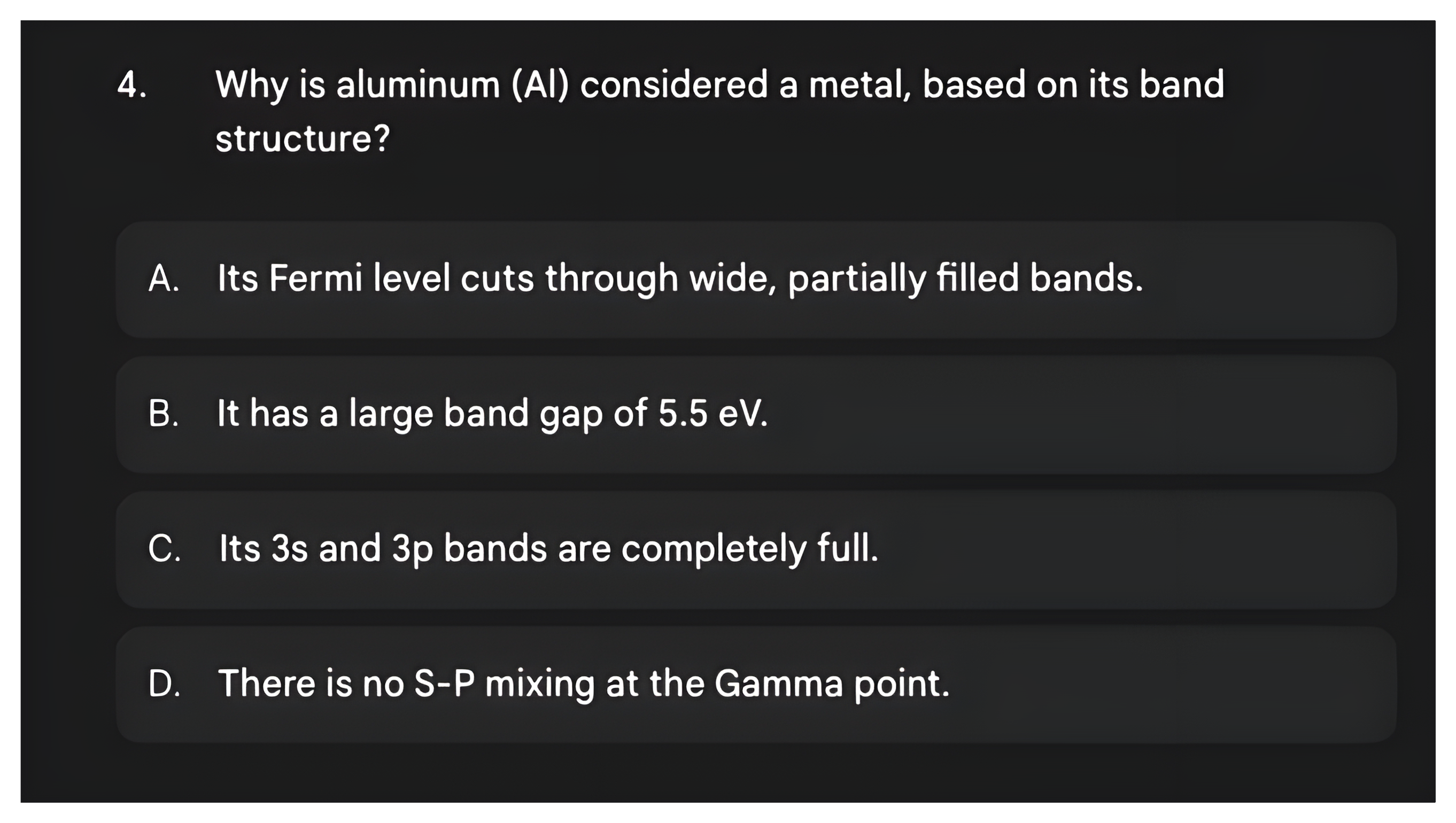
Question 4 asking why aluminum is considered a metal based on its band structure, then its answer: its Fermi level cuts through wide, partially filled bands.

Check Your Understanding: Down Group 14
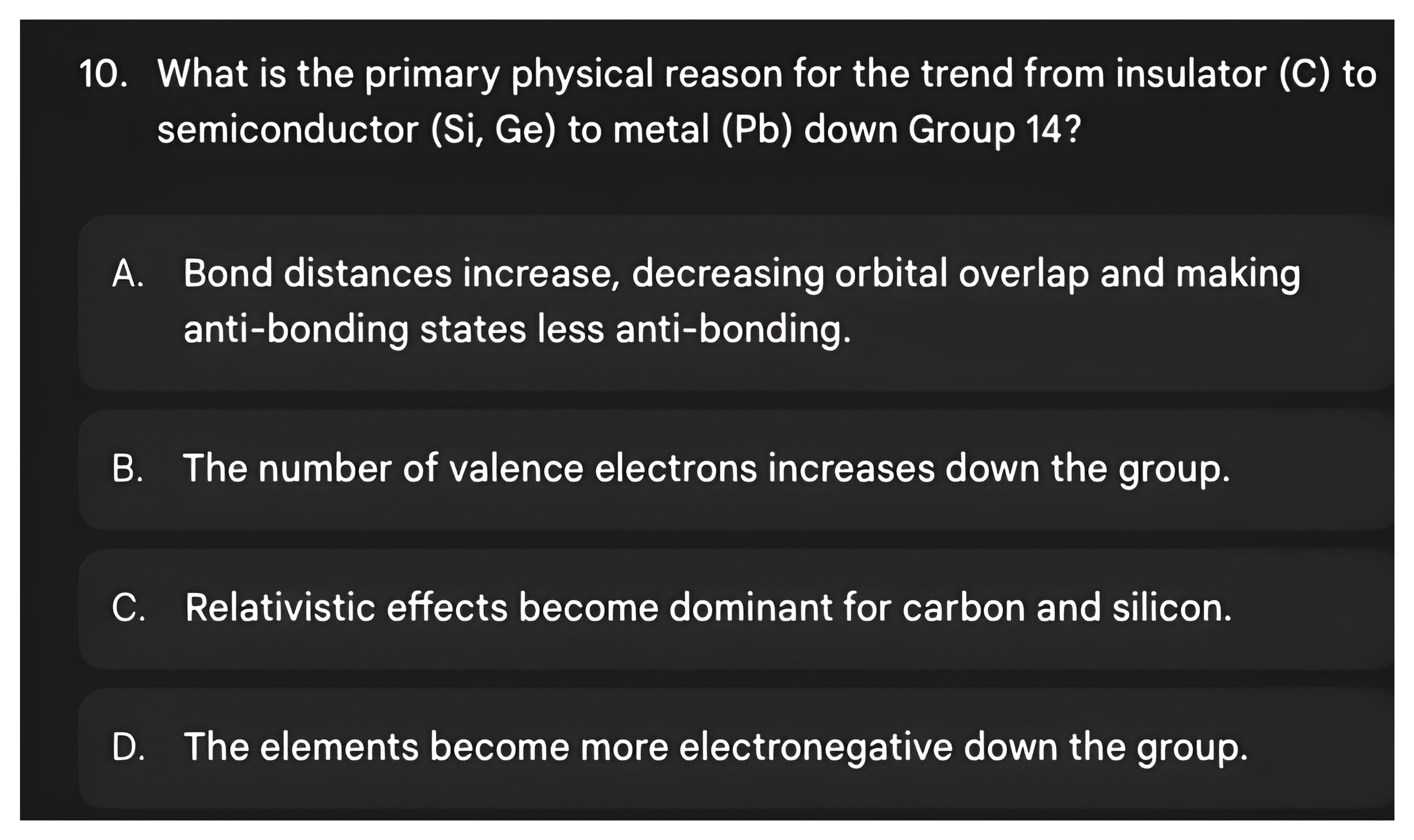
Question 10 asking for the primary physical reason for the insulator to semiconductor to metal trend down Group 14, then its answer: bond distances increase, decreasing orbital overlap and making anti-bonding states less anti-bonding.
CHEM 548