CHEM 548: Materials Chemistry

Lecture 15: 1D Band Structures and Bloch Functions

Mon 10/26/2026 · Meeting 17

Reading: Woodward, Karen, Evans, and Vogt, Solid State Materials Chemistry
Ch. 6, §§6.1–6.3

Learning Objectives: Intro to Band Theory

Learning Objectives — Intro to Band Theory (1D Hydrogen Chain)

  • Understand why crystals require band structures instead of molecular orbitals.
  • Define a crystal orbital as a Bloch function (periodic basis × lattice phase term).
  • Interpret k as both a wavevector and crystal momentum.
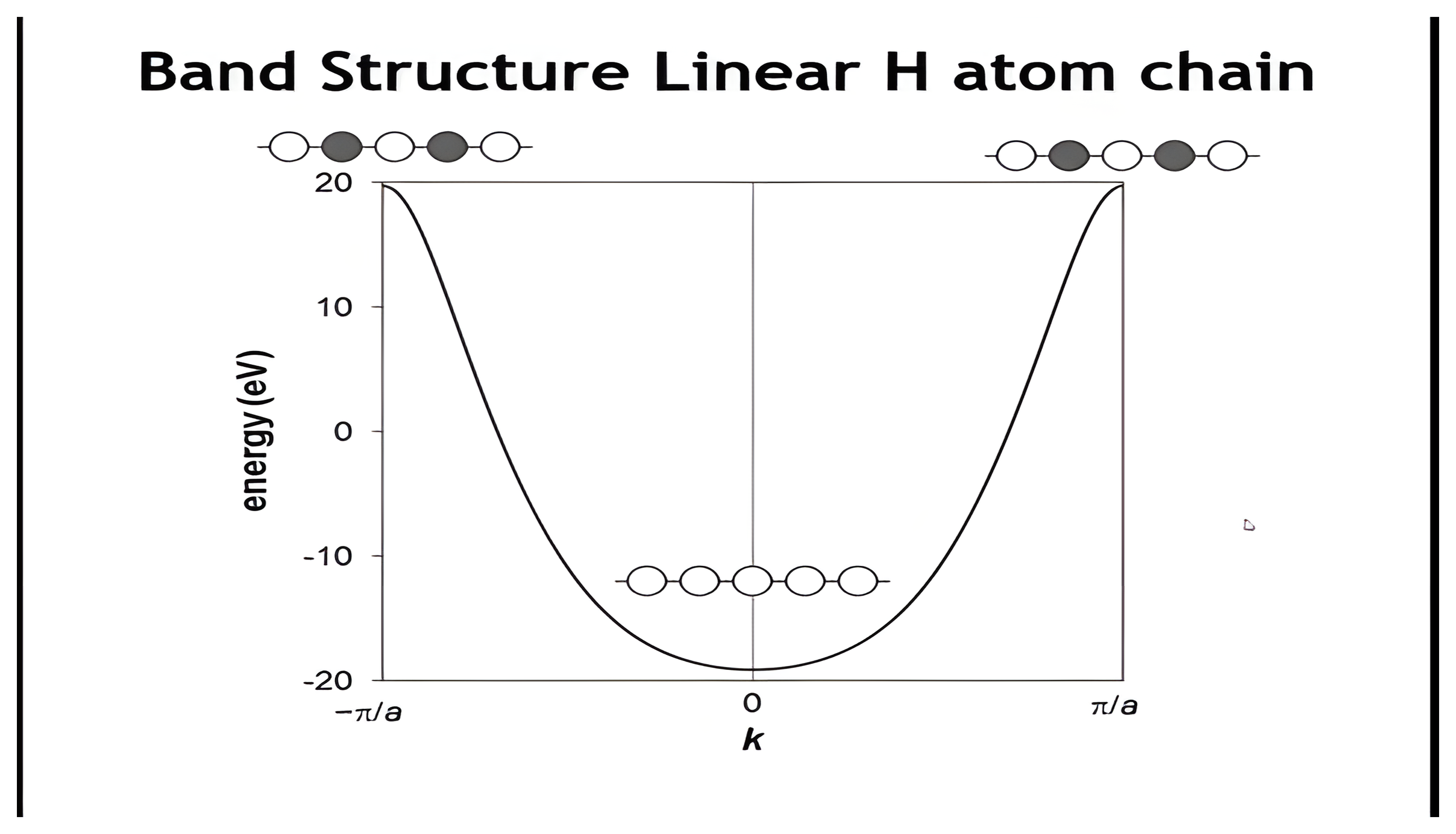
  • Identify bonding (k=0) and antibonding (k=π/a) limits in the 1st Brillouin zone.
  • Relate band width to orbital overlap (wide = delocalized, narrow = localized).
  • Recognize density of states (DOS) as a summary of orbital distribution vs. energy.

Electronic Band Structure
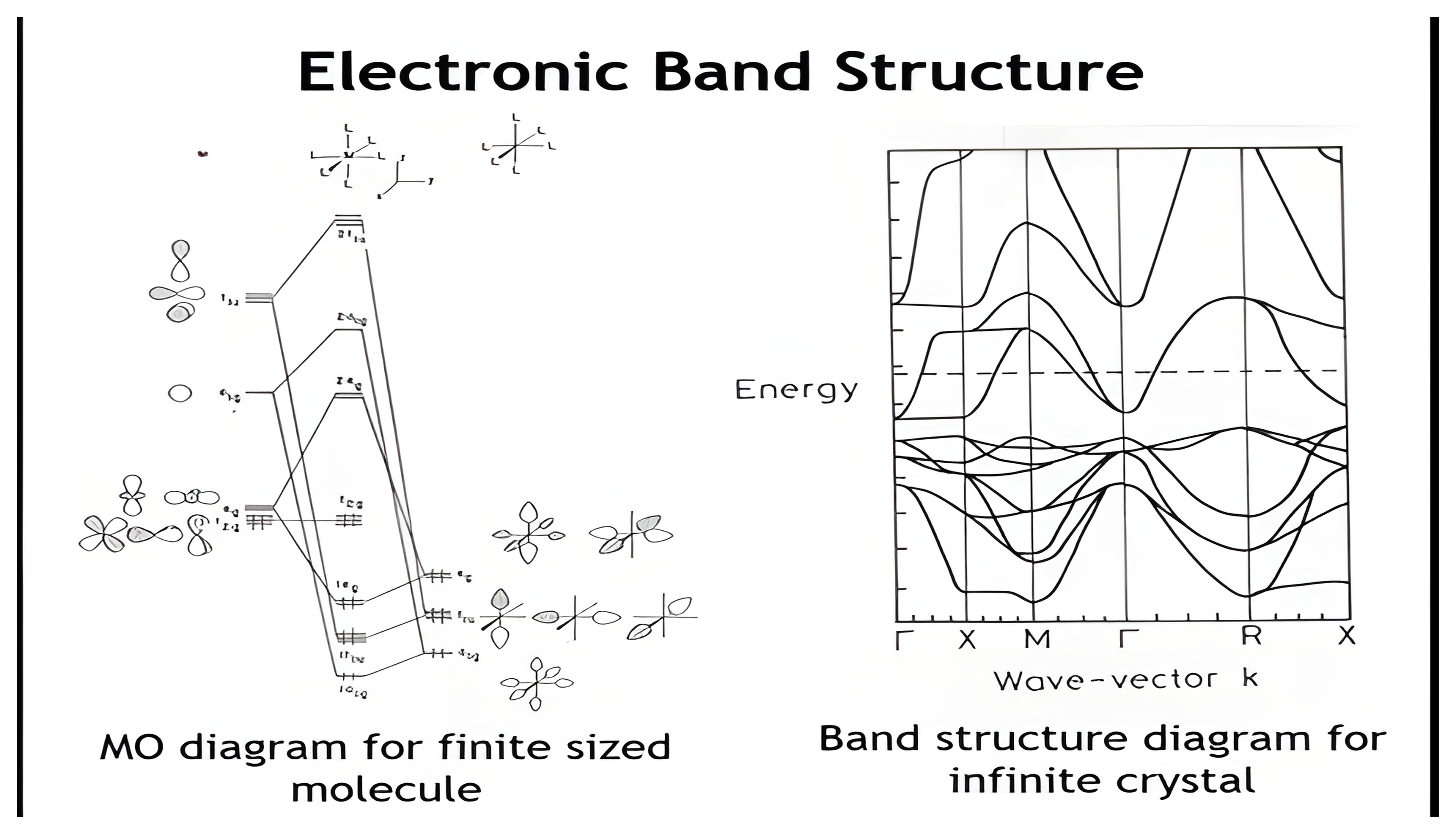
Molecular orbital diagram for a finite molecule beside the band structure diagram for an infinite crystal.

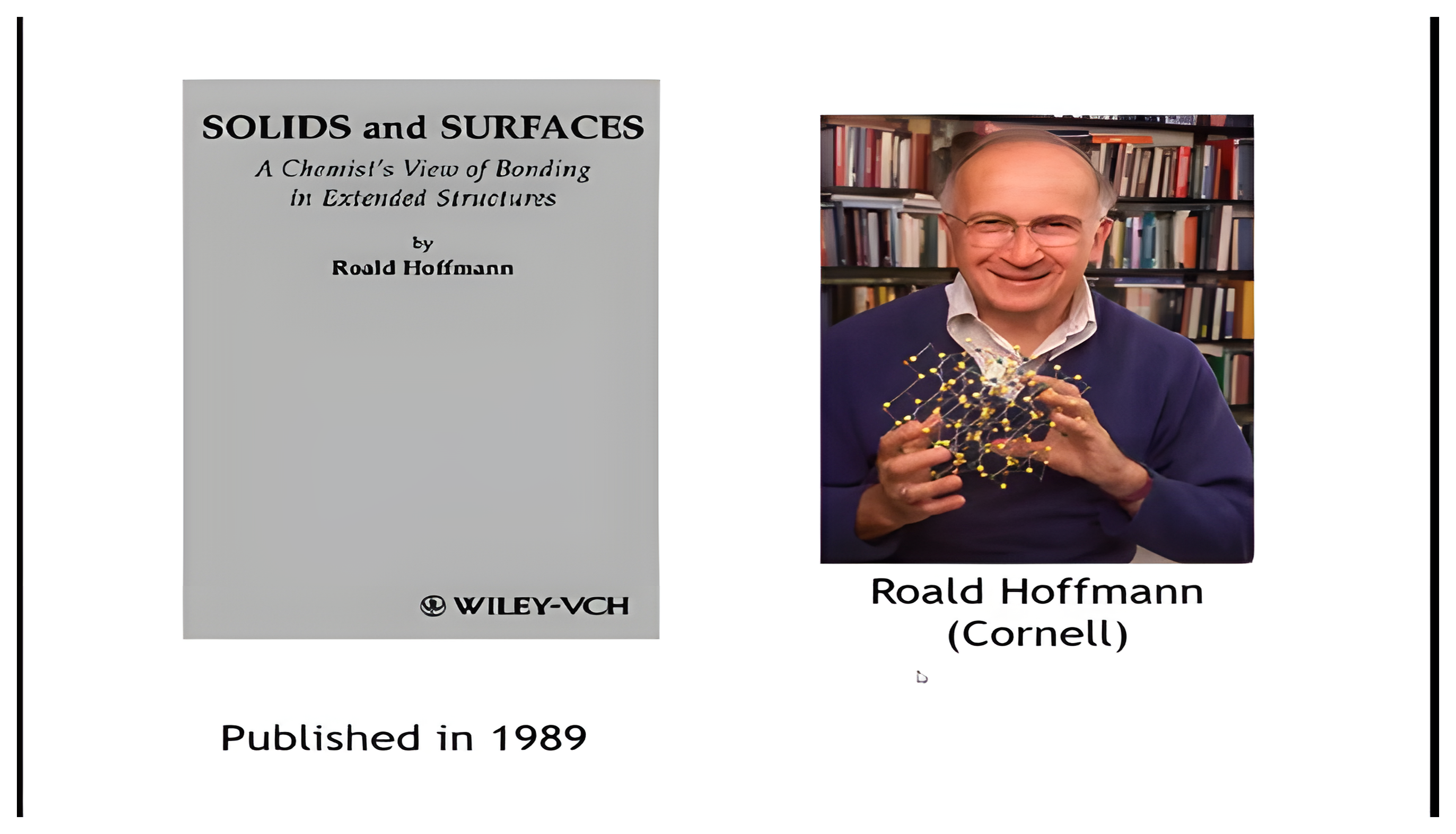
Solids and Surfaces (Hoffmann, 1989)

Cover of Roald Hoffmann's 1989 book Solids and Surfaces beside a photo of Hoffmann.

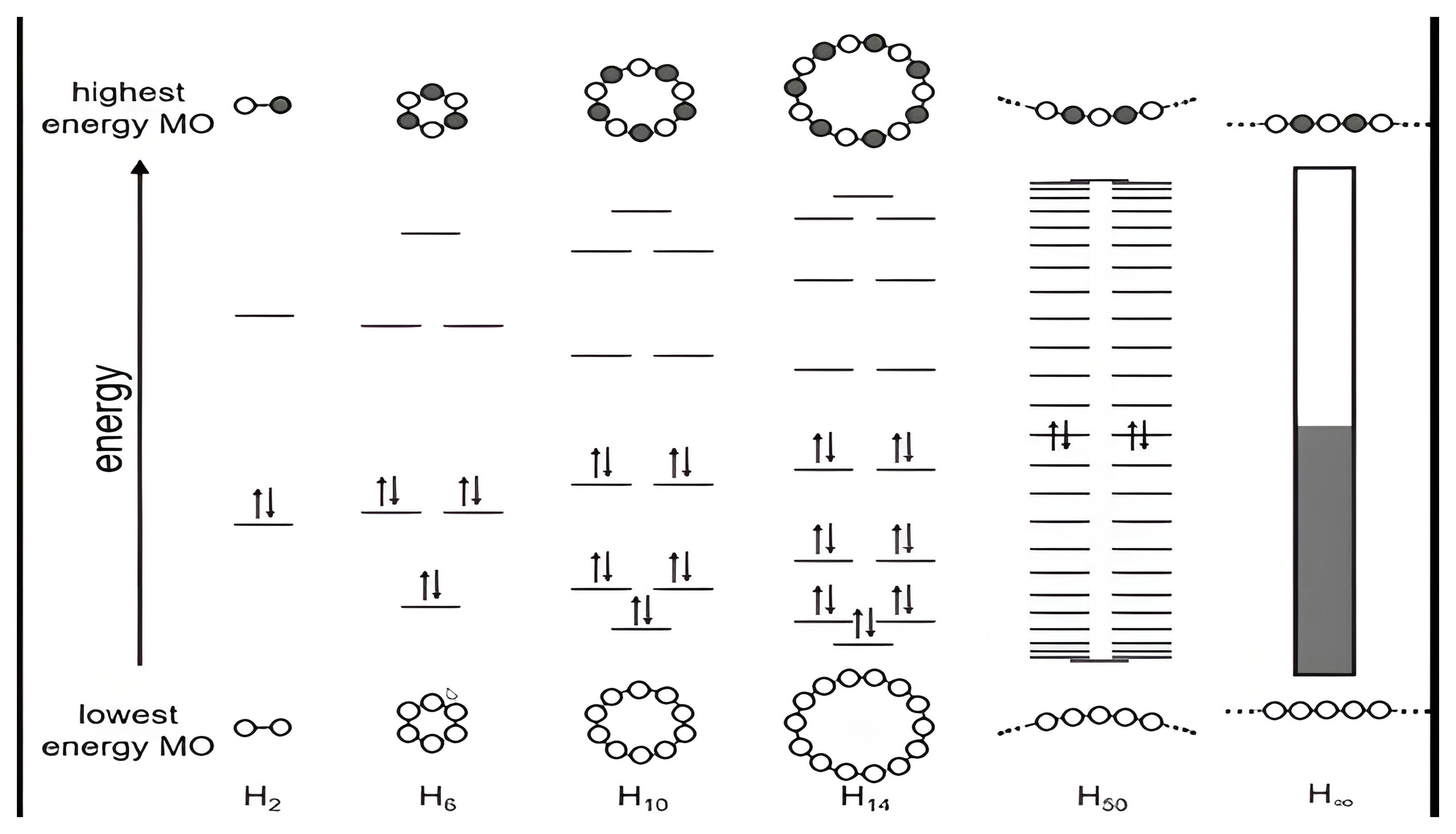
From Molecules to an Infinite Chain

Energy-level diagrams for H2 through H50 rings ending at the infinite hydrogen chain continuum.

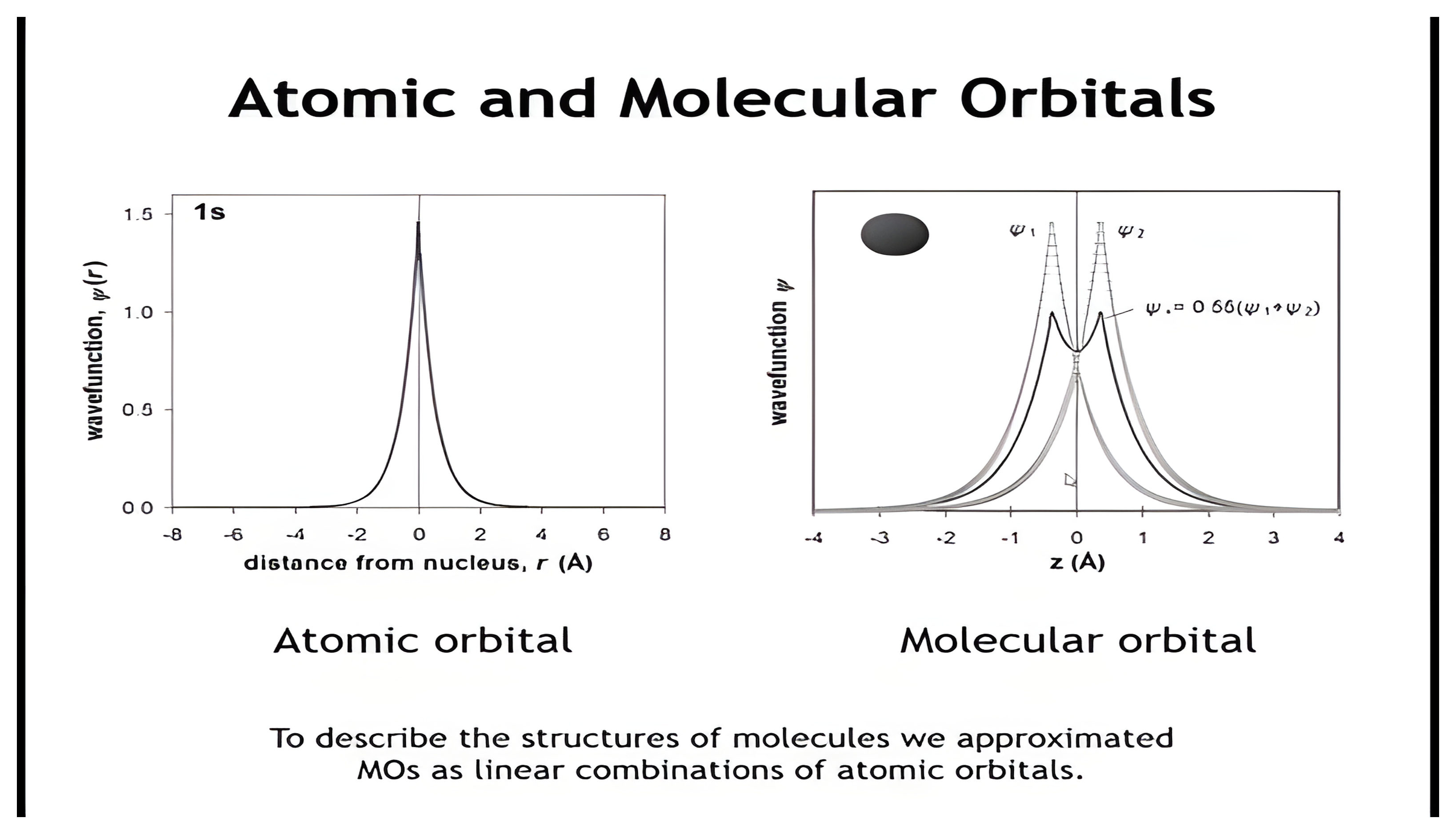
Atomic and Molecular Orbitals

Hydrogen 1s atomic orbital wavefunction beside a molecular orbital built as a linear combination of atomic orbitals.

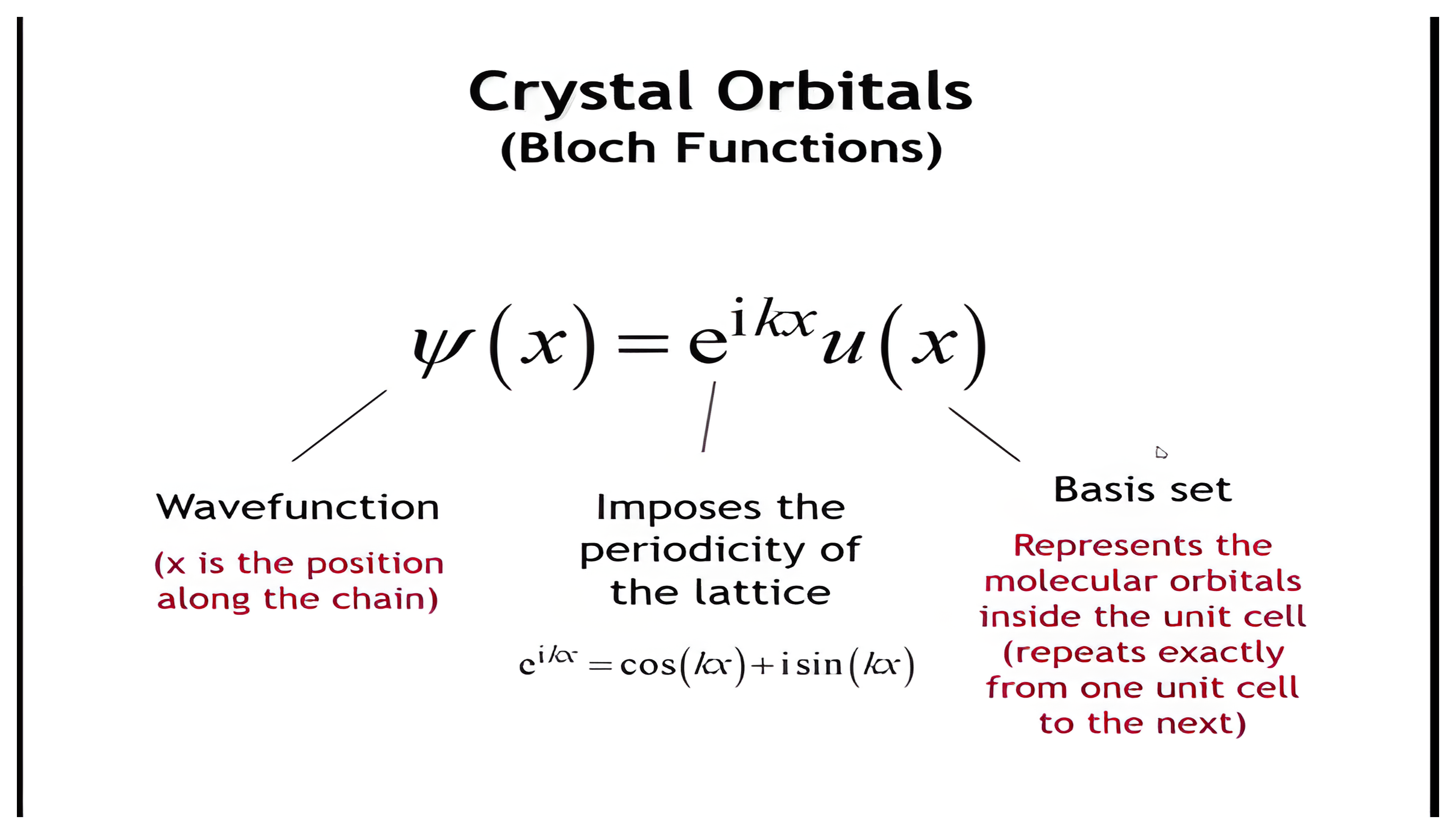
Crystal Orbitals: Bloch Functions

The Bloch function psi(x) = e^(ikx) u(x) with its wavefunction, periodicity, and basis-set parts labeled.

$\psi(x)=u(x)e^{ikx}$

First Brillouin Zone
Build asking what k is and what values it can take, developed on a ring of N hydrogen atoms.

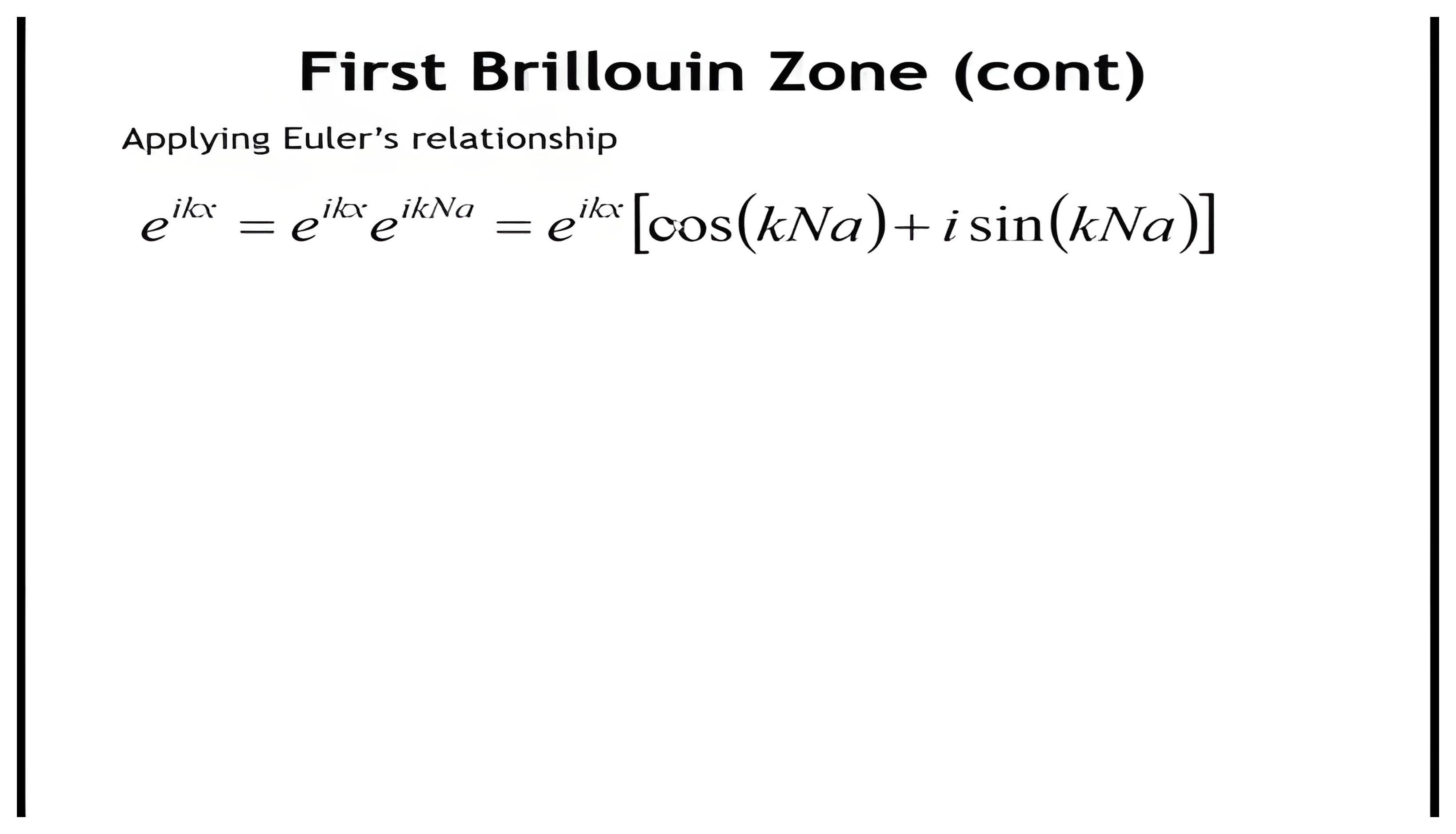
First Brillouin Zone (cont)

Euler's relationship applied to e^(ikNa), leading to the allowed k values and the first Brillouin zone.

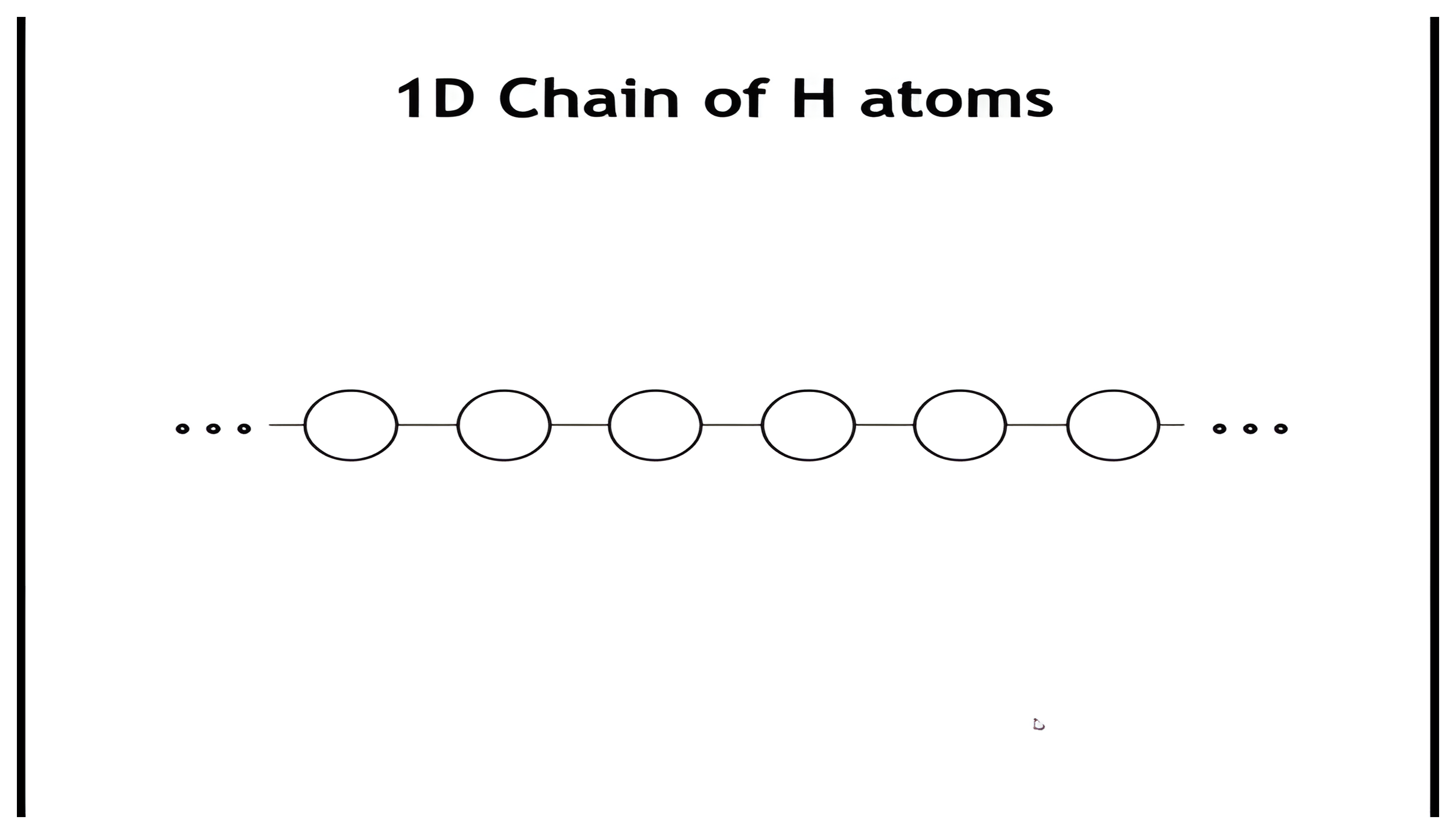
1D Chain of H Atoms

An infinite one-dimensional chain of hydrogen atoms drawn as connected circles.

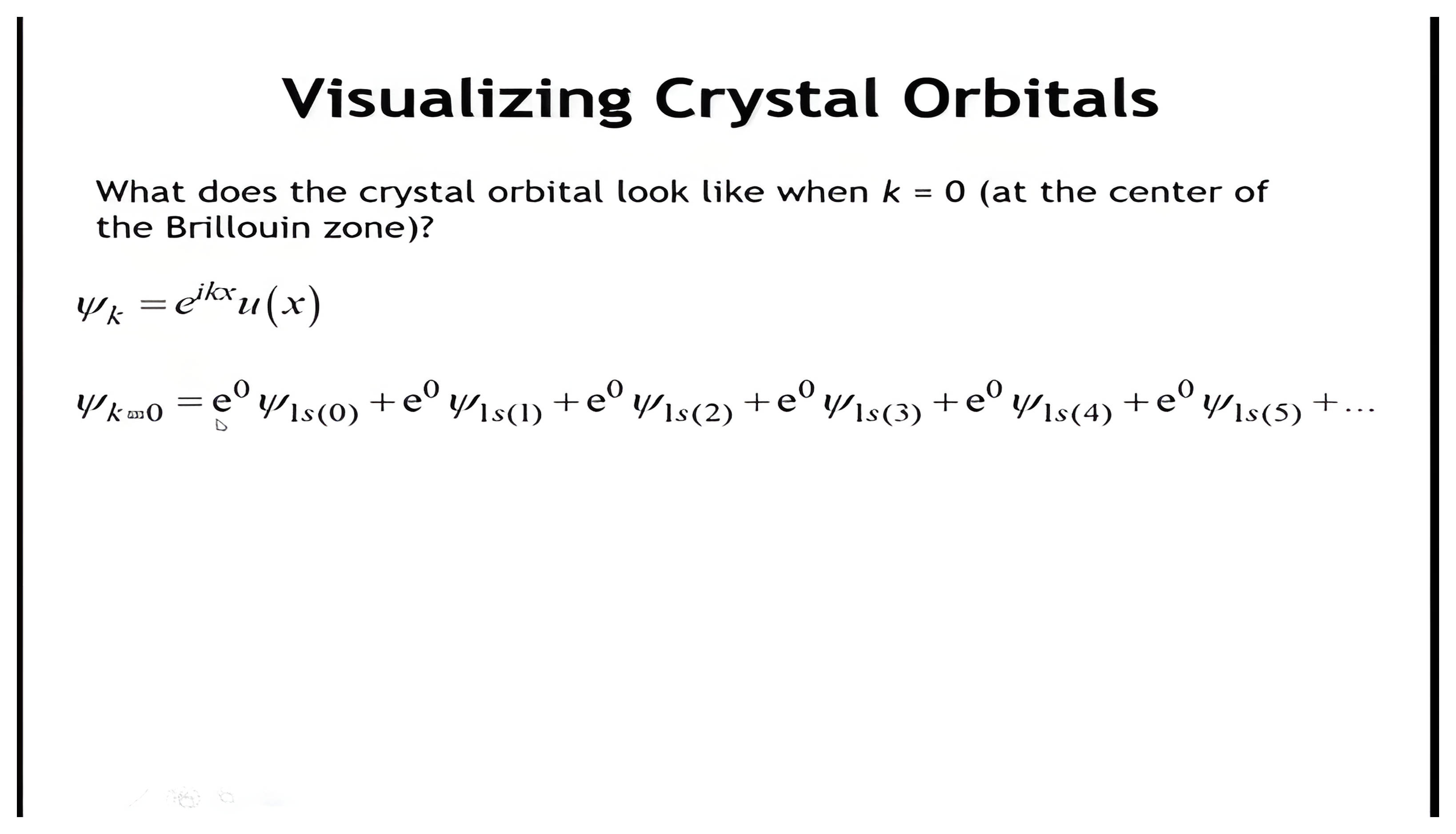
Visualizing Crystal Orbitals: k = 0

Build expanding the crystal orbital sum at k = 0, ending in the fully bonding hydrogen chain.

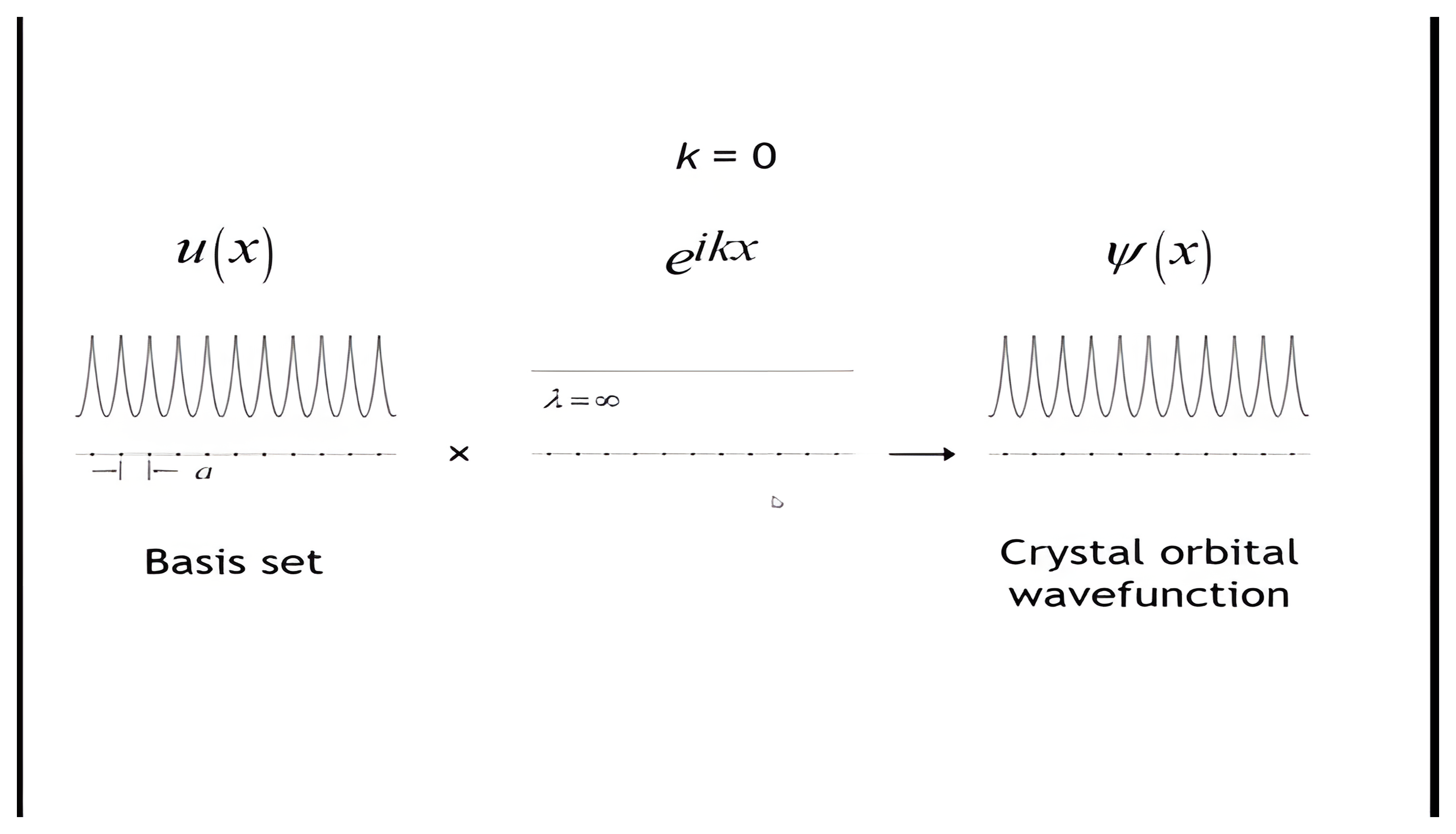
Crystal Orbital at k = 0

At k = 0 the basis set u(x) times the constant phase factor gives the summed 1s crystal orbital wavefunction.

Visualizing Crystal Orbitals: k = π/a
Build expanding the crystal orbital at k = pi over a, term by term, ending in the fully antibonding chain.

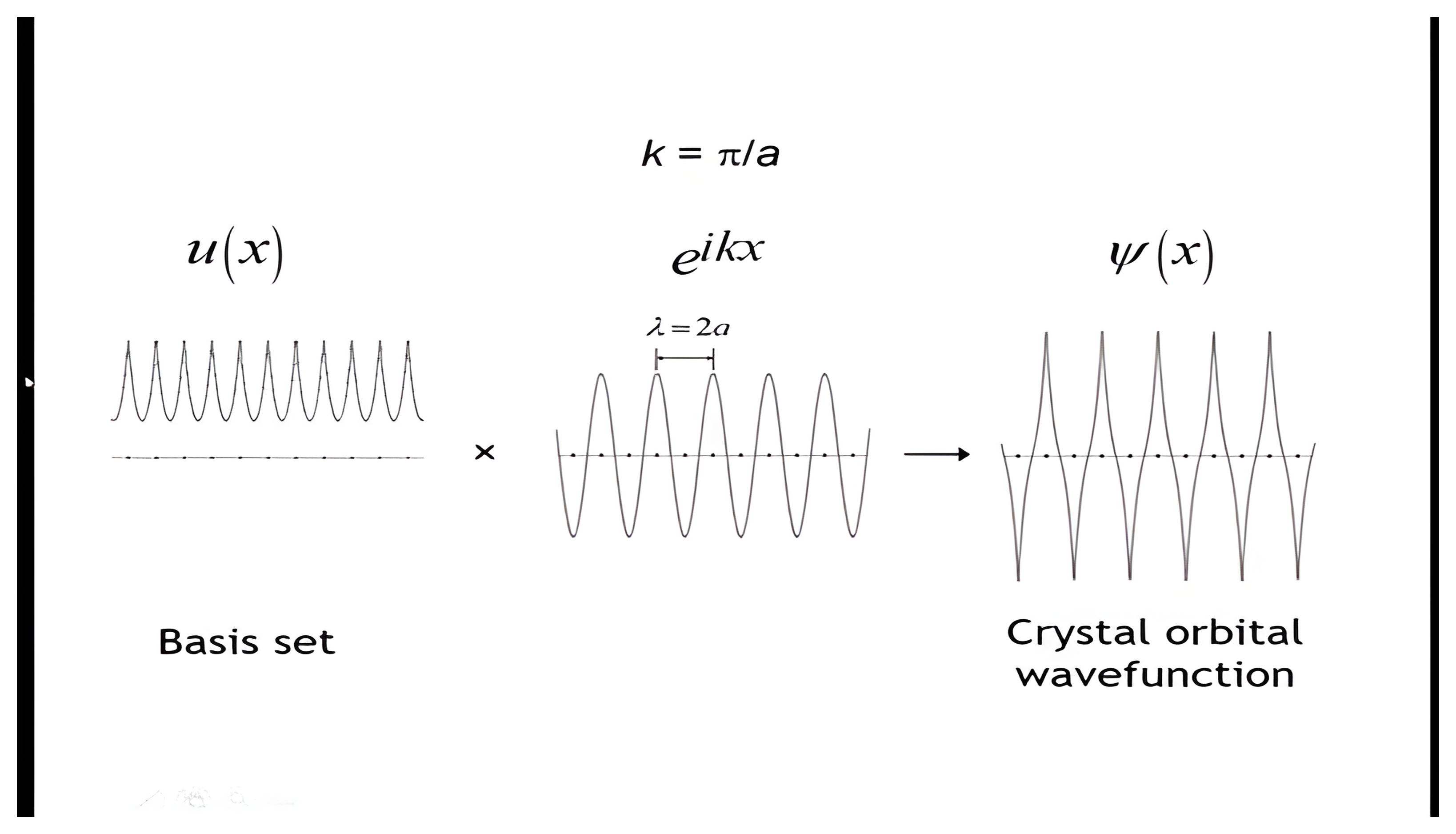
Crystal Orbital at k = π/a

At k = pi over a the basis set u(x) times a phase factor of wavelength 2a gives the alternating crystal orbital wavefunction.

Band Structure: Linear H-Atom Chain

Band structure of the linear hydrogen atom chain: energy versus k from minus pi over a to plus pi over a.

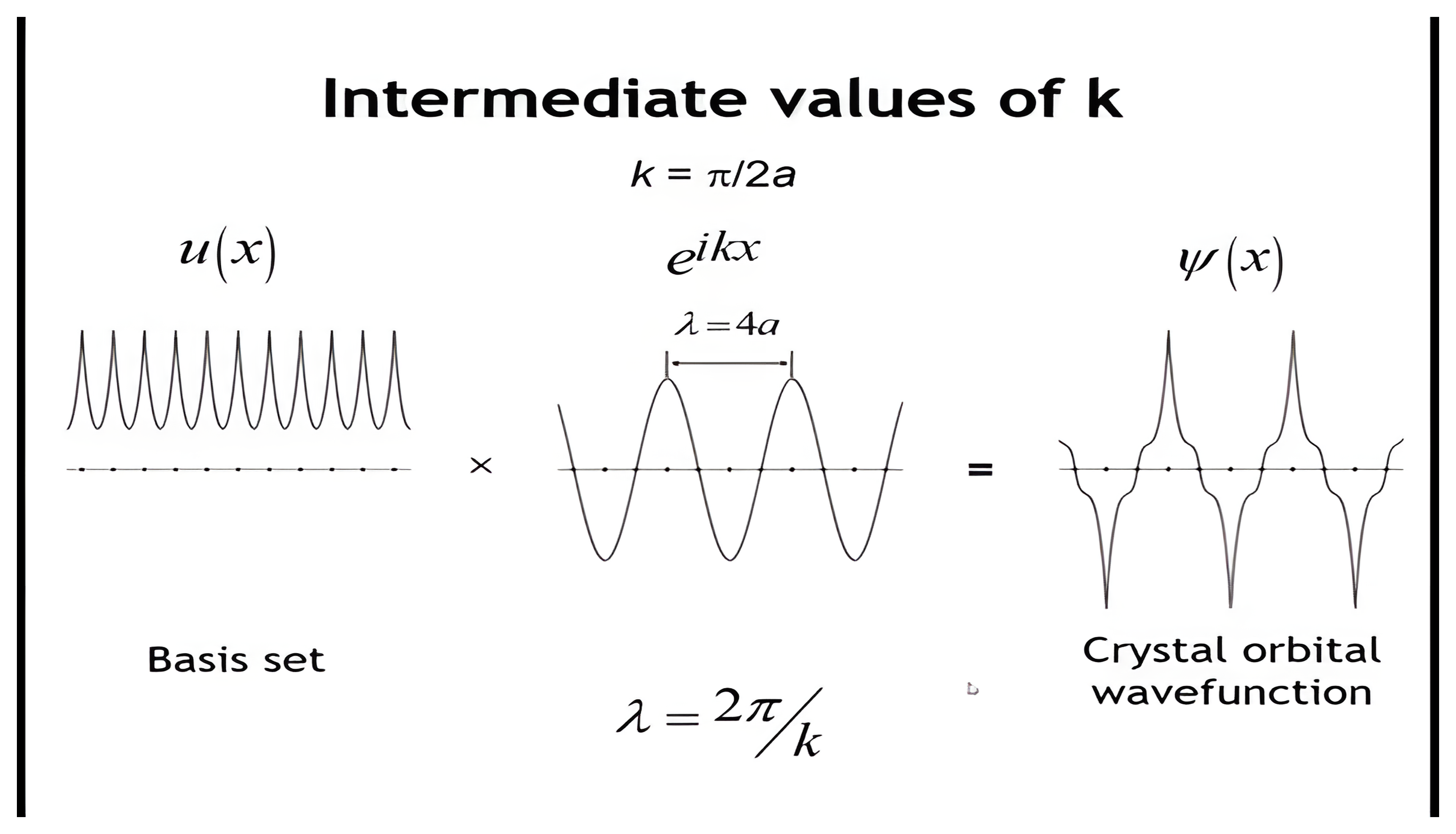
Intermediate Values of k

At k = pi over 2a the phase factor has wavelength 4a, giving a crystal orbital with nodes every two atoms.

What Is k?

  • k is a quantum number that “labels” wave functions (analogous to SALCs) generated by the translational symmetry of the crystal (it determines the coefficients of the basis set)
  • Reciprocal space wavevector. It tells us how rapidly the crystal orbital changes phase

$\lambda = 2π/k$

  • It determines the crystal momentum of an electron

$p = h/\lambda$$\;\longrightarrow\; p = hk/2π = \hbar k$

Bandwidth and Orbital Overlap
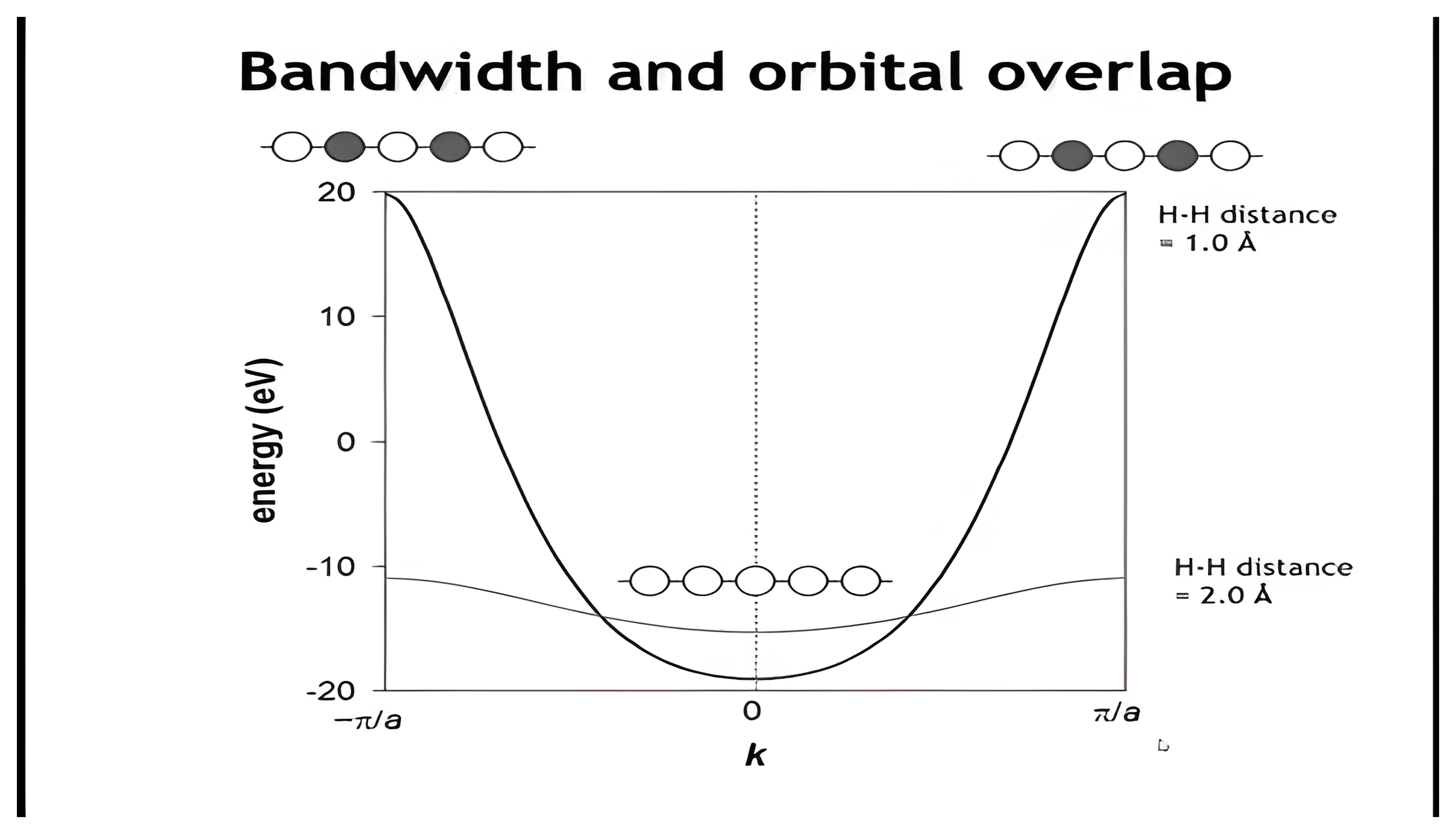
Build comparing the hydrogen-chain band at H-H distances of 1.0 and 2.0 angstroms to define bandwidth.

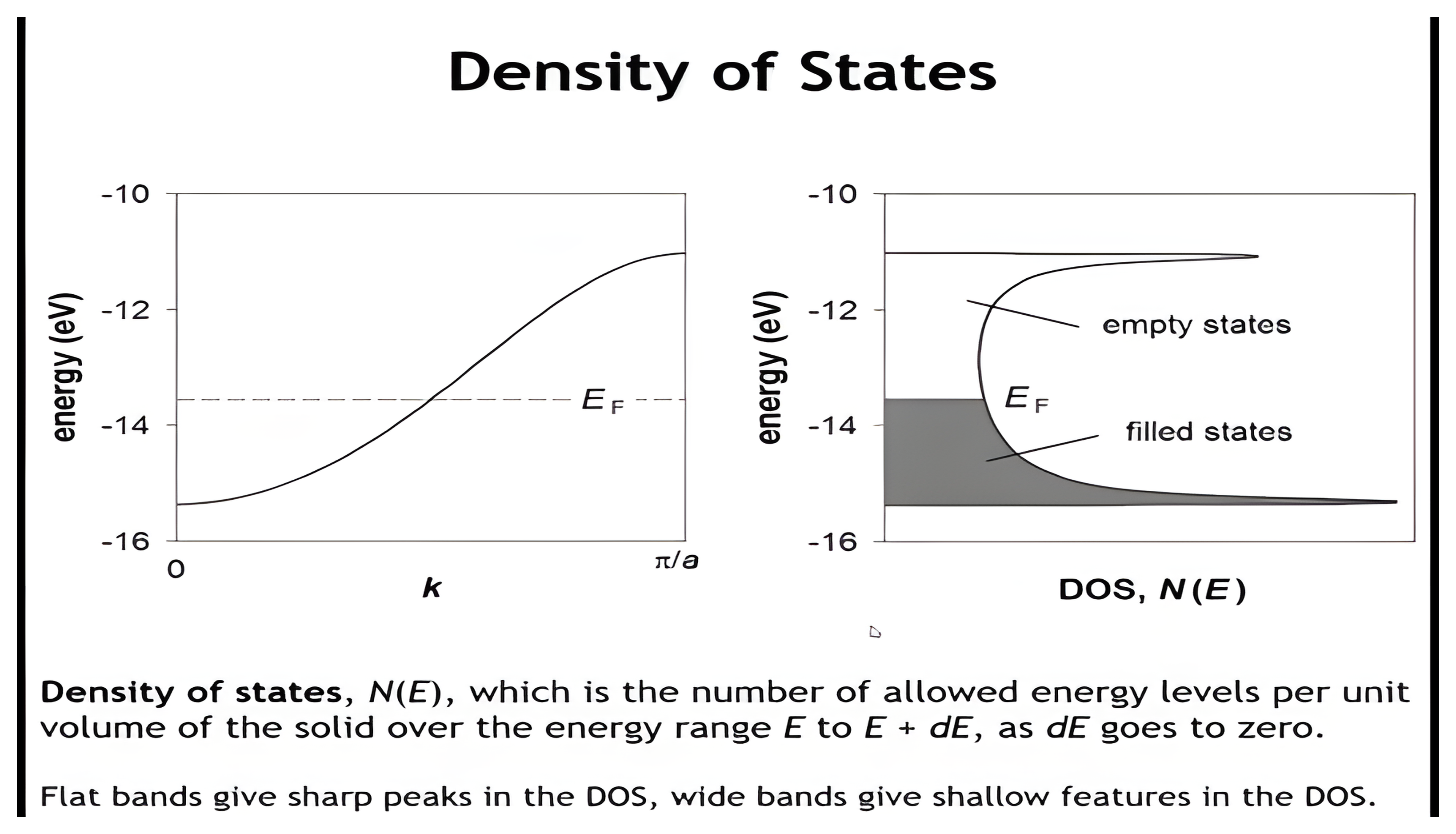
Density of States

The hydrogen-chain band beside its density of states plot with filled and empty states around the Fermi level.

Lecture Summary

  • Goal: Bridge from molecular orbitals → crystal band structure.
  • Approach: Extend MO theory to infinite periodic solids using Bloch functions:
    $\psi(x) = u(x)\cdot e^{ikx}$
    • u(x): periodic basis (hydrogen 1s)    eikx: imposes lattice periodicity
  • k (“crystal momentum”):
    • Labels distinct crystal orbitals
    • Determines wavelength $\lambda = 2π/k$ → momentum $p = \hbar k$
    • Allowed range: $−π/a \le k \le +π/a$ (1st Brillouin zone)
  • Extremes:
    • $k = 0$ → all bonding (ψ in-phase)    lowest energy
    • $k = π/a$ → all antibonding (ψ alternating ±)    highest energy
  • Bandwidth: $\Delta E \approx E(π/a) − E(0) \propto$ orbital overlap
    • Large overlap → wide band → delocalized electrons
    • Small overlap → narrow band → localized electrons
  • Density of States (DOS): number of states per energy interval dE
    • Peaks where bands are flat (bottom/top)
    • Minima where bands steep (midband)
  • Essence: Infinite chain → continuous bands; k maps real-space bonding to energy-momentum space.

Check Your Understanding: The Basis Set

Question asking what the basis set is in the context of Bloch functions and how it is chosen for the 1D hydrogen chain, then its answer.

Check Your Understanding: k and Bonding

Question asking how the value of k determines whether a crystal orbital is bonding or antibonding, then its bulleted answer.

Learning Objectives: Molecular Chains and Band Gaps
Learning-objectives page for electronic band structures in 1D systems: build band structures for molecular chains and see how dimerization creates band gaps, predict the number of bands from the orbitals in the unit cell, distinguish direct from indirect band gaps, classify metals, semiconductors and insulators by Fermi-level position, and analyze how s, p-sigma and p-pi orbitals contribute to band formation.

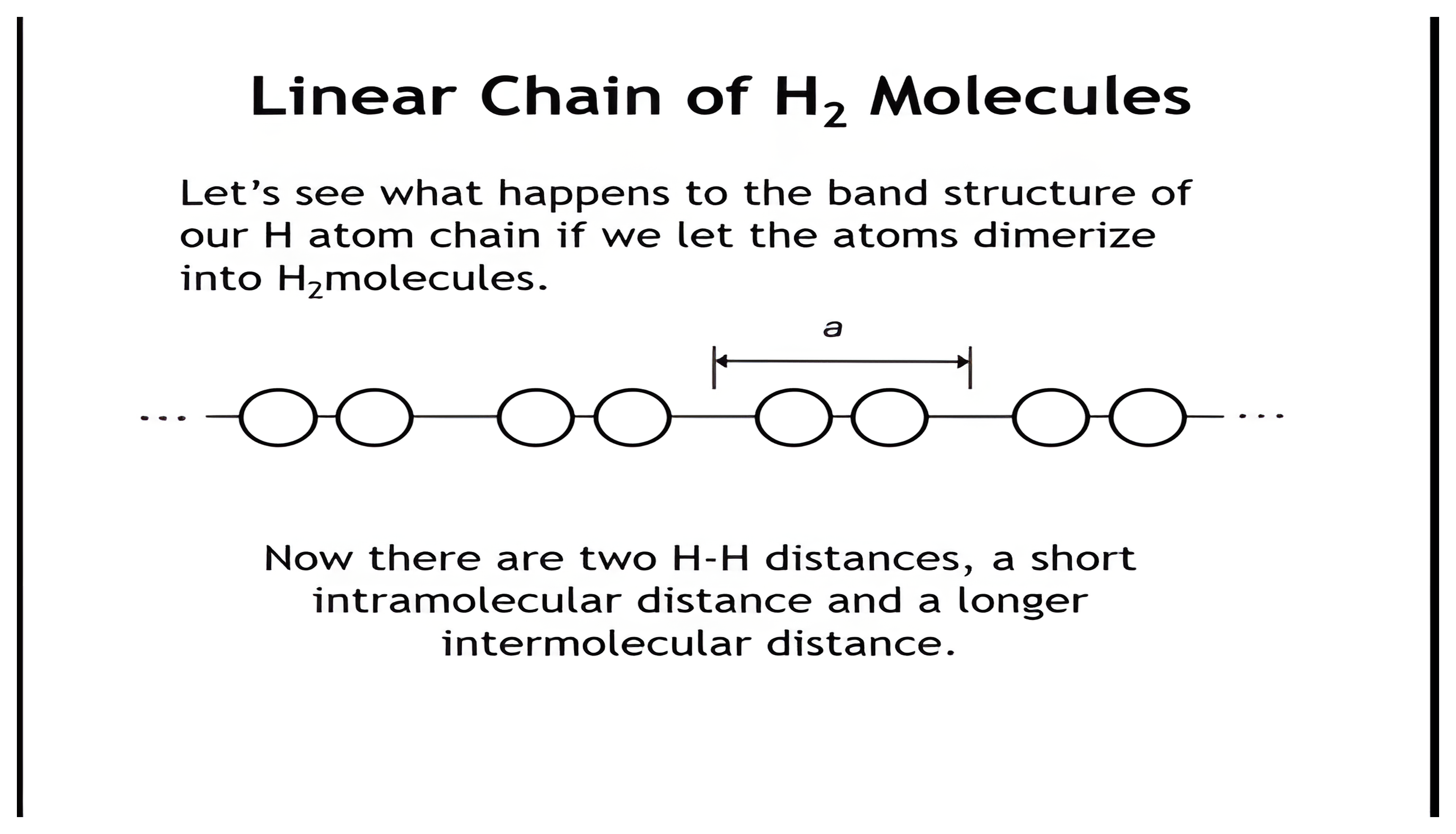
Linear Chain of H2 Molecules

A chain of hydrogen atoms dimerized into H2 molecules: paired circles with a short intramolecular H-H distance and a longer intermolecular distance, with the repeat distance a spanning one pair.

Two Orbitals per Unit Cell, Two Bands
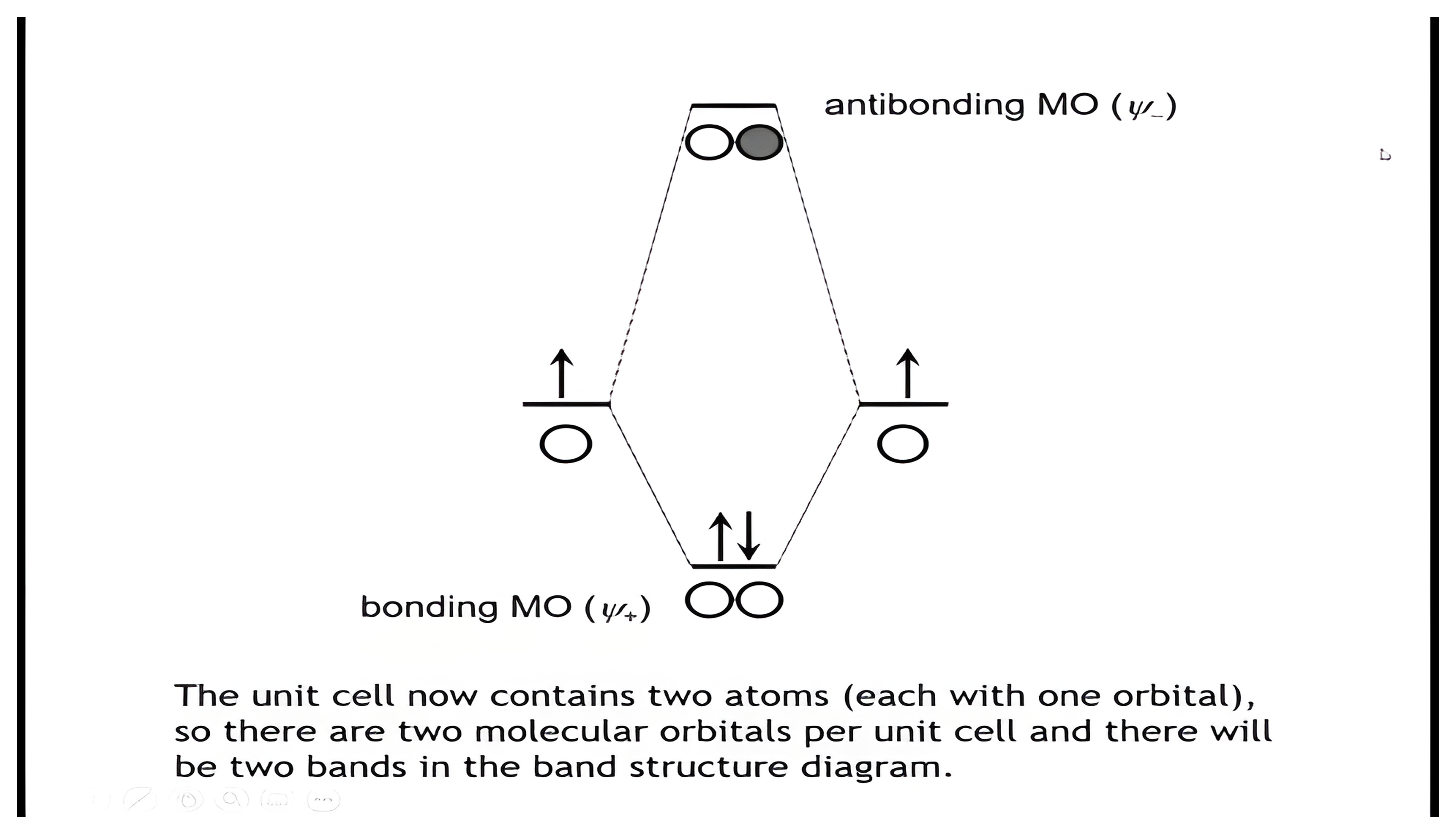
Molecular orbital diagram of one H2 molecule: two hydrogen 1s orbitals combine into a filled bonding MO psi-plus and an empty antibonding MO psi-minus, so the two-atom unit cell carries two molecular orbitals and the chain has two bands.

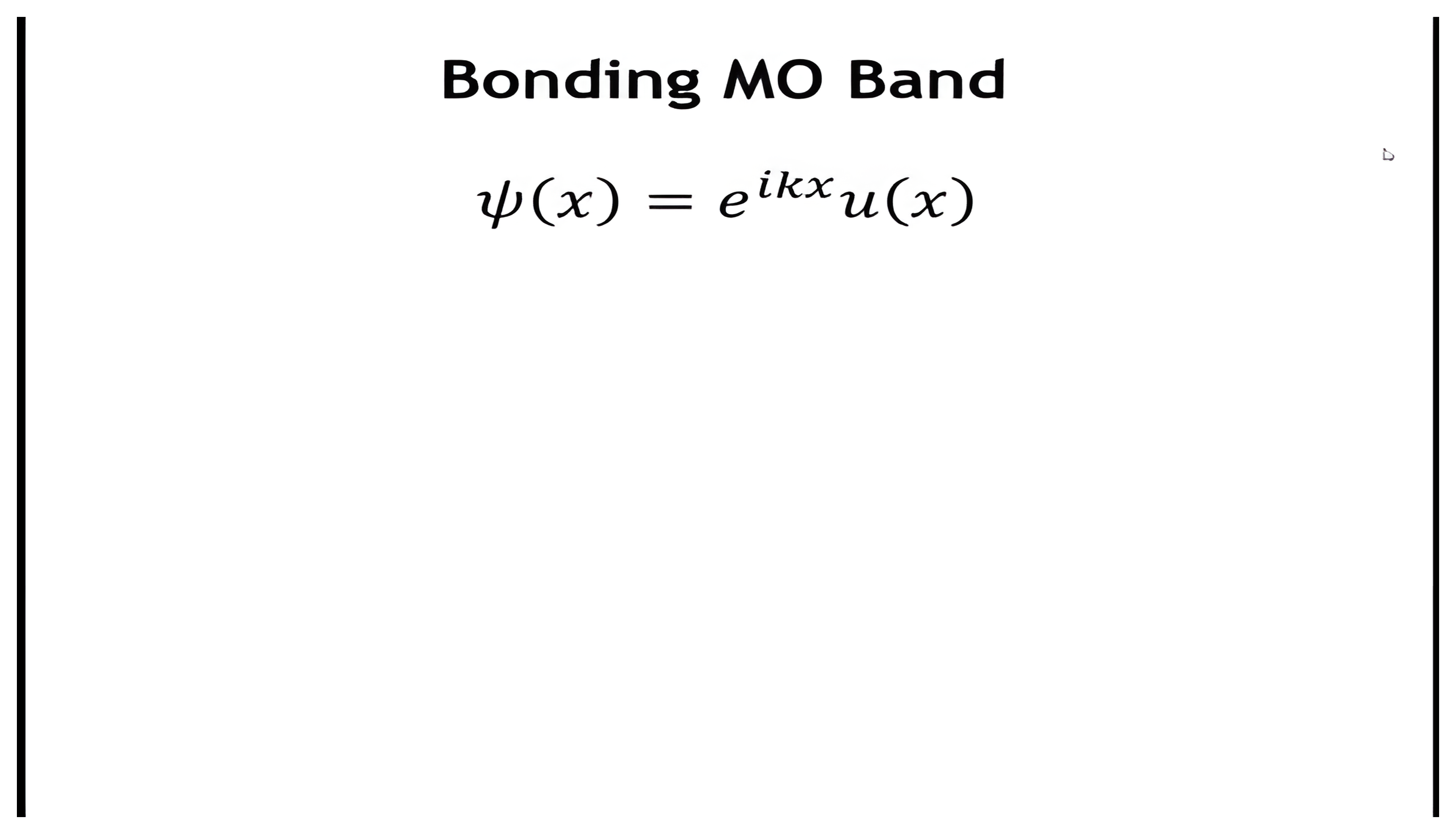
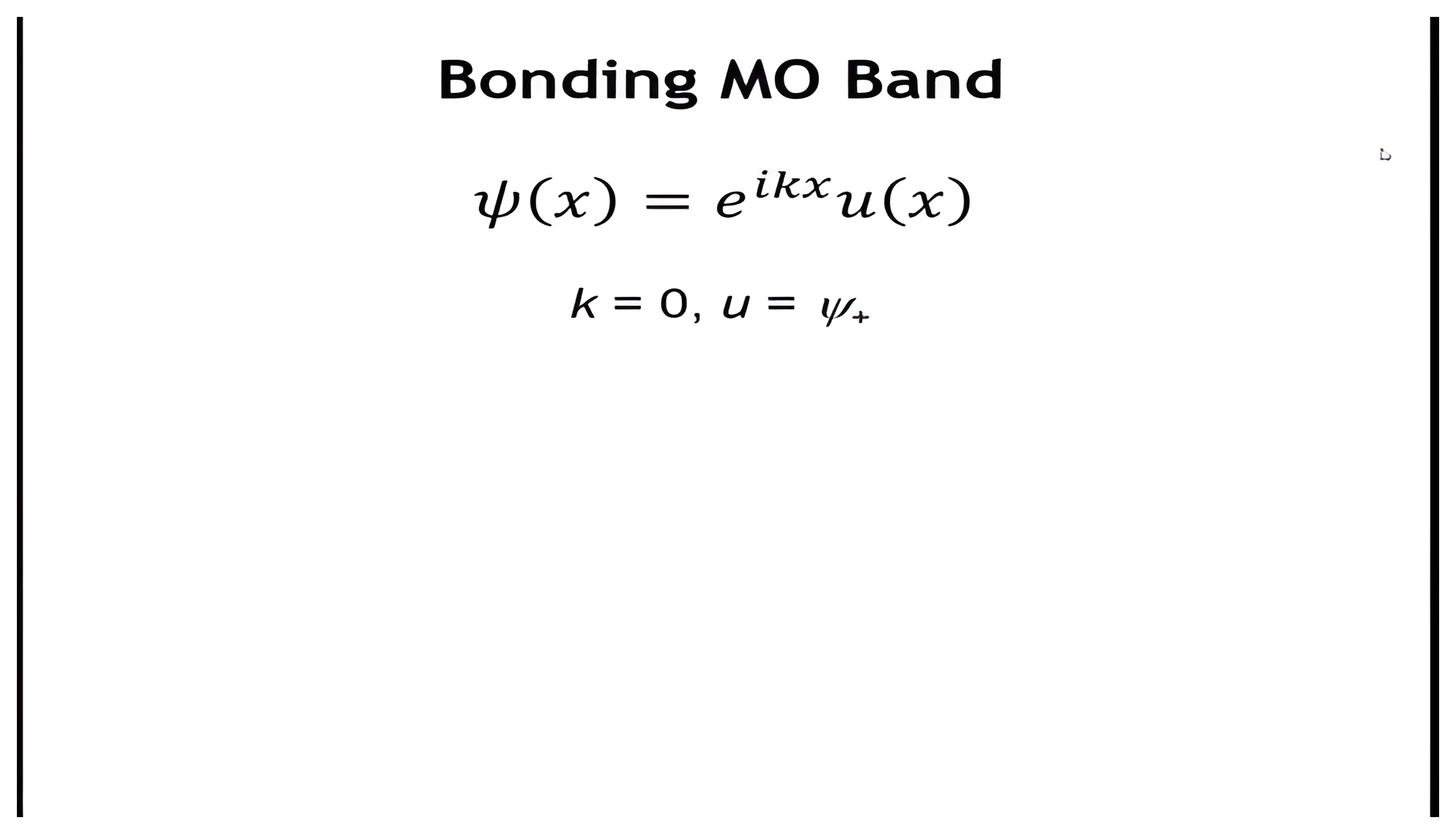
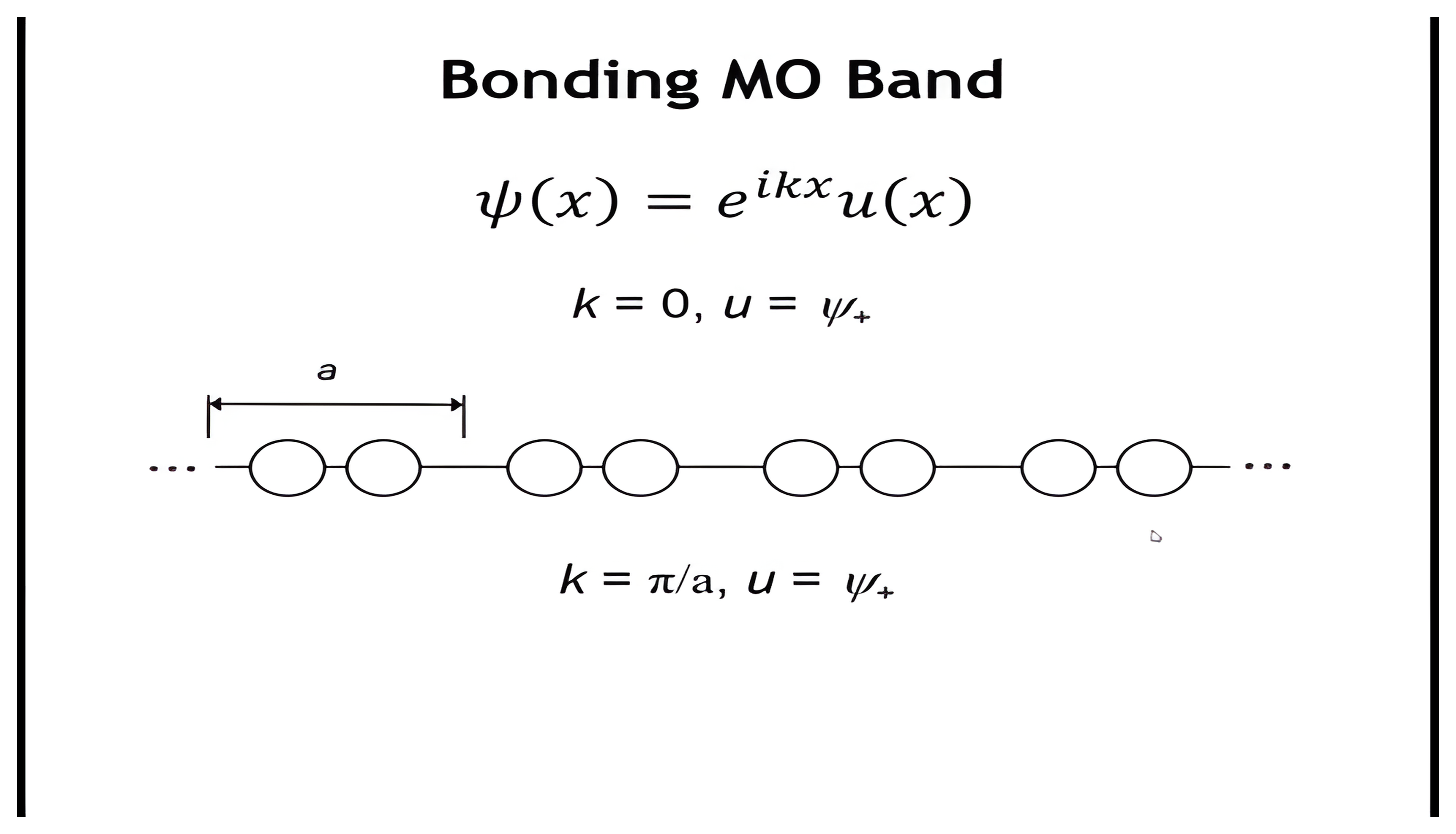
Bonding MO Band: k = 0 and k = π/a
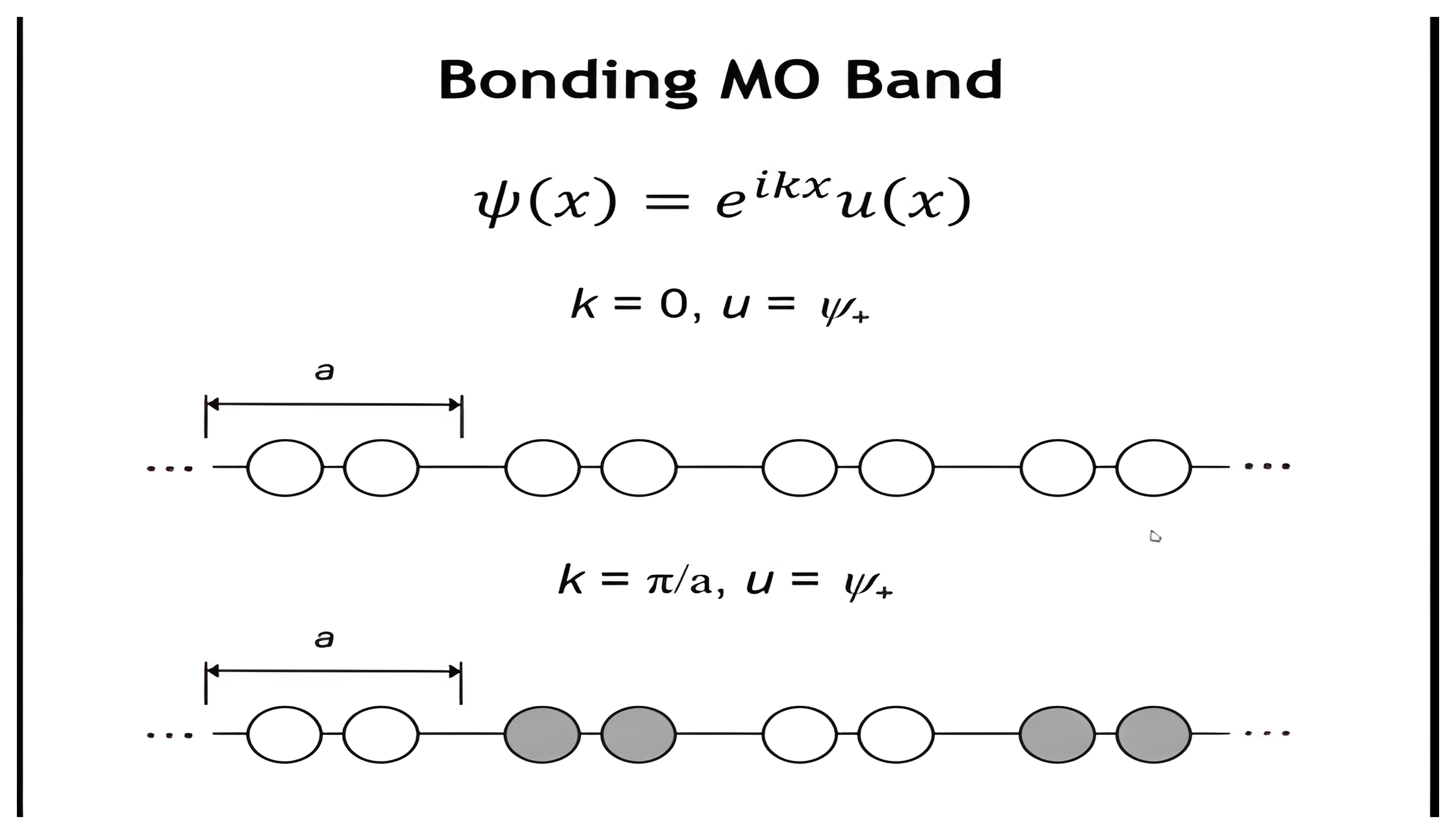
Build developing the bonding MO band from the Bloch function psi of x equals e to the i k x times u of x, adding k = 0 with u = psi-plus and then the chain of H2 dimers with every orbital in phase, and ending at k = pi over a where the phase alternates from one dimer to the next.

Antibonding MO Band

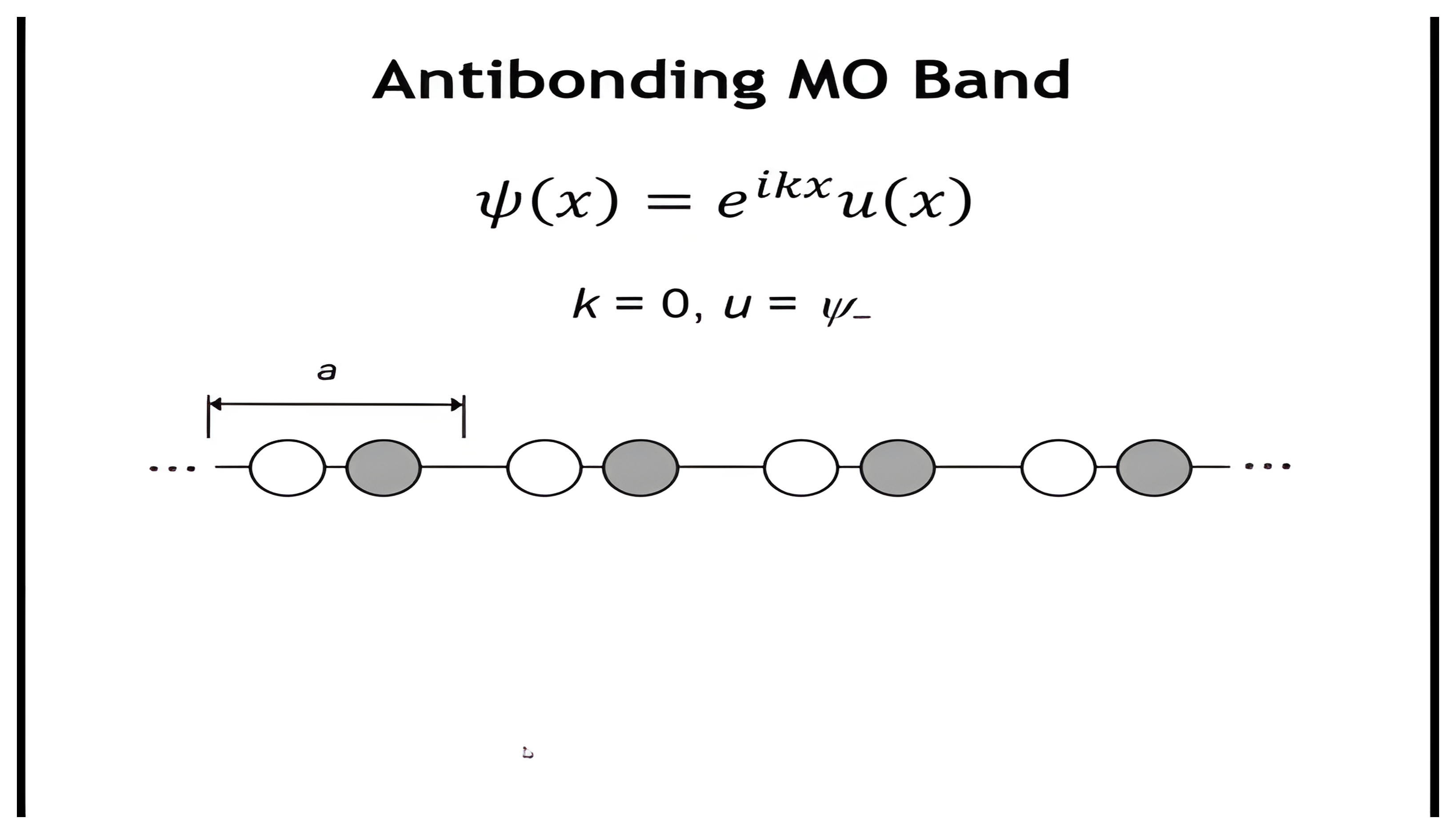
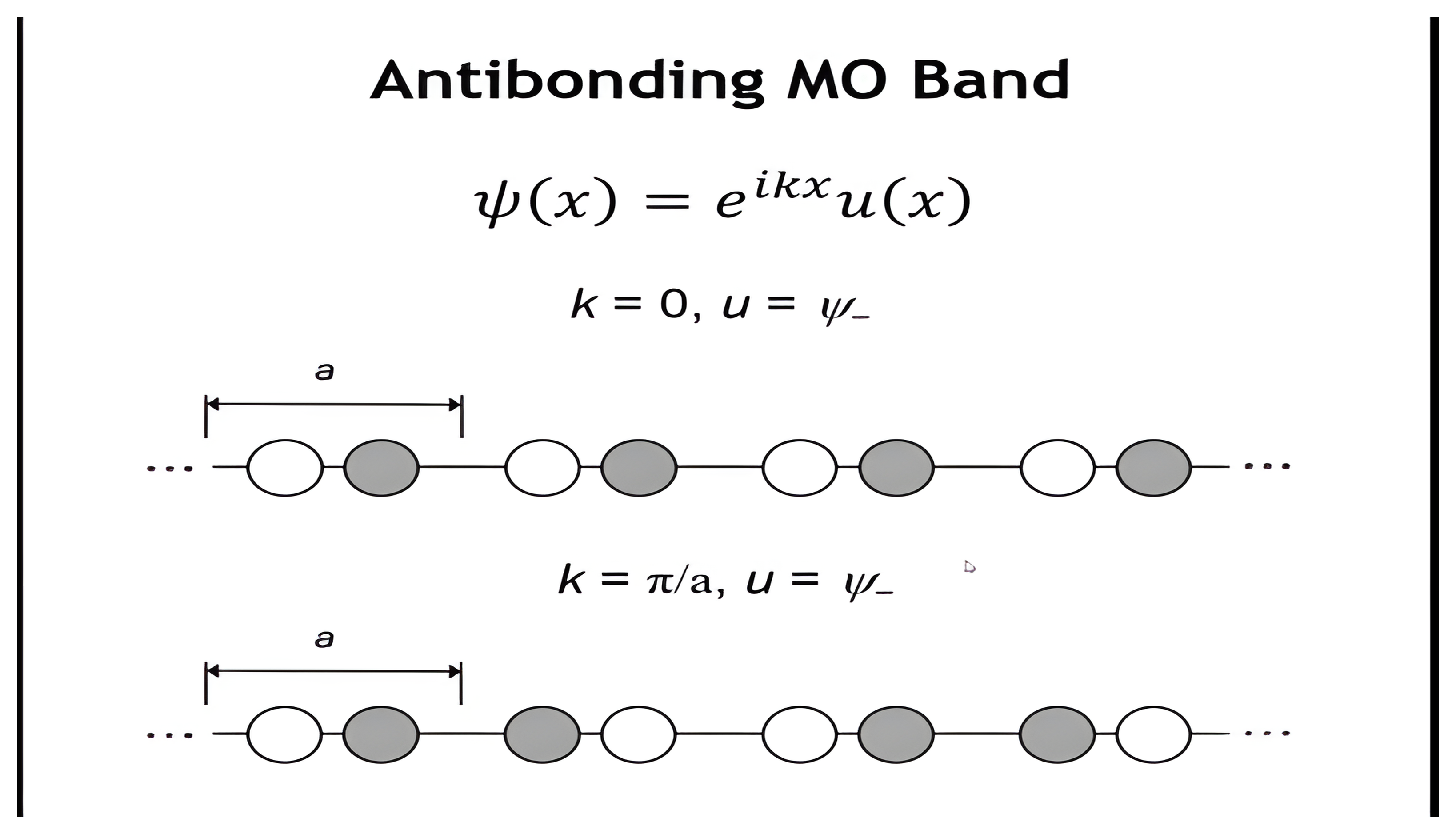
Build running the antibonding molecular orbital through both k points, from the k = 0 chain in which each antibonding H2 dimer repeats identically, ending at k = pi over a where the antibonding dimer flips sign from one unit cell to the next.

Ordering the Four Crystal Orbitals

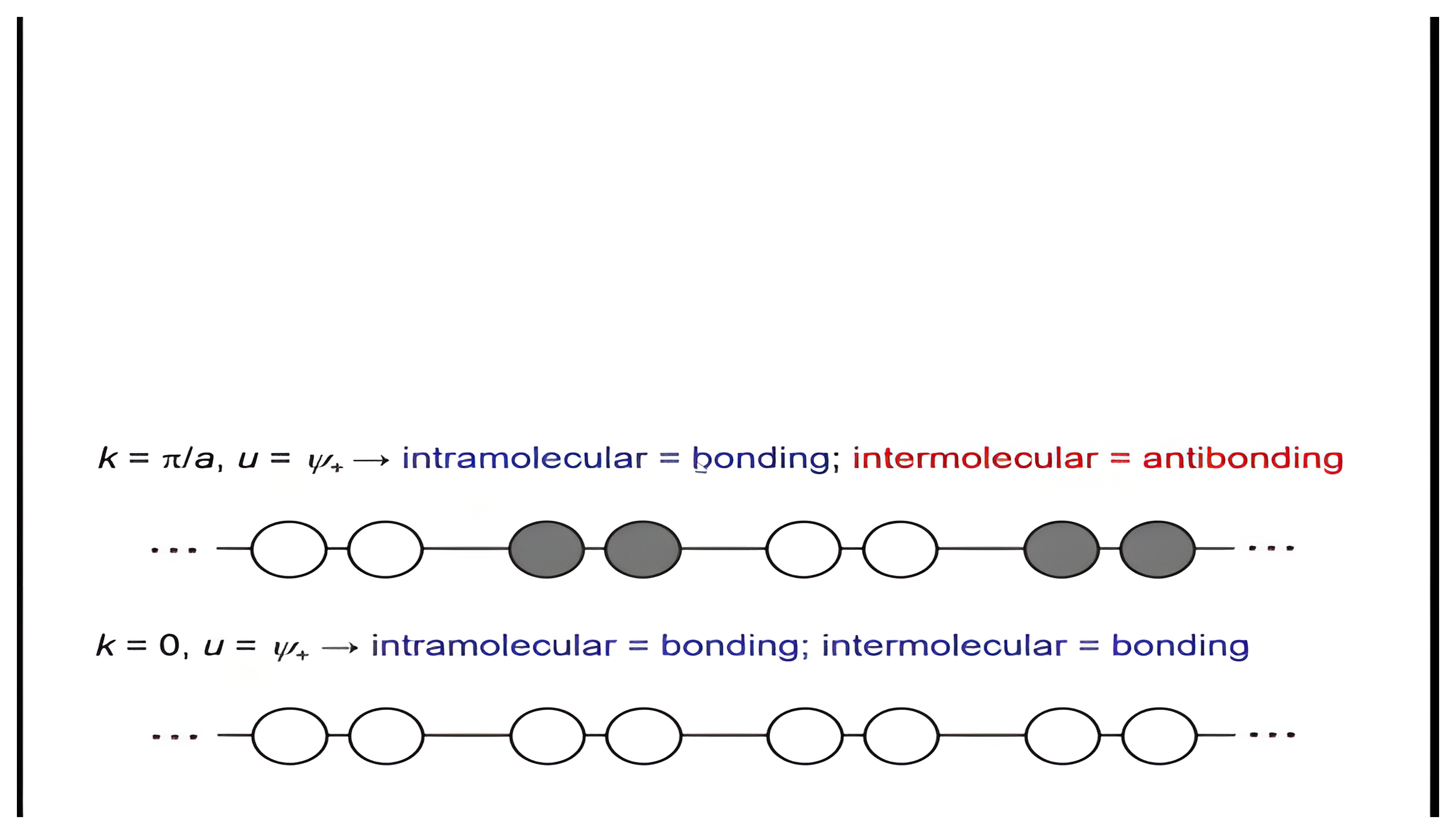
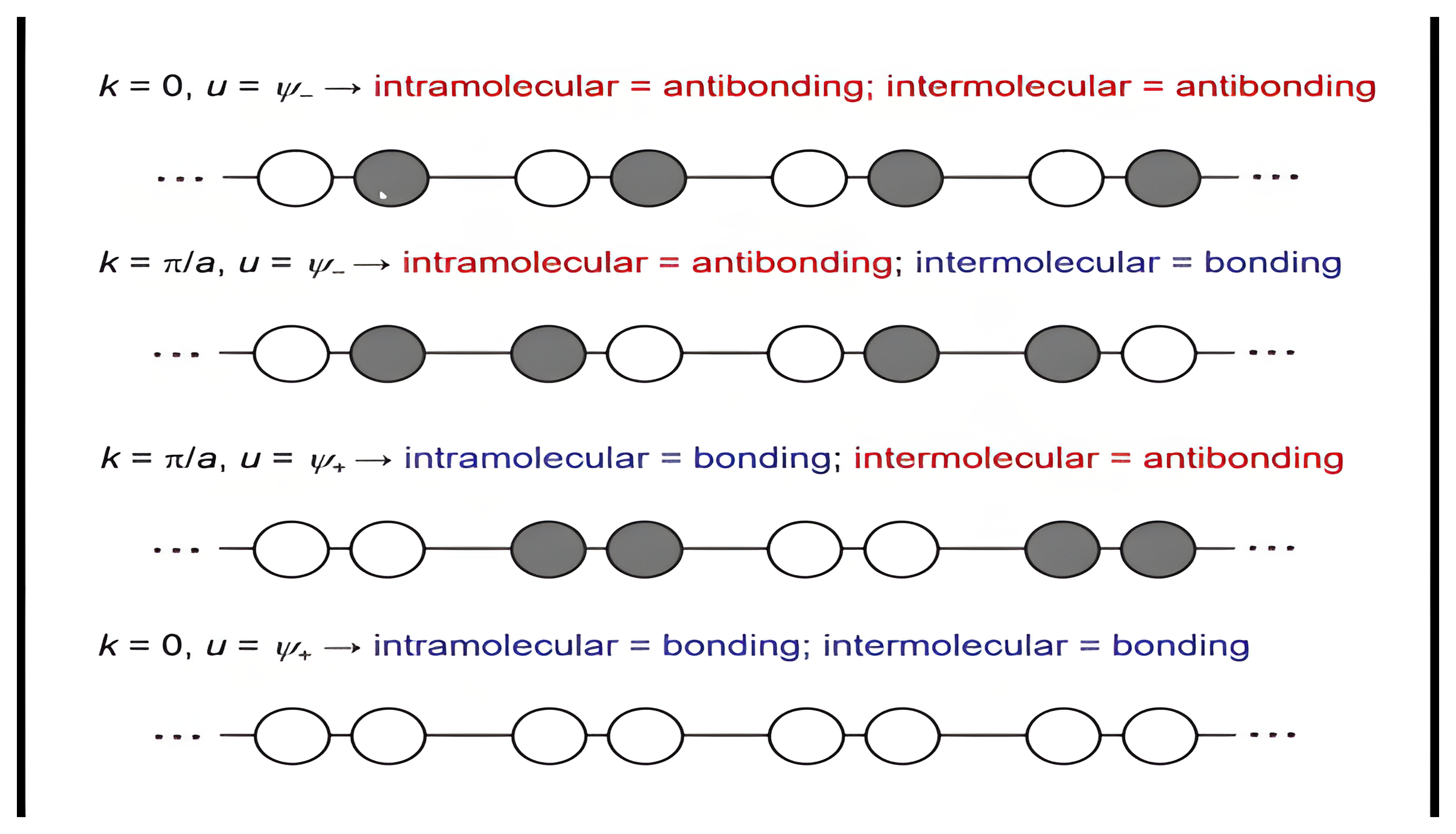
Build ordering the crystal orbitals of the H2 chain by energy, from the two psi-plus orbitals at k = 0 and k = pi over a labelled by their intramolecular and intermolecular bonding character, ending in all four stacked from the doubly antibonding k = 0 psi-minus orbital down to the doubly bonding k = 0 psi-plus orbital.

Two Bands and the Fermi Level

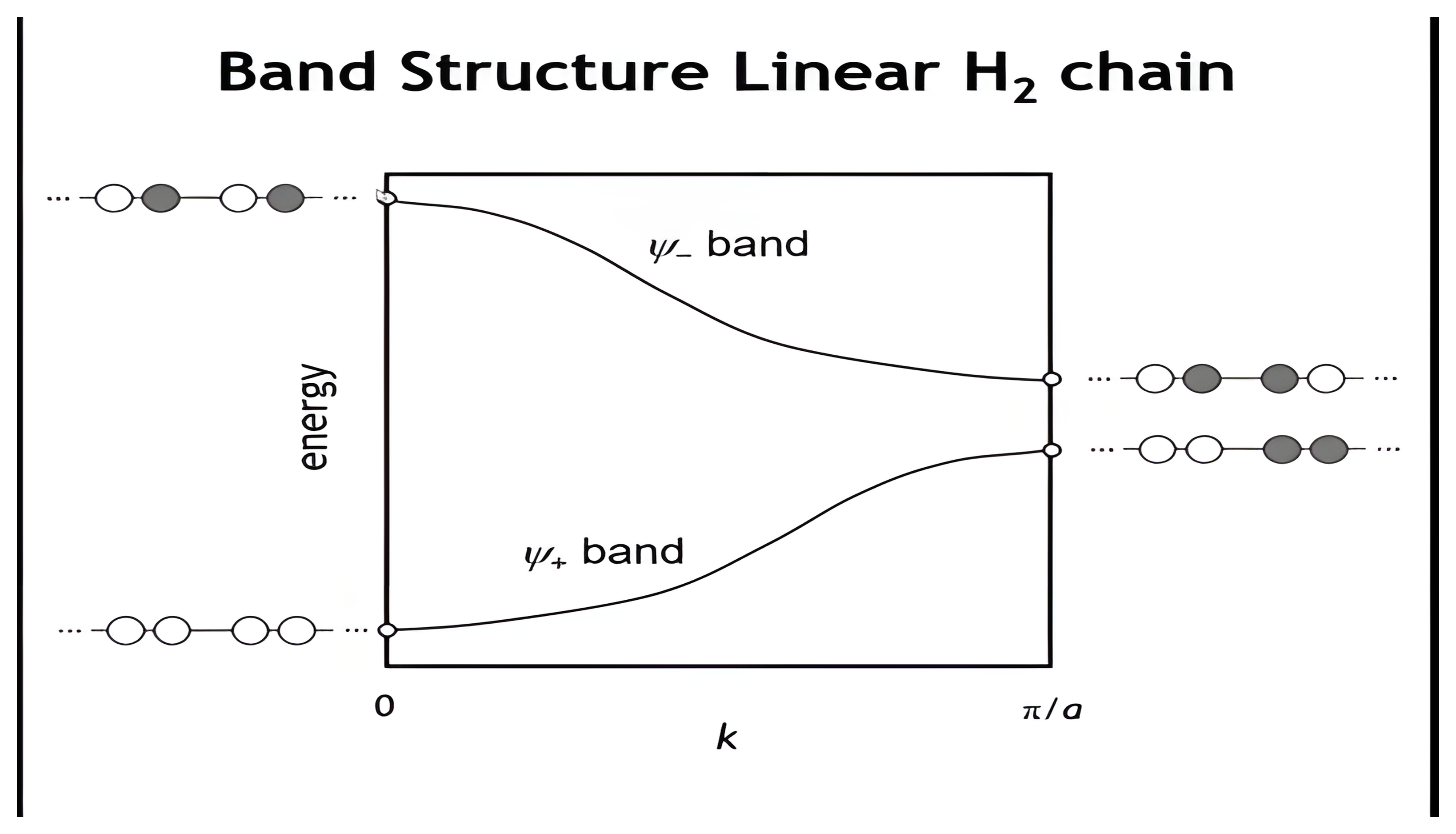
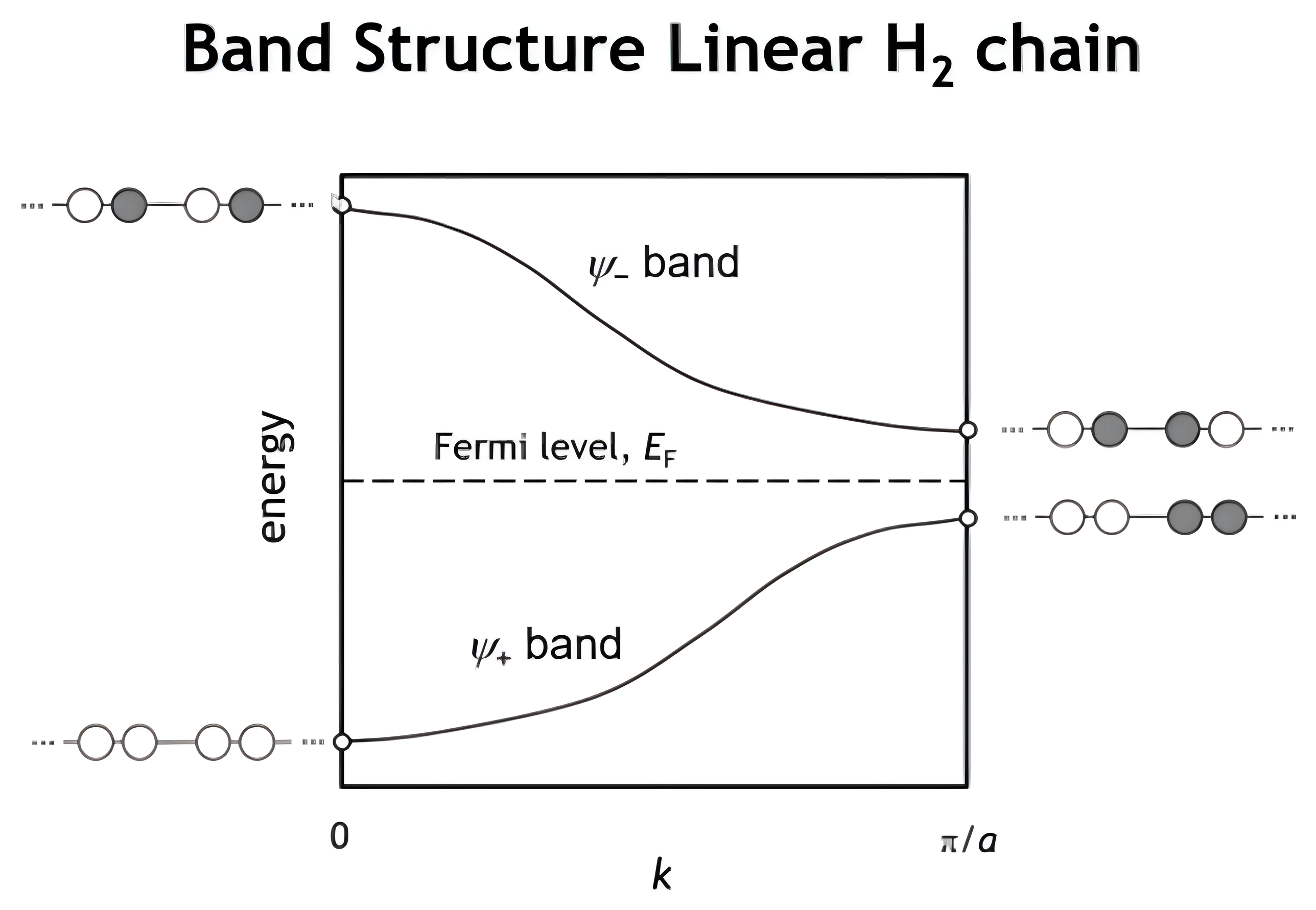
Build of the band structure of the linear H2 chain, energy against k from 0 to pi over a with the psi-plus band rising and the psi-minus band falling either side of a gap at pi over a, ending with the Fermi level drawn as a dashed line inside that gap between the filled and the empty band.

Valence Band, Conduction Band, and the DOS
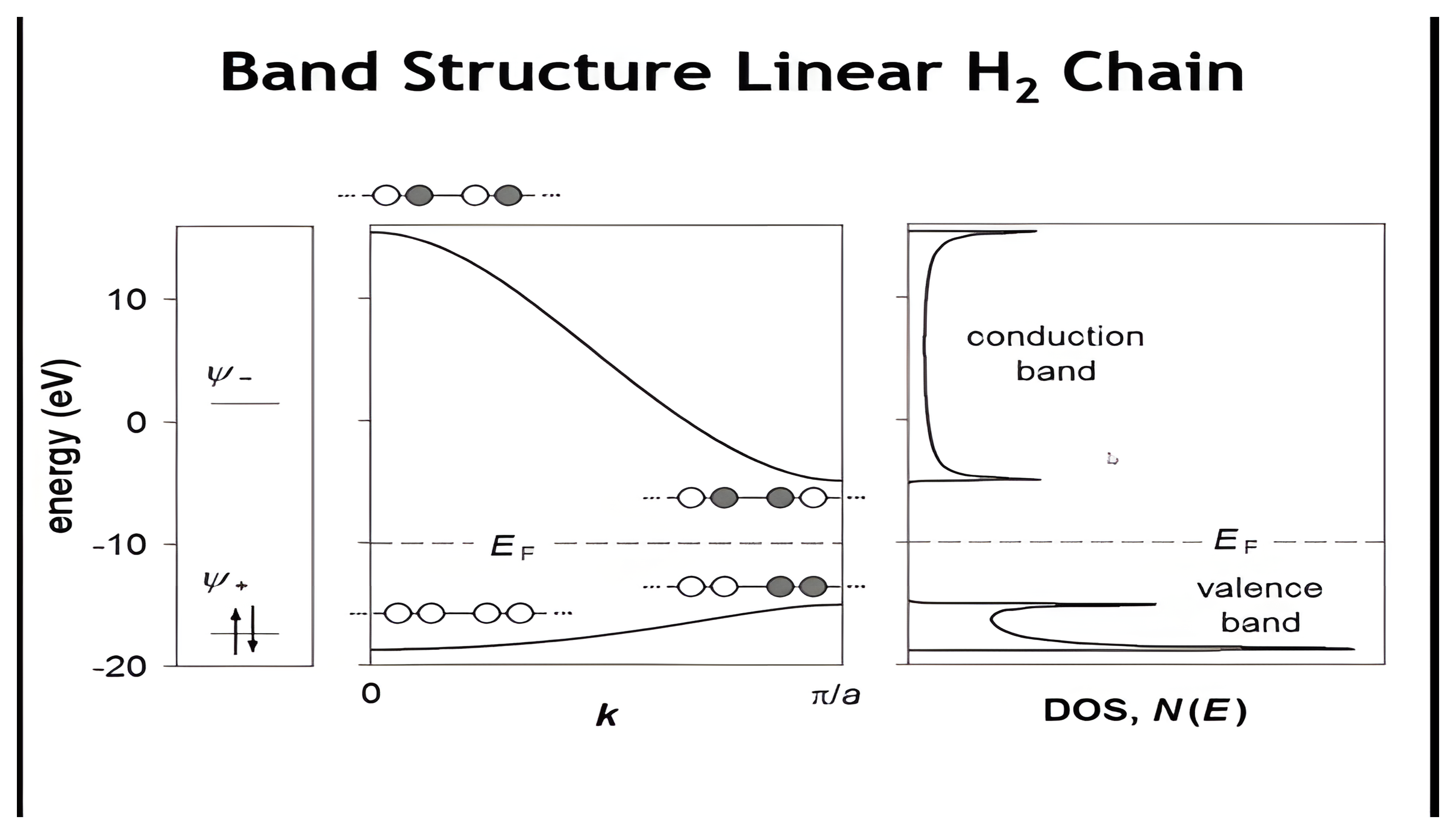
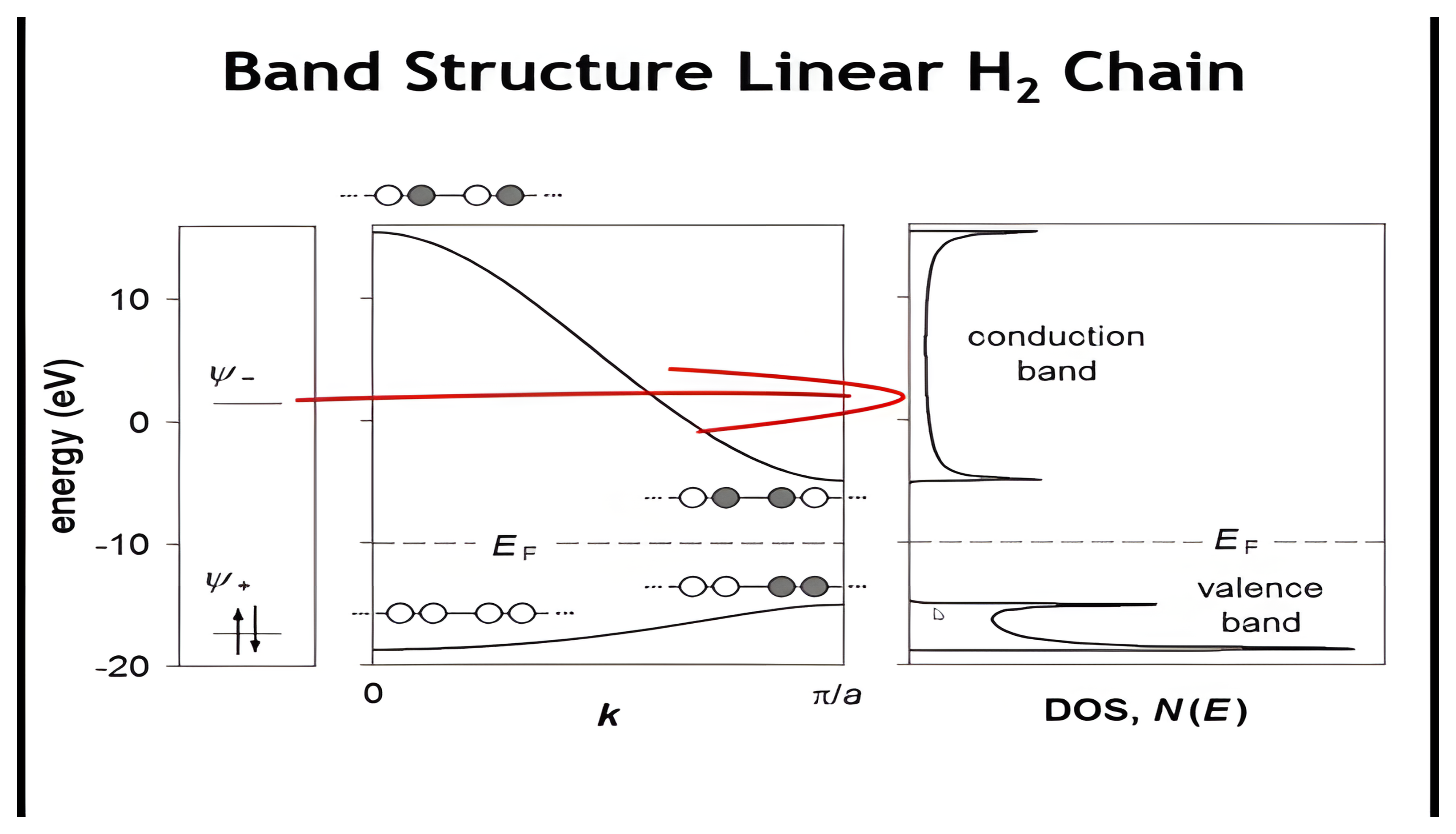
Build of the extended-Hückel band structure and density of states of the H2 chain, from the filled psi-plus valence band and empty psi-minus conduction band either side of the Fermi level with the molecular orbital levels of one H2 molecule at the left and N of E at the right, ending with a red arrow tracing the antibonding psi-minus molecular orbital into the conduction-band peak of the density of states.

Direct vs. Indirect Band Gaps

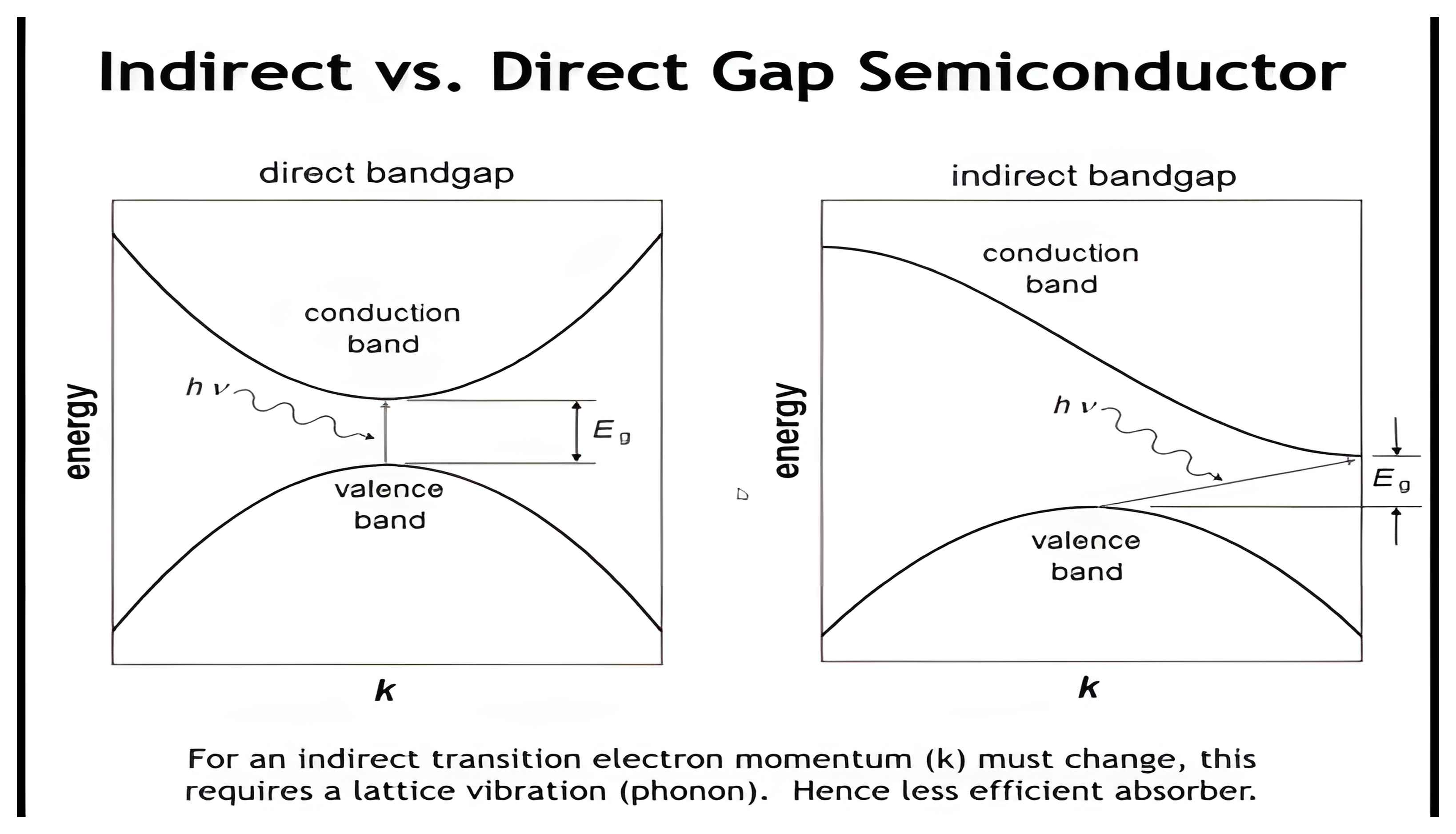
Direct and indirect band gaps compared: on the left the conduction-band minimum sits directly above the valence-band maximum and a photon alone bridges the gap; on the right the minimum is displaced in k, so the transition also needs a lattice vibration and the material absorbs less efficiently.
CHEM 548