CHEM 548: Materials Chemistry
Lecture 4: Space Groups and Crystal Structures
Wed 09/02/2026
Space-group symbols, Wyckoff sites, crystal-structure representation, close packing, metallic solids, and ionic structures
Reading: Woodward, Karen, Evans, and Vogt, Solid State Materials Chemistry
Learning objectives
Represent a structure describe a complex crystal structure by its space group, its unit cell dimensions, and its Wyckoff sites
Read the Tables use Wyckoff site information from the International Tables for Crystallography to determine atom positions, multiplicity, and site symmetry within a unit cell
Centered lattices work out how centering operations generate additional atomic positions from a single set of fractional coordinates
Theoretical density calculate the theoretical density of a crystal from its unit cell dimensions, its atomic contents from Wyckoff multiplicities, and its atomic masses
By the end of today you should be able to represent a crystal structure compactly, giving its space group, its unit cell dimensions, and its Wyckoff sites.
Read the Tables : use Wyckoff site information from the International Tables for Crystallography to determine atom positions, multiplicity, and site symmetry within a unit cellCentered lattices : work out how centering operations, like face-centering, generate additional atomic positions from a single set of fractional coordinatesTheoretical density : calculate the theoretical density of a crystal from its unit cell dimensions, its atomic contents from Wyckoff multiplicities, and its atomic masses
Representing a structure compactly is where we start, because some unit cells hold hundreds of atoms.
How do we represent Crystal Structures?
Sometimes there are hundreds of atoms per unit cell
We don’t want to draw them all out
How do we represent the crystal structures more compactly?
How can we use software to better visualize crystal structures?
We want to specify a crystal structure completely without listing every atom in the unit cell.
[advance: hundreds of atoms per unit cell]
Some unit cells hold hundreds of atoms
[advance: we do not want to draw them all out]
We do not want to draw all of them out
[advance: the compactness question]
First question: how to represent a crystal structure more compactly
[advance: the software question]
Second question: how to get software to draw the structure from that compact description
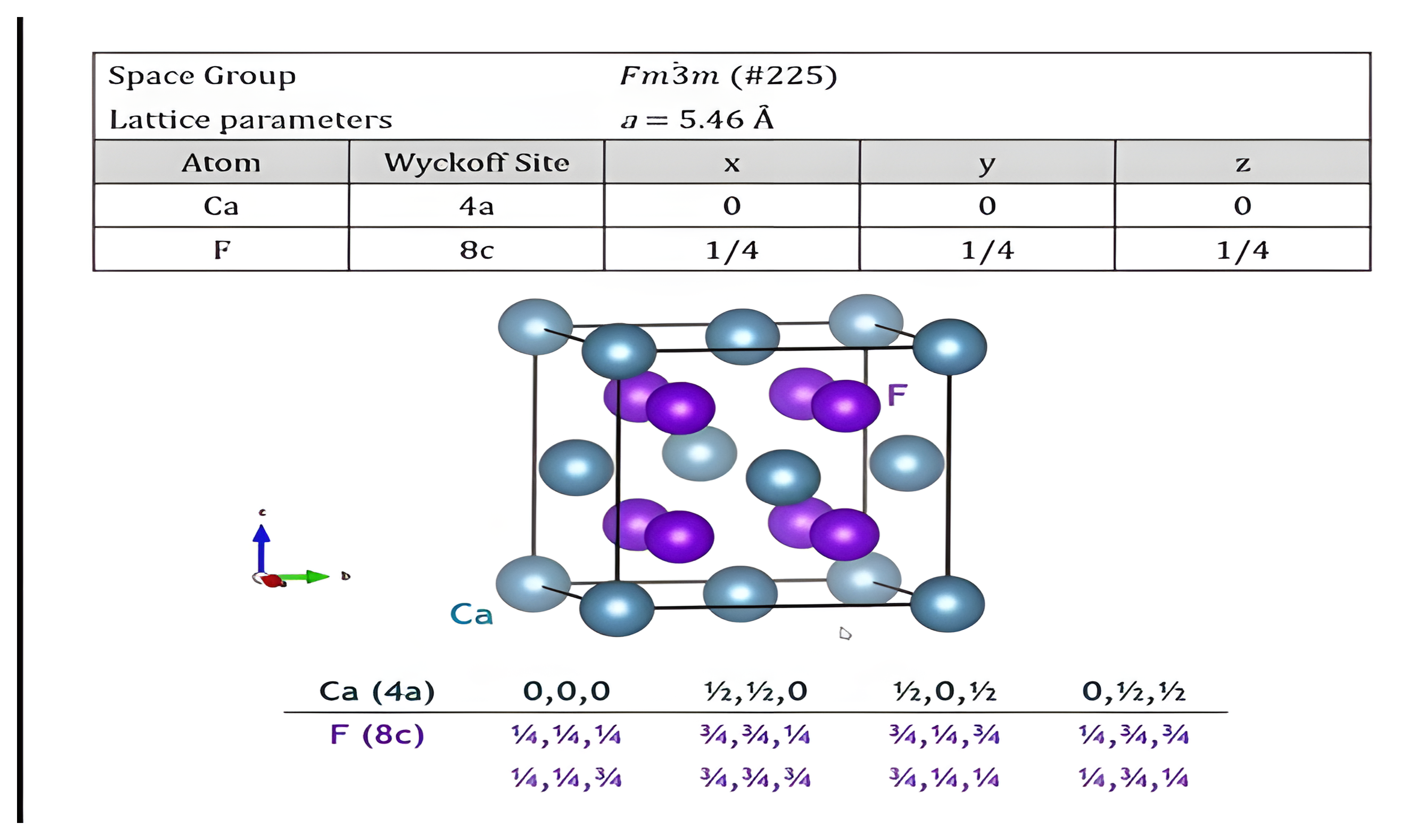
Fluorite is the example I will use, and everything we need for it fits in one table.
Per Solid State Materials Chemistry , §1.1.8.
Fluorite is calcium fluoride, and pure calcium fluoride is colorless.
The purple here is color centers – fluoride vacancies that have trapped an electron
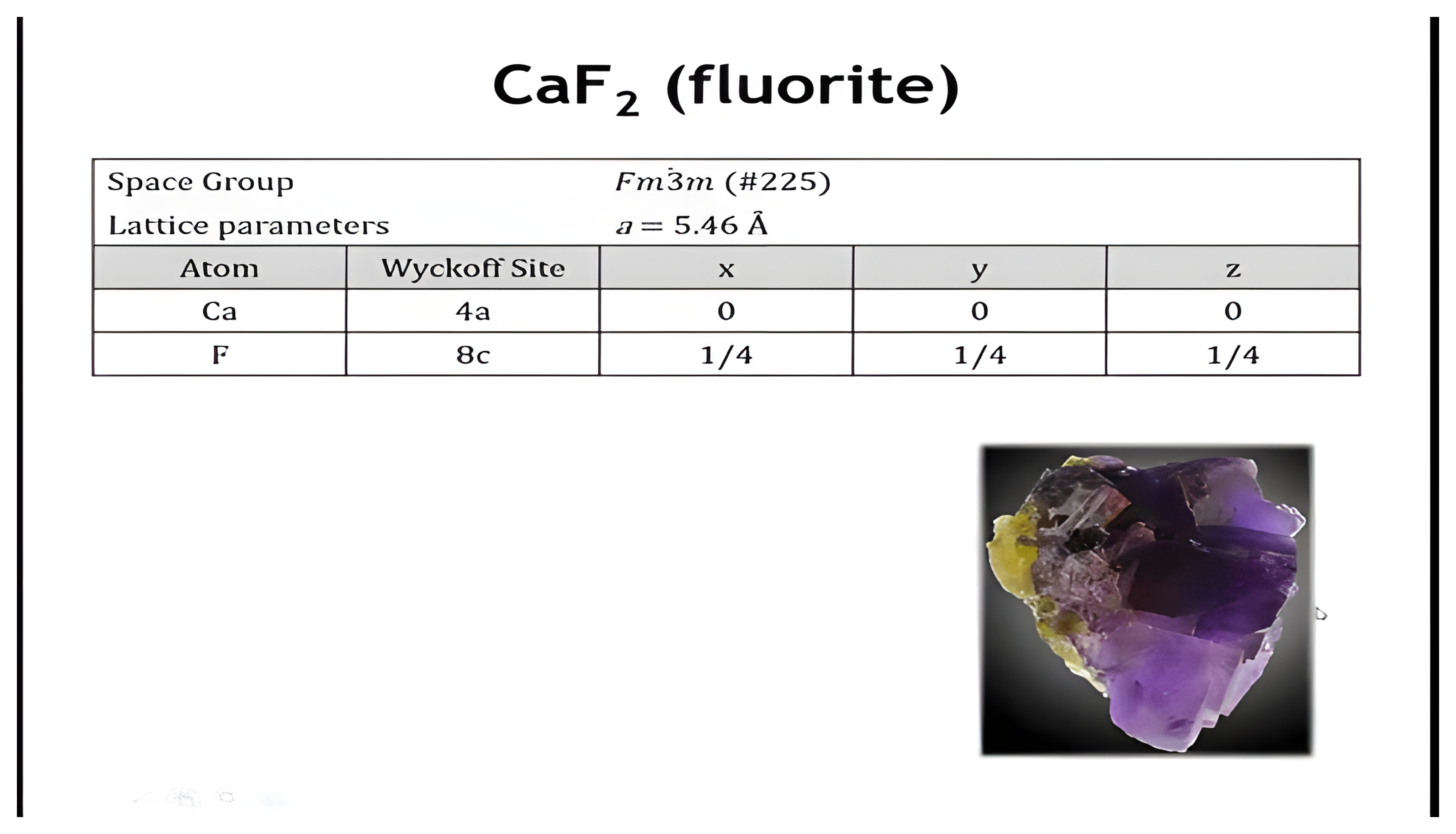
To specify a crystal structure we give four things : the space-group symmetry, the unit cell dimensions, the Wyckoff sites the atoms occupy, and the fractional coordinates of the unique atoms
This table gives all four: space group Fm-3m , entry number 225
Cubic , so we need only one number: a = 5.46 ÅCa on Wyckoff site 4a – one of those four atoms is at the origin
F on site 8c – one of those eight atoms is at ¼,¼,¼
Next, I will unpack the symmetry notation in this table.
How to read the notation (Hermann–Mauguin) Fm3̅m
For cubic point groups the three symbol positions map to fixed direction families. The full symbol for m-3m is:
$4/m$
$\bar{3}$
$2/m$
$\langle 100\rangle$: $4/m$ three 4-fold axes along x, y, z, each with a mirror plane ⊥ to the axis, the {100} mirrors
$\langle 111\rangle$: $\bar{3}$ four body-diagonal 3-fold rotoinversion axes, each running through opposite cube corners
$\langle 110\rangle$: $2/m$ six 2-fold axes along the face diagonals, each with a mirror plane ⊥ to the axis, the {110} mirrors
$m\bar{3}m$ the condensed symbol drops the explicit “4/” and “2/” because those rotations are implied by the mirrors and $\bar{3}$
For cubic point groups each of the three positions in the symbol stands for one family of directions in the cube.
The full symbol for m-3m is 4/m −3 2/m
[advance: the first position]
First position, 4 over m , the cube axes: three 4-fold axes along x, y, and z, each with a mirror plane ⊥ to it, the {100} mirrors
[advance: the second position]
Second position, −3 , the body diagonals: four 3-fold rotoinversion axes, each through a pair of opposite cube corners
[advance: the third position]
Third position, 2 over m , the face diagonals: six 2-fold axes along those diagonals, each with a mirror plane ⊥ to it, the {110} mirrors
[advance: the condensed symbol]
We usually write the condensed m-3m , which drops the explicit 4 and 2 because the mirrors and the −3 already imply those rotations
I will now use the Wyckoff table to generate the atoms in fluorite.
International Tables for Crystallography, Vol. A, entry No. 225, pp. 664, 666.
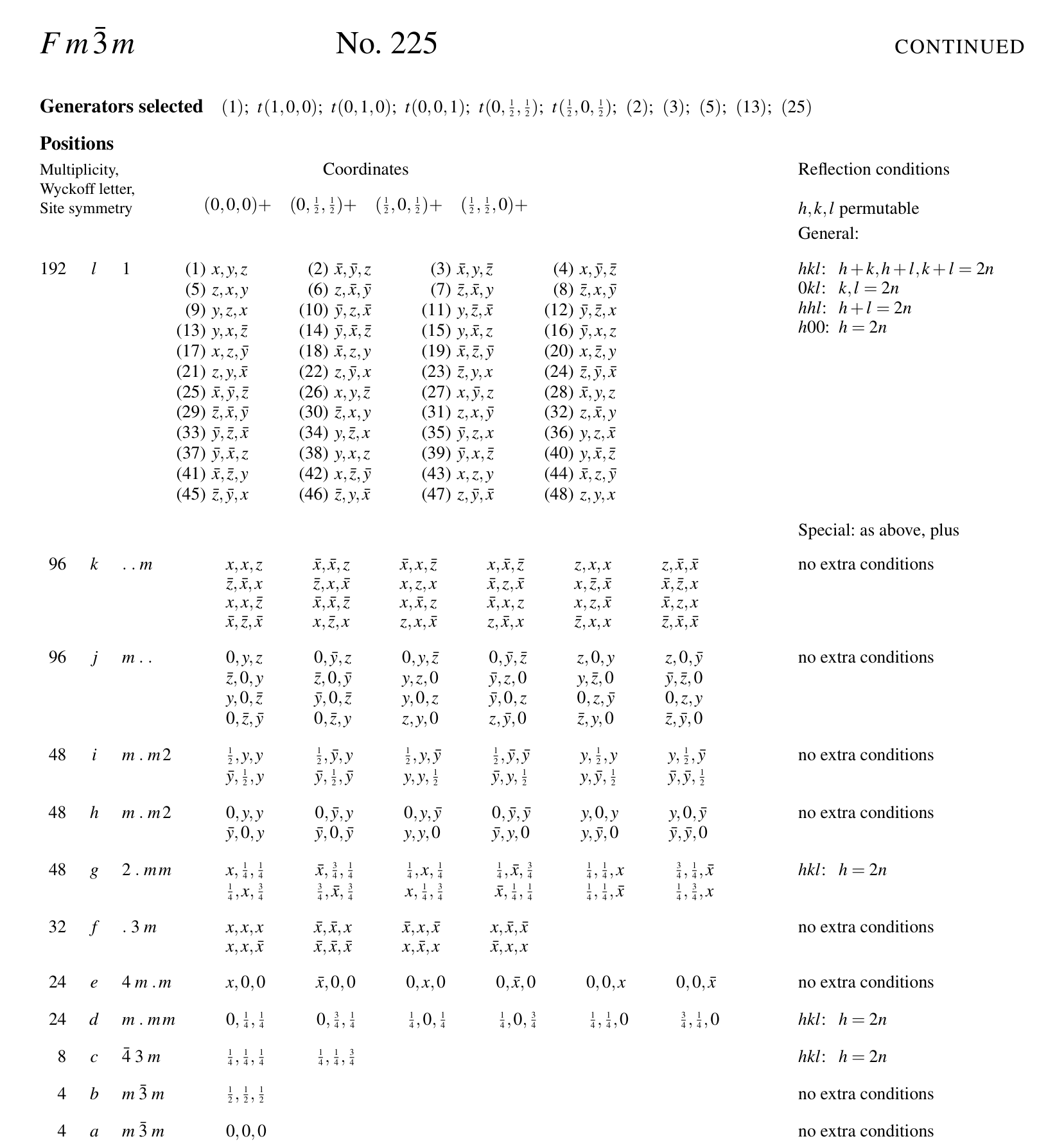
Here is the whole Positions page for space group 225. Eleven Wyckoff sites sit on it, each one a set of points held in place by a symmetry element, and the print is too small to read from a seat, so every click enlarges the piece I am talking about.
[advance: mark the header]
The header names the group three ways: the symbol Fm-3m , the entry number 225 , and the point group m-3m
[advance: mark the centering shifts]
The four shifts on this line are what the F in Fm-3m means: every coordinate below appears four times, once at the origin and once at each of the three face centers
[advance: mark the general position]
The general position has a multiplicity of 192
We cannot fit 192 atoms into a cube 5.46 Å on a side, so fluorite's atoms sit on special positions
[advance: mark the two fluorite rows]
Out of all eleven, fluorite needs only the two rows at the bottom of the page: one for calcium and one for fluoride
[advance: reveal the fluorite sites]
Fluorite fills 4a and 8c
The 4a row lists one coordinate, the origin; its multiplicity of four comes from the four centering shifts at the top of the page
Calcium alone on 4a would be a face-centered cubic metal ; in fluorite we also have the eight fluorides on 8c
Next, I will draw the unit cell that these two sites generate.
(0,0,0)
(½,½,0)
(½,0,½)
(0,½,½)
8 F inside the cell: (¼,¼,¼)-type positions
If we draw the unit cell with every atom that lies fully or partly inside it, we get this picture. A calcium atom sits at the origin, and the three centering shifts put calcium at (½,½,0), (½,0,½), and (0,½,½) as well.
The rest of the calcium in the picture comes from translational symmetry : integer multiples of the cell vectors added to those four positions
We can always add or subtract an integer to bring an atom back inside the cell
[advance: reveal fluoride positions]
Eight fluorides in the cell; the 8c row gives two of them, (¼,¼,¼) and (¼,¼,¾)The centering vectors generate the other six: (¼,¼,¾) plus (½,0,½) is (¾,¼,1¼)
Subtract one from z and that atom is at (¾,¼,¼), inside the cellWork through the shifts: every combination of ¼ and ¾ in the three coordinates, eight positions in all
[advance: reveal the polyhedral representation]
We can also draw the structure as polyhedra
Each calcium sits in a cube of eight fluorides , which is why its site symmetry on 4a is m-3m , the full symmetry of a cube
Each fluoride sits in a tetrahedron of four calciums , site symmetry -43m
12 atoms in the cell, but we specify only the symmetrically distinct ones, the asymmetric unit , or the motif from lecture one
Next, I will calculate density from this unit cell.
Calculations of Theoretical Density
The fluorite cell. Four calcium per cell, red, on the face-centered sites and eight fluoride, blue, in the tetrahedral holes.
Ca on 4a: 4 F on 8c: 8 Z = 4, so 4 Ca + 8 F
The Wyckoff multiplicities give the cell contents.
Density is the mass of the atoms in the cell over the cell volume. From the Wyckoff multiplicities the cell holds four CaF$_2$: 4 Ca and 8 F.
$\text{mass} = 4(40.08) + 8(19.00) = 312.32\ \text{amu} = \dfrac{312.32}{6.022 \times 10^{23}}\ \text{g} = 5.186 \times 10^{-22}\ \text{g}$
$\text{volume} = a^3 = (5.46 \times 10^{-8}\ \text{cm})^3 = 1.628 \times 10^{-22}\ \text{cm}^3$
$\text{density} = \dfrac{5.186 \times 10^{-22}\ \text{g}}{1.628 \times 10^{-22}\ \text{cm}^3} = 3.19\ \text{g/cm}^3$
Density is the mass of the atoms within the unit cell divided by the unit cell volume, and the density of one unit cell is the density of the whole crystal, because the crystal is that cell repeated. So the contents of the cell and its dimensions are all we need for a theoretical density.
[advance: count the atoms in the unit cell]
From the Wyckoff site multiplicities we see that there are four CaF₂ formula units within the unit cell, Z equals four; four calcium and eight fluorine
[advance: add up their mass]
Four times 40.08 amu plus eight times 19.00 amu is 312.32 amu
Dividing by 6.022 × 10²³ amu per gram turns that into 5.186 × 10⁻²² g
[advance: calculate the unit-cell volume]
The edge is 5.46 × 10⁻⁸ cm, so the volume is that cubed; 1.628 × 10⁻²² cm³
Unit cell volumes for other minerals are tabulated at webmineral.com , under help and cell dimensions
[advance: reveal the density]
5.186 × 10⁻²² g over 1.628 × 10⁻²² cm³ is 3.19 g/cm³
Water is about 1 g/cm³ and the densest elements are near 20 g/cm³, so 3.19 is a reasonable density for a mineral
Run it backward : from a measured density you can get the number of formula units in an unknown cell
Next, I will use a drawing program to see the structure.
Crystal Structure Drawing Programs
There are several crystal structure programs, and we will use VESTA.
VESTA is free, runs on every platform, and is the one I will use whenever I draw a structure in this courseDiamond and CrystalMaker are the two commercial alternatives, and both do the same job: measuring distances and angles, and building polyhedral views
Next, I will summarize how this notation represents a crystal structure.
Summary - Representing Crystal Structures (Example: CaF₂ )
Why compact representations?
Unit cells can contain many atoms → instead of listing all positions, we use space group symmetry, unit cell dimensions, and Wyckoff positions + fractional coordinates of unique atoms.
Case study: Calcium Fluoride (CaF₂)
Space group Fm-3m (#225) , cubic, a = 5.46 Å; Ca at Wyckoff 4a (0,0,0), F at 8c (¼,¼,¼).
Multiplicities & centering operations generate all atoms in the unit cell. Ca in a cubic (octahedral) environment; F in a tetrahedral environment.
Density and tools
4 CaF₂ units per cell → 4 Ca + 8 F = 312.32 amu = 5.19 × 10⁻²² g; cell volume (5.46 × 10⁻⁸ cm)³ = 1.63 × 10⁻²² cm³; density = 3.19 g/cm³ .
Visualization/drawing: VESTA (free) , CrystalMaker, Diamond; useful for measuring distances/angles & building polyhedral views.
We started from the problem that one unit cell can hold hundreds of atoms.
[advance: the compact description]
Rather than list every position: space group symmetry , unit cell dimensions , and Wyckoff positions with the fractional coordinates of the unique atoms
[advance: the calcium fluoride case study]
Calcium fluoride: space group Fm-3m (#225) , cubic, a = 5.46 Å; Ca on Wyckoff 4a (0,0,0), F on 8c (¼,¼,¼)
Multiplicities and centering operations generate every atom in the cell; Ca in a cube of eight fluorides, F in a tetrahedron of four calciums
[advance: the density and the tools]
Four CaF₂ units per cell: 4 Ca and 8 F = 312.32 amu = 5.19 × 10⁻²² g
Cell volume (5.46 × 10⁻⁸ cm)³ = 1.63 × 10⁻²² cm³, so the density is 3.19 g/cm³ , reasonable for a mineral solid
Tools: VESTA (free) , CrystalMaker, Diamond – measuring distances and angles and building polyhedral views
I will now begin the metallic-solids part of the lesson.
Learning Objectives
Three classes sort an extended solid into the metallic, ionic, or covalent-network class from its bonding and its structure
Packing in a plane explain the densest packing of atoms in one plane and how it extends into three dimensions
HCP versus CCP tell hexagonal close packing from cubic close packing by the ABAB and ABCABC stacking sequences
Metallic unit cells describe the FCC, BCC, and primitive cubic cells and compare their coordination numbers and packing efficiencies
Periodic trends recognize how the preferred metal structure varies across the periodic table and how it follows bonding and band filling
Variations identify other stackings such as ABAC, ordered compounds such as CsCl and Cu₃Au, and high-coordination structures such as SmCo₅
By the end of today you should be able to sort an extended solid into metallic, ionic, or covalent-network from its bonding and its structure.
Classify an extended solid as metallic, ionic, or covalent-network from its bonding and its structureExplain packing in metals : densest packing in a plane, and how it carries into three dimensionsTell HCP from CCP by their stacking sequences, ABAB vs ABCABCDescribe the metallic unit cells (FCC, BCC, primitive cubic) and compare coordination numbers and packing efficienciesRecognize the periodic variation in which structure a metal takes, and its link to bonding and band fillingIdentify the variations : other stackings (ABAC), ordered compounds (CsCl, Cu₃Au), high coordination (SmCo₅)
I will start by separating the three classes of extended solid.
Extended Solids
Metallic Solids (Al, Fe, …)
Bonding: Atoms held together by delocalized metallic bonding
Structural Attributes: Closely packed atoms (large coordination numbers, symmetric structures)
“Ionic” Solids (Al₂O₃, CaF₂, …)
Bonding: Atoms held together by electrostatic attractions between ions of opposite charge
Structural Attributes: Symmetric structures that maximize cation-anion interactions, but minimize cation-cation and anion-anion interactions
Covalent-Network Solids (WO₃, C, SiO₂, …)
Bonding: Extended networks of atoms held together by covalent bonds
Structural Attributes: Lower coordination numbers and densities than metallic and ionic solids
With crystallographic symmetry in hand we can talk about the structures of extended solids, the ones that are not built from discrete molecules.
[advance: metallic solids]
Electrons delocalized over the crystal, so the bonding has no direction
Atoms pack as closely as they can: large coordination numbers , symmetric structures (Al, Fe)
[advance: ionic solids]
Electrostatic attraction between ions of opposite chargeMaximize cation-anion contact, keep like charges apart: symmetric, large CN but smaller than the metals (Al₂O₃, CaF₂)
[advance: covalent-network solids]
Extended networks of localized, directional covalent bonds
Each atom takes only the neighbors its bonding allows: lowest CN and density of the three (C, SiO₂, WO₃)
The rest of today is about the metallic solids, starting with how spheres pack in a plane.
Close packed structures
Spheres form a close packed hexagonal layer
→
Second layer sits in the depressions marked B
Hexagonal close packing (ABAB…)
Cubic close packing (ABCABC…)
Take the metals and treat the atoms as hard spheres.
Densest 2D arrangement: every sphere touches six others, a close-packed hexagonal layer
Spheres = A ; the two sets of depressions = B and C , too close together for both to fill
[advance: the second layer in the B depressions]
Second layer over B: stacking is A then B , the only dense choice with two layers
The third layer is where the choice appears: back over A , or into C
[advance: the third layer over the A spheres]
Repeats every second layer, ABAB : hexagonal close packing
[advance: the third layer over the C depressions]
Repeats every third layer, ABCABC : cubic close packing, filling space equally well
In the layer: B and C depressions on three-fold axes, spheres on six-fold axes, so the layer is hexagonal and stacking straight up keeps that
Getting a cube out of the same layers takes more work to see
Next I will build the unit cell that ABAB stacking makes.
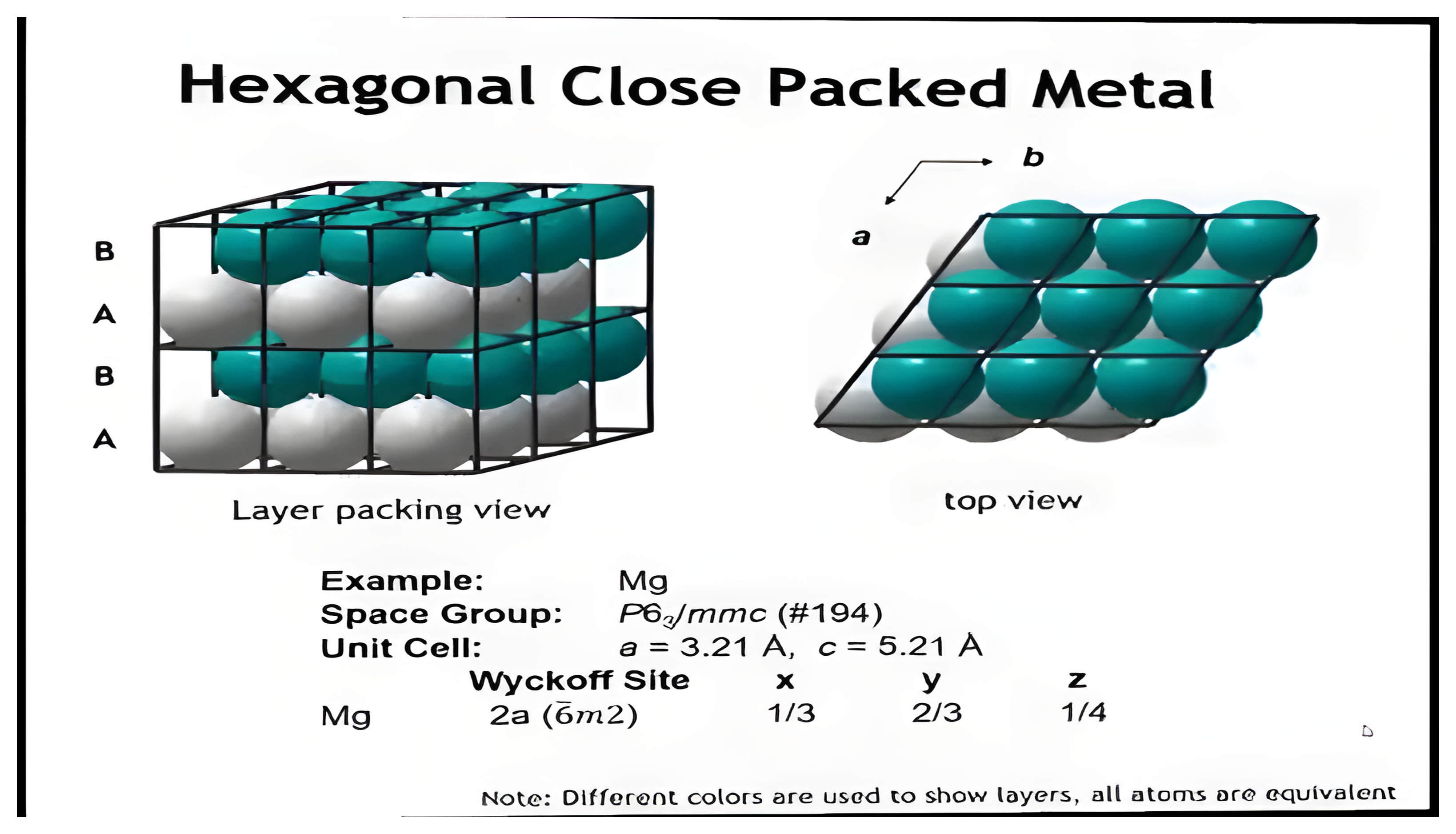
CN 12 · 74% packed
This is a hexagonal close-packed metal.
Cell holds two atoms , one from layer A and one from layer B
Related by a 6₃ screw axis : rotate the gray layer 60°, translate up half the cell, land on the green layer
So both atoms are crystallographically equivalent: one Wyckoff site
CN 12 (6 in the layer, 3 above, 3 below), 74% of space filled
Next I will build the cubic cell out of the same layers.
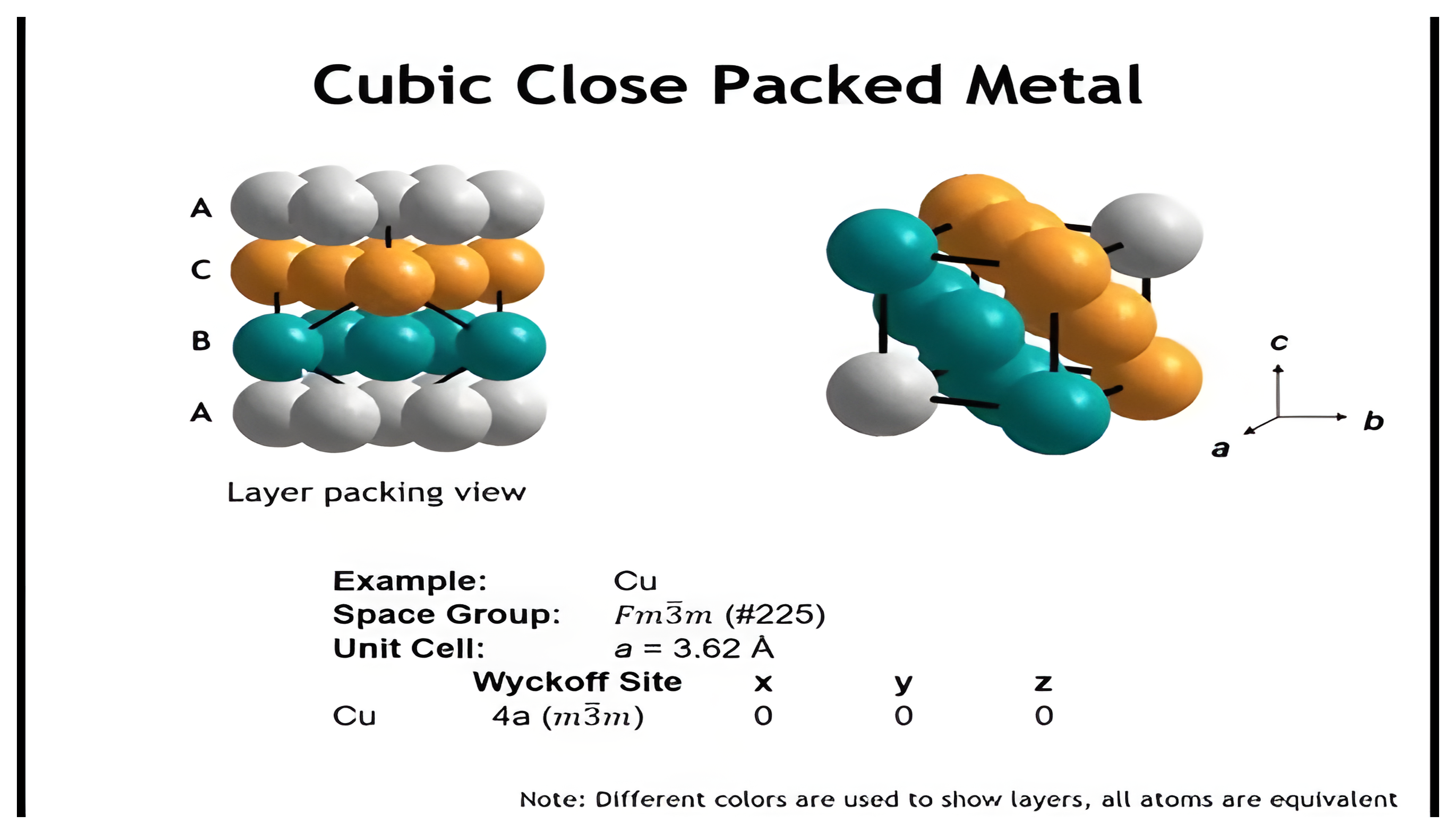
CN 12 · 74% packed
The way to get a cube out of hexagonal layers is to remember that a cube carries a three-fold rotation axis along its body diagonal.
Look down the ABC stacking direction and that is the axis you are looking down
Walk the body diagonal: A to B to C and back to A
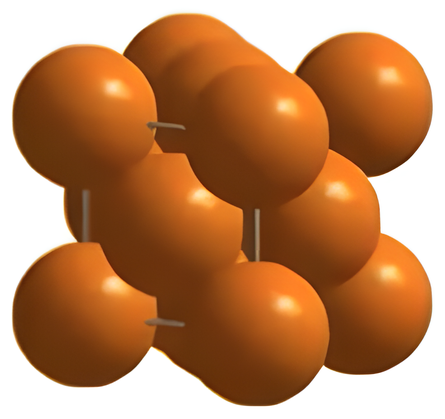
Atoms on every corner and every face: the face-centered cubic cell, space group Fm-3m , all atoms equivalent, one Wyckoff site
Same as HCP: CN 12 , 74% filled. Only the stacking differs
Next I will compare this with the cubic metals that are not close packed.
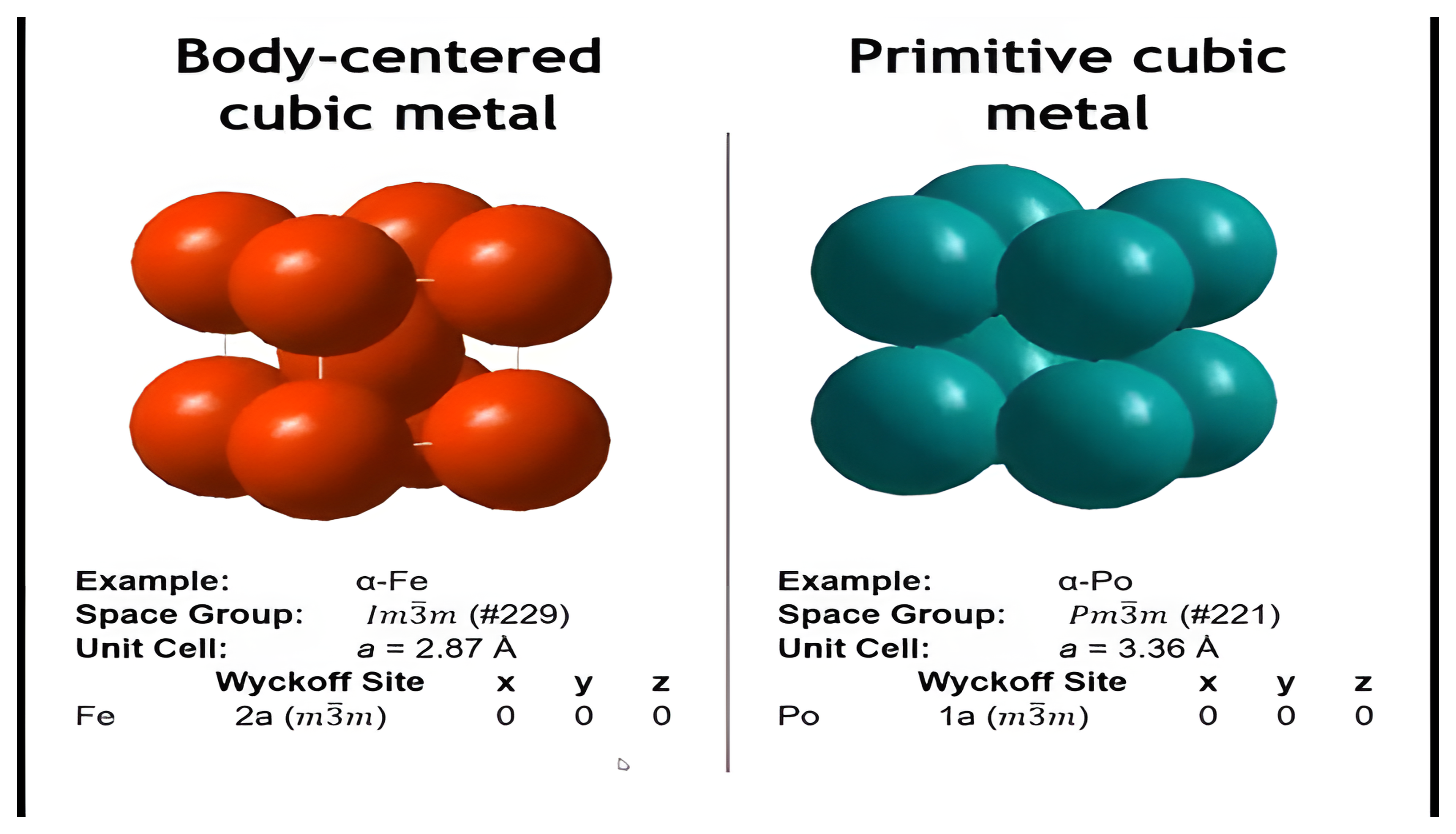
CN 8 · 68% packed CN 6 · 52% packed
Two other cubic metal structures show up.
Body-centered cubic : atom at the cube center as well as the corners, α-FePrimitive cubic : corners only, polonium
CCP and HCP: CN 12 (6 in plane, 3 above, 3 below), 74%
BCC: CN 8 , a cube of neighbors, 68%
PC: CN 6 , an octahedron of neighbors, 52%
[advance: the comparison table]
Efficiency and density fall: close packed → body centered → primitive
Site symmetry does not fall: all three cubic structures put the atom on m-3m , because the cuboctahedron of 12, the cube of 8, and the octahedron of 6 all have it
Next I will show where those three percentages come from.
How full is cubic close packing?
The face-centered cubic cell with the atoms drawn small. The gold plane is the face shown at the right.
a a a√2 = 4r The face at true size. The corner atoms touch the face-center atom.
The face is a square of side $a$, so the diagonal is $d^2 = a^2 + a^2 = 2a^2$ and $d = a\sqrt2$.
The atoms touch along the diagonal, so $4r = a\sqrt2$ and $r = a\sqrt2/4$. The cell holds four atoms.
Cube the radius: $r^3 = \left(\dfrac{a\sqrt2}{4}\right)^3 = \dfrac{2\sqrt2}{64}\,a^3 = \dfrac{\sqrt2}{32}\,a^3$.
$\dfrac{4 \cdot \frac{4}{3}\pi r^3}{a^3} = \dfrac{4 \cdot \frac{4}{3}\pi \cdot \frac{\sqrt2}{32}\,\textcolor{#ff6b6b}{\cancel{a^3}}}{\textcolor{#ff6b6b}{\cancel{a^3}}} = \dfrac{\pi\sqrt2}{6} = 74\%$
cubic close packed · 74% body-centered primitive
We have said close packing fills 74% of space. Here is where that number comes from, and it is one question: which direction do the atoms touch along?
In the face-centered cubic cell nothing touches along the edge and nothing touches along the body diagonal . The contact runs across the face , corner to face center to corner
On the right that face is drawn at true size, with the three spheres in contact and the triangle we are about to solve
[advance: Pythagoras on the face]
The face is a square of side a , so both legs of the triangle are a and the diagonal is the hypotenuse
d² = a² + a² = 2a², so d = a√2. That is the whole of the geometry on this slide
[advance: turn the diagonal into a radius]
Four radii span that diagonal, so r = a√2/4
Count the cell contents: eight corners shared eight ways and six faces shared two ways, four atoms
[advance: substitute the radius]
Cube it: r³ = (a√2/4)³ = (√2/32) a³, since (√2)³ = 2√2 and 4³ = 64
The radius is gone and a number times a³ has taken its place, and a³ is exactly what the cell volume is
[advance: the efficiency]
Four of those spheres on top, the cell volume a³ underneath: the a³ sits on the top and on the bottom , so we cross both of them out
What is left is π√2/6, a pure number with no a in it, 74% , the same for copper as for gold
Hexagonal close packing gives 74% as well : same twelve neighbors, same contacts, only the stacking differs
Next, the same question for a cell that is not close packed.
How full is body-centered cubic?
The body-centered cubic cell. The gold plane is the diagonal section shown at the right.
a√2 a a√3 = 4r The section at true size, $a\sqrt2$ by $a$. The corner atoms touch the center atom.
The face diagonal is $f^2 = a^2 + a^2 = 2a^2$. The body diagonal is the hypotenuse of the triangle with legs $f$ and $a$, so $d^2 = 2a^2 + a^2 = 3a^2$ and $d = a\sqrt3$.
The atoms touch along the body diagonal, not across the face, so $4r = a\sqrt3$ and $r = a\sqrt3/4$. The cell holds two atoms.
Cube the radius: $r^3 = \left(\dfrac{a\sqrt3}{4}\right)^3 = \dfrac{3\sqrt3}{64}\,a^3$.
$\dfrac{2 \cdot \frac{4}{3}\pi r^3}{a^3} = \dfrac{2 \cdot \frac{4}{3}\pi \cdot \frac{3\sqrt3}{64}\,\textcolor{#ff6b6b}{\cancel{a^3}}}{\textcolor{#ff6b6b}{\cancel{a^3}}} = \dfrac{\pi\sqrt3}{8} = 68\%$
cubic close packed · 74% body-centered · 68% primitive
Body-centered cubic asks the same question and gets a different answer, because the contact moves.
Look at a face of this cell: corner atoms only, and they do not reach each other
The atoms touch through the body , corner to center to corner, so the plane to cut is the diagonal section , the gold one on the left
That section is a rectangle, a√2 wide and a tall, and it holds four corner atoms and the body-center atom
[advance: Pythagoras, twice]
First on a face, exactly as before: f² = a² + a² = 2a², so the face diagonal is a√2, which is the long side of the section
Now the triangle in the section itself, legs f and a: d² = 2a² + a² = 3a², so the body diagonal is a√3
Two right triangles, one after the other, is the whole trick for any body diagonal
[advance: turn the diagonal into a radius]
Four radii span it, so r = a√3/4
Cell contents: eight corners shared eight ways plus the center, two atoms
[advance: substitute the radius]
Cube it: r³ = (a√3/4)³ = (3√3/64) a³, since (√3)³ = 3√3
Again the radius turns into a number times a³ , the same a³ the cell volume is
[advance: the efficiency]
Two of those spheres on top, a³ underneath: the a³ is on the top and on the bottom , so we cross both out
That leaves π√3/8, which is 68% : less than close packing, and the eight neighbors instead of twelve say the same thing
Next, the loosest of the three.
How full is primitive cubic?
The primitive cubic cell, corner atoms only. The gold plane is the face shown at the right.
a = 2r The face at true size. The corner atoms touch along the edge.
The atoms touch along the cell edge, so there is no triangle to solve.
The edge is two radii, so $2r = a$ and $r = a/2$. The cell holds one atom.
Cube the radius: $r^3 = \left(\dfrac{a}{2}\right)^3 = \dfrac{a^3}{8}$.
$\dfrac{1 \cdot \frac{4}{3}\pi r^3}{a^3} = \dfrac{\frac{4}{3}\pi \cdot \frac{1}{8}\,\textcolor{#ff6b6b}{\cancel{a^3}}}{\textcolor{#ff6b6b}{\cancel{a^3}}} = \dfrac{\pi}{6} = 52\%$
cubic close packed · 74% body-centered · 68% primitive · 52%
Primitive cubic is the easiest case and the emptiest structure.
Corner atoms only, and they touch along the edge itself
[advance: no triangle this time]
There is nothing to solve. The contact lies along the cell edge, so the edge is two radii , which is why this is the case you can do in your head
[advance: the radius and the count]
r = a/2, and eight corners shared eight ways leaves one atom in the cell
[advance: substitute the radius]
Cube it: r³ = (a/2)³ = a³/8, a number times a³ once more
[advance: the efficiency]
One sphere on top, a³ underneath: the a³ is on the top and on the bottom , so we cross both out
That leaves π/6, which is 52% . Nearly half the space is empty, which is why polonium is the only element that takes it
Read the three off the strip: 74, 68, 52 , falling as the contact moves from the face to the body to the edge
Nothing here was memorized. Each number came from one contact direction, one or two right triangles, and a count of atoms in the cell
Next I will look at which of these structures the elements actually take.
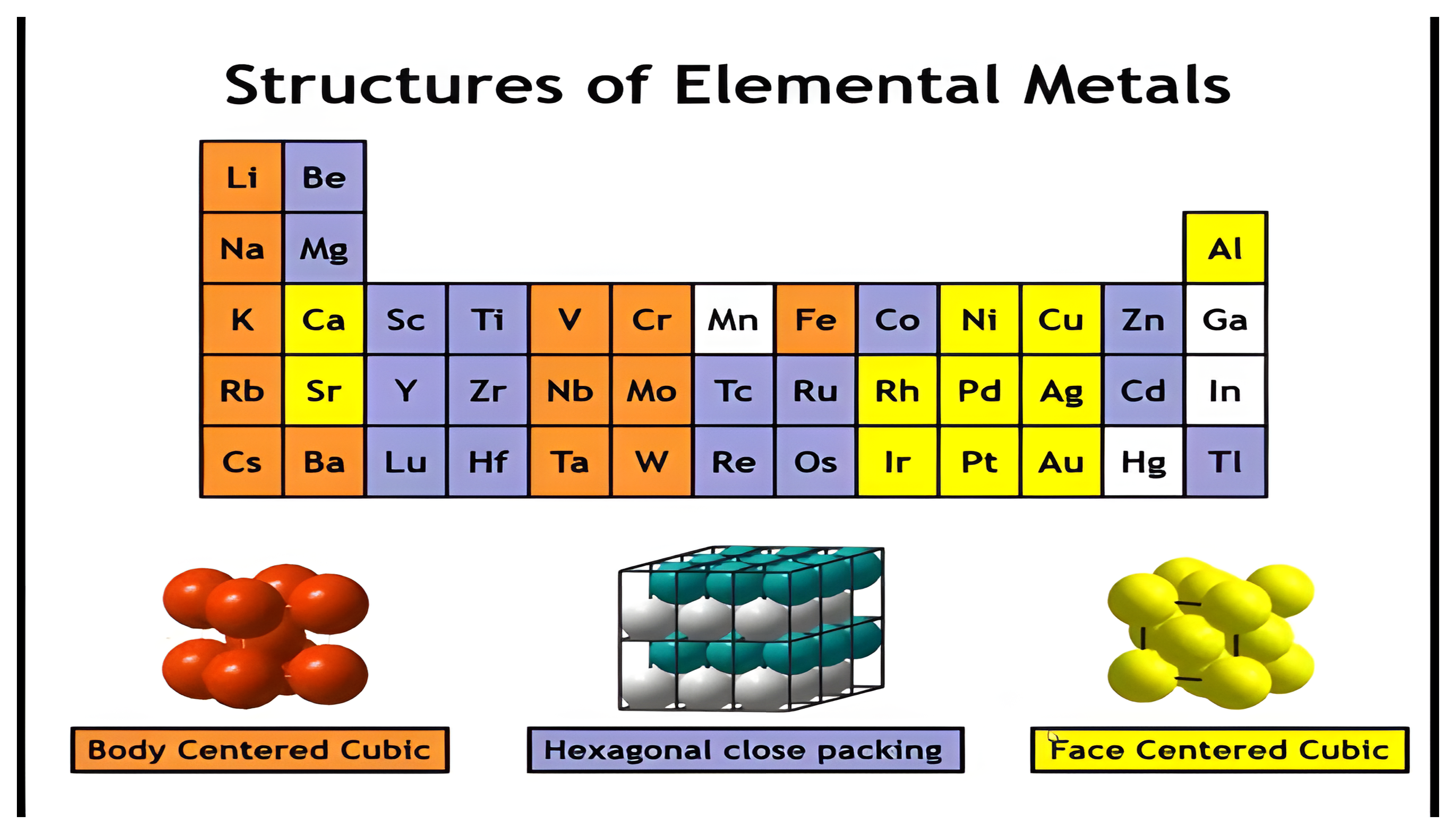
You would expect metals to go close packed, since face-centered cubic and hexagonal close packing both fill space as tightly as spheres can.
That is not what the elements do.
BCC , at 68% rather than 74%, is nearly as common as either close packingWhich structure a metal takes varies in a periodic way across the table
The decider is the detail of metallic bonding and band filling , not packing efficiency, and it does not reduce to a simple rule
Next I will show a close-packed metal whose stacking is neither of the two simple sequences.
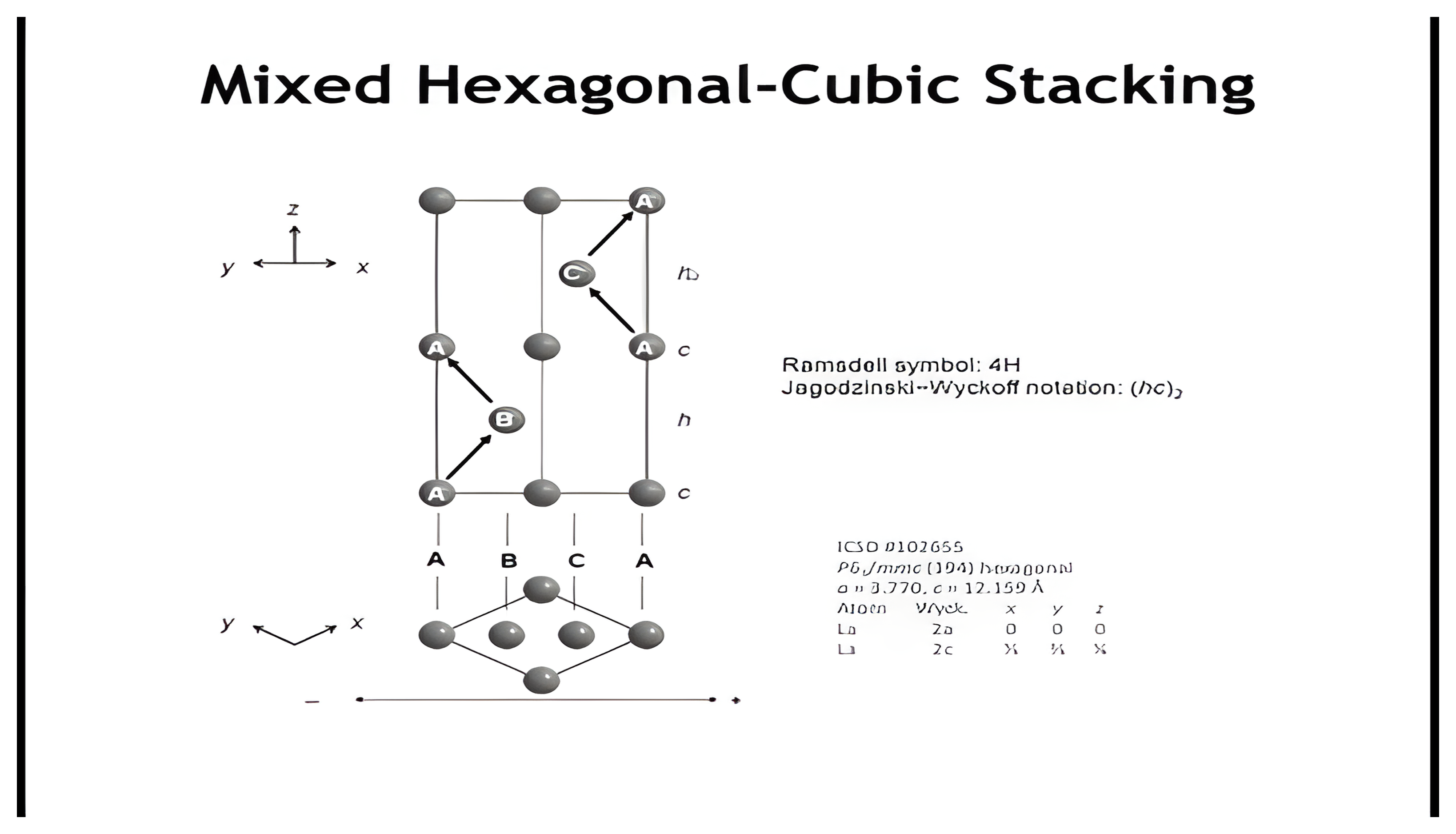
Some close-packed metals stack in a sequence that is neither ABAB nor ABCABC.
Lanthanum stacks ABAC : still close packed, but the repeat takes four layers. Other rare earths do the same
Ramsdell symbol : layers in the repeat plus the lattice letter. ABAC is 4H , space group P6₃/mmcJagodzinski-Wyckoff notation : same letter above and below → h ; different letters → c
Walk the four layers, remembering the sequence repeats:
First A : C below, B above → c
B : A below, A above → hSecond A : B below, C above → c
C : A below, A above → hRepeat is c h c h, written (hc)₂
Next I will keep the lattice and change the atoms on it.
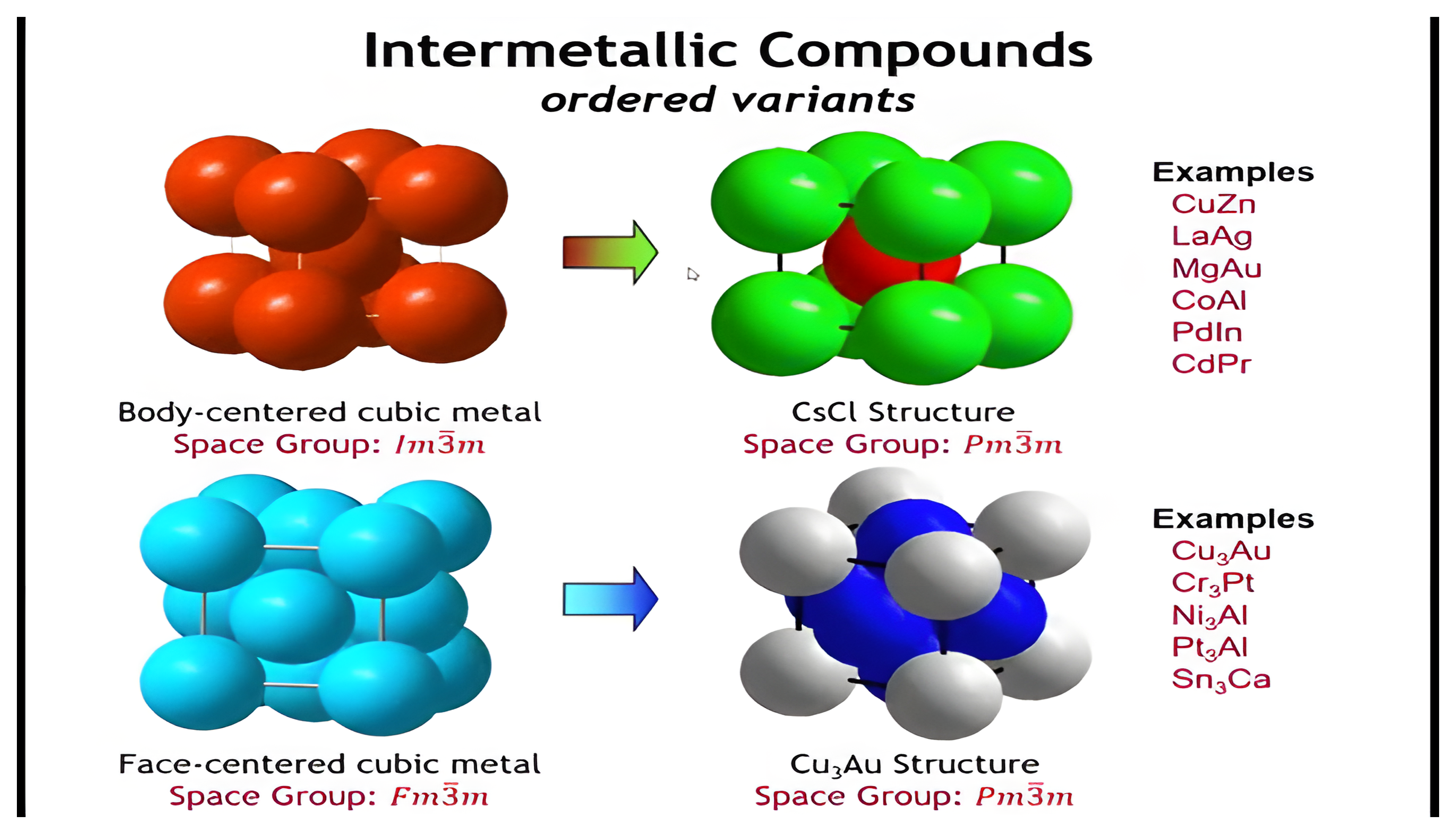
Some metals build ordered intermetallic structures by keeping the framework of a simple metal structure and putting different elements on different sites.
From BCC, body center a different element from the corners: the CsCl structure . CsCl is ionic, but PdIn and MgAu are metals that take it
Center and corners now differ, so the centering operation is gone: the lattice is primitive cubic , not body centered
From FCC, Au and Cu at 3:1 order into Cu₃Au , Au on the corners, Cu on the faces
The point: fixed composition and long-range order , which is what separates these from a random alloy
Next I will finish the metals with a structure that has an unusually high coordination number.
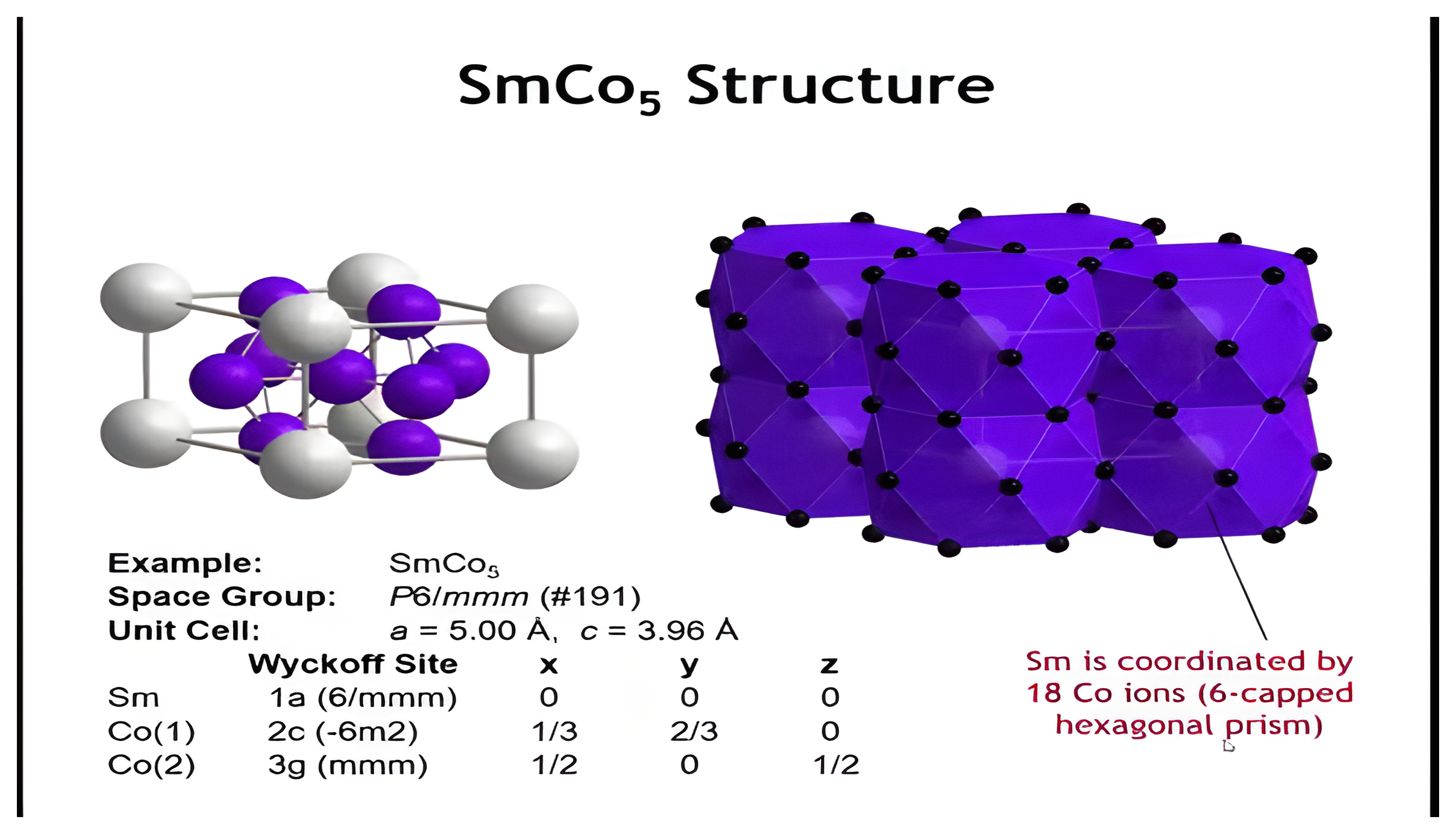
SmCo₅ is worth stopping on, both because it is an important permanent magnet and because of how many neighbors the samarium gets.
Hexagonal cell: one Sm at the origin and five Co
Count around one Sm: a hexagon of 6 Co above , a hexagon of 6 below , and each of the six vertical prism faces capped by another Co
6 + 6 + 6 = 18 : a capped hexagonal prism, about as high as coordination numbers get
Next I will pull the extended solids together.
Summary: Extended Solids
Three classes
Metallic, ionic, and covalent-network solids differ in what holds the atoms together, and that bonding sets the structure. Delocalized electrons pack atoms densely at high coordination numbers, electrostatic attraction builds symmetric structures that keep like charges apart, and localized covalent bonds give the lowest coordination numbers and densities.
Variations and intermetallics
Lanthanum and other rare earths stack ABAC, as densely as either simple sequence: Ramsdell symbol 4H, Jagodzinski-Wyckoff notation (hc)₂. Ordering two metals on one framework gives CsCl-type PdIn and MgAu from BCC, and Cu₃Au from FCC. SmCo₅ puts 18 cobalt neighbors around each samarium.
What decides the structure
Band filling and the details of metallic bonding decide it, not packing efficiency alone. BCC is about as common among the elements as either close packing.
Extended solids come in three classes, metallic, ionic, and covalent-network, and the bonding sets the structure.
Delocalized electrons pack metals densely at high CN, electrostatic attraction builds symmetric ionic structures that keep like charges apart, localized covalent bonds give the lowest CN and density
Four metal unit cells: CCP/FCC ABCABC, CN 12, 74% · HCP ABAB, CN 12, 74%, two atoms per cell · BCC CN 8, 68% · primitive cubic CN 6, 52%
Variations: rare earths stack ABAC = Ramsdell 4H = Jagodzinski-Wyckoff (hc)₂
Ordered intermetallics: PdIn, MgAu (CsCl type, from BCC) and Cu₃Au (from FCC); SmCo₅ at CN 18
What settles the choice: band filling and metallic bonding , not packing efficiency alone, which is why BCC holds its own across the table
Next are ionic structures, where the close packing we just used for metals holds the anions and the cations sit in the holes between them.
Ionic Structures
Many ionic structure types can be described as a close packing of anions with cations filling voids or holes in the structure. Generally we will consider two types of holes (for the cations)
Octahedral holes – Voids are surrounded by 6 anions and lead to octahedral coordination of the cationTetrahedral holes – Voids are surrounded by 4 anions and lead to tetrahedral coordination of the cation
Why would anions want to close pack?
For a detailed answer to this question see: M. O’Keeffe, Acta Cryst. A 33 , 924-927 (1977)]
Next, let's look at ionic solid structures, which have a lot in common with metallic solids from a symmetry standpoint.
A useful way to describe them: treat the anions as a close-packed lattice , either cubic close packed (FCC) or hexagonal close packed (HCP)
About 26% of the space in such a lattice is holes, and the cations sit in them
Two types: octahedral holes , with six anion neighbors, and tetrahedral holes , with four
It may seem odd that anions close-pack at all, since like charges repel — the answer is symmetry
As close together as possible gives the same geometric pattern as as far apart as possible, at fixed box volume — either way a uniform, symmetric distribution, and that is close packing
In a real ionic solid the anions do not touch each other — they stay well separated and leave symmetric holes for the cations; cations and anions generally do touch
Let me show you exactly where those two kinds of holes sit.
Octahedral and tetrahedral holes
Every anion has two tetrahedral holes, one pointing up and one pointing down, against one octahedral hole.
Let's take a closer look at what I mean by these holes.
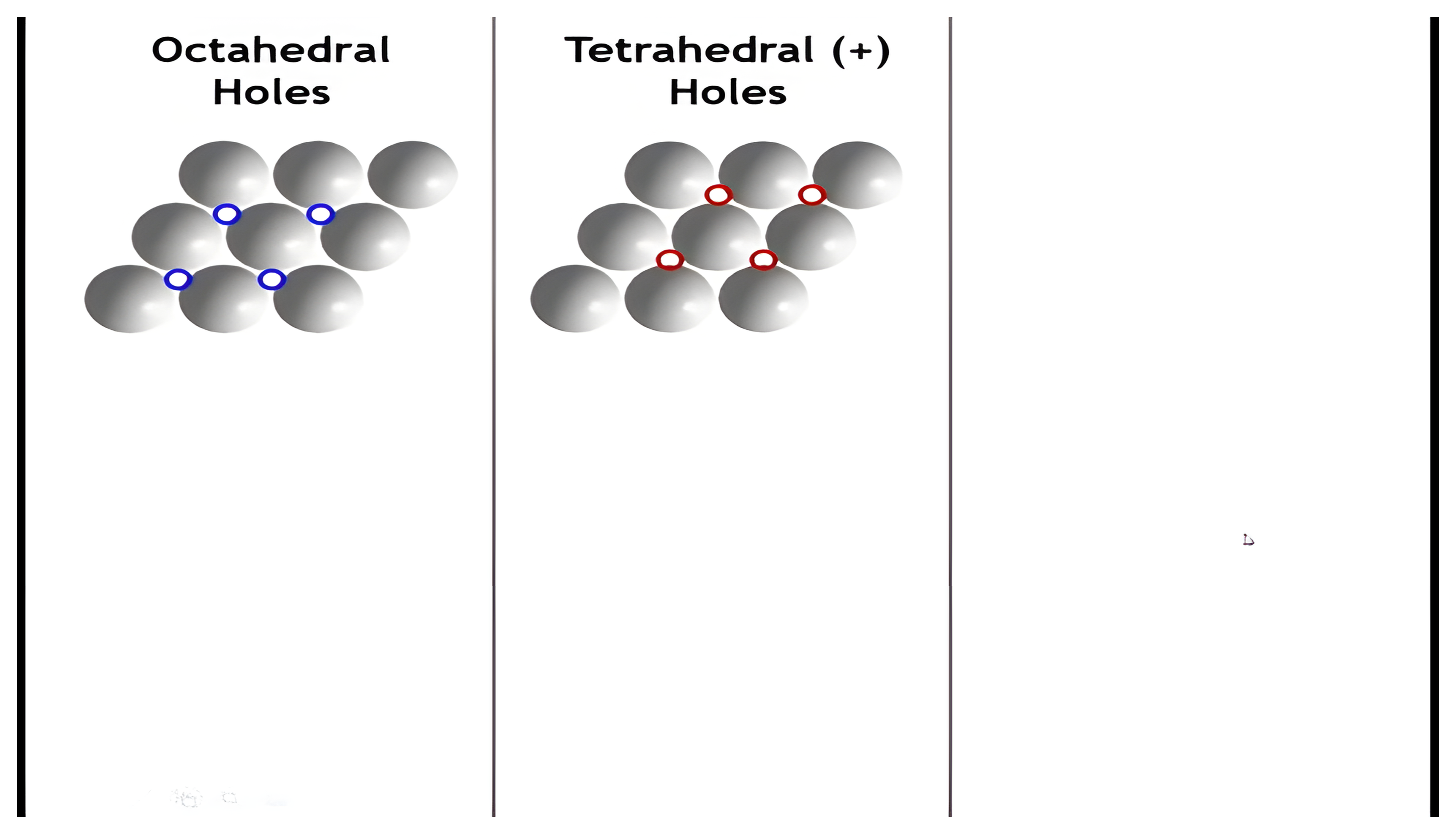
A very small piece of a close-packed layer , let's say anions — we could just as well describe these structures as close-packed cations with the anions in the holes, but conventionally that is not what we do
Now put cations on top: the blue circles on the left are one set of holes, the red circles a different set — blue first
[advance: put cations in the blue voids]
A cation everywhere there is a blue circle — each one nestled up against three anions in the layer below, and those three make a triangle
[advance: add the next anion layer to close the octahedron]
Add the next layer: three more anions in the opposite orientation — the six make a trigonal antiprism, here an octahedron ; in a close-packed array of anions, the number of octahedral holes equals the number of anions
[advance: now put cations in the red depressions]
A different set of depressions on that same layer — still three neighbors below , a triangle of anions nestled up against the cation
[advance: the top layer caps the tetrahedron]
Put the layer on top and an anion goes directly over the cation — triangular base plus one neighbor above, a triangular-based pyramid, which is a tetrahedron ; the cation sits closer to the bottom layer than to the top one so that all four distances come out equal
[advance: the third column: cations directly on top of the anions]
Or put the cations right on top of the anions — counterintuitive at first, but we can do it, and the next layer of anions lands a triangle on top of each cation
[advance: the downward-pointing tetrahedra complete the picture]
Triangular base above, one neighbor below — a tetrahedron too, but it points down ; hence tetrahedral plus and tetrahedral minus holes
The thing to take away: twice as many tetrahedral holes as octahedral holes
[advance: the count behind the two-to-one ratio]
Count around one anion: eight tetrahedral holes touch it, and each of those is shared by four anions — eight over four is two
Six octahedral holes touch it, and each of those is shared by six anions — six over six is one ; two tetrahedral holes per anion against one octahedral hole
Before we decide which holes to fill, it is worth knowing how big they are.
How big a cation fits a cube of 8?
Eight anions at the corners of a cube with the cation at the center, both drawn to the same scale.
1 √2 √3 The same plane at true size. The gold edge is where two anions touch, and the dashed lines run from the cation to an anion.
Take the anion radius as 1, so anions in contact are 2 apart. From the cation to an anion is half an edge across, 1, and half a face diagonal up, $\sqrt2$, so the distance is $\sqrt{1^2 + (\sqrt2)^2} = \sqrt3$.
The anion takes 1 of that $\sqrt3$ and the cation takes the rest.
$r = \sqrt3 - 1 = 0.732$calcium in fluorite
cube of 8 · 0.732 octahedron of 6 tetrahedron of 4
We have put cations into holes without once asking how big a hole is. Hard spheres answer that on their own, and the answer is one number per environment.
The recipe is the same every time: take the anion radius as 1 , so two anions that touch have centers 2 apart, then shrink the cation until those anions just come into contact
Start with the widest environment, the cube of 8 , which is calcium in fluorite from earlier in this lecture
Cut the cube's diagonal plane, the gold one, and everything is in view: two anions touching along the edge, and the cation between them
[advance: Pythagoras from the cation to an anion]
Step from the cation to an anion in two moves , the dashed legs on the right: half an edge across , which is 1, and half a face diagonal up , which is √2
1² + (√2)² = 3, so the step is √3. All three of these slides are that same two-leg step
[advance: subtract the anion]
That √3 is the center-to-anion distance , and the anion itself accounts for 1 of it
[advance: the radius]
r = √3 - 1, which is 0.732
That is the smallest cation that still holds the anions apart, not a prediction of what sits there
Next, the same construction for the octahedral hole.
How big a cation fits an octahedron of 6?
Six anions at the corners of an octahedron with the cation at the center.
1 1 √2 The square of four anions at true size. The other two sit above and below the plane.
Four of the six anions form a square of edge 2. From the cation to a corner is half an edge across, 1, and half an edge up, 1, so the distance is $\sqrt{1^2 + 1^2} = \sqrt2$.
The anion takes 1 of that $\sqrt2$ and the cation takes the rest.
$r = \sqrt2 - 1 = 0.414$sodium in the NaCl structure
cube of 8 · 0.732 octahedron of 6 · 0.414 tetrahedron of 4
The octahedral hole is one of the two a close-packed array actually offers, so this number matters more than the last one.
Six anions, and the four around the equator are the ones to work with; the other two sit above and below the cation and tell us nothing new
Those four make a square of edge 2 , drawn at true size on the right
[advance: Pythagoras from the cation to an anion]
The same two-leg step, and here both legs are the same: half an edge across and half an edge up , 1 and 1
1² + 1² = 2, so the step is √2
[advance: subtract the anion]
The anion accounts for 1 of that √2
[advance: the radius]
r = √2 - 1, which is 0.414 : a smaller cation than the cube takes, because six neighbors close in tighter than eight
Sodium in the NaCl structure is the case we have already met, every octahedral hole filled
One environment left, and it is the tightest.
How big a cation fits a tetrahedron of 4?
Four anions on alternate corners of a cube. The gold plane is the diagonal section shown at the right.
√2/2 1 √(3/2) √2 2 the other two anions, edge on The gold diagonal section at true size, √2 by 2. Two anions and the cation lie in it. The other two anions touch it at the dot.
The anions sit on alternate corners of a cube and touch along its face diagonals, so the face diagonal is 2 and the cube edge follows from $e^2 + e^2 = 2^2$, $e = \sqrt2$.
In the diagonal section, from the cube centre to an anion centre is half a cube edge across, $\sqrt2/2$, and half a face diagonal up, 1, so the distance is $\sqrt{(\sqrt2/2)^2 + 1^2} = \sqrt{3/2}$.
The anion takes 1 of that $\sqrt{3/2}$ and the cation takes the rest.
$r = \sqrt{3/2} - 1 = 0.225$zinc in sphalerite
cube of 8 · 0.732 octahedron of 6 · 0.414 tetrahedron of 4 · 0.225
The tetrahedral hole is the other one a close-packed array offers, and it is the tightest of the three.
The four anions take alternate corners of a cube , which is the picture on the left with the cube drawn faint behind the tetrahedron
They touch across a face diagonal of that cube, not along a cube edge, which is what makes this case different
[advance: the cube edge from the contact]
The contact fixes the face diagonal at 2 , and the cube edge follows by running Pythagoras backwards: e² + e² = 2², so e = √2
[advance: the two-leg step in the section]
The gold plane is the diagonal section of the cube , the same slice the body-centered cell used, and it is drawn at true size on the right, √2 wide and 2 tall, with the cation at the centre
Two anions touch along the right side. The other two are edge on , one radius off the plane, and both meet it at the single dot on the left
The same two-leg step from the centre: half a cube edge across , √2/2, and half a face diagonal up , 1
(√2/2)² + 1² = 1/2 + 1 = 3/2, so the step is √(3/2)
[advance: subtract the anion, and the radius]
The anion accounts for 1 of that √(3/2), so r = √(3/2) - 1, which is 0.225 , and zinc in sphalerite is the example we will come back to
Read the strip: 0.732, 0.414, 0.225 . Wider coordination takes a bigger cation, and of the two holes a close-packed array offers, the octahedral one is larger
[advance: what the ordering is and is not good for]
These are smallest cations, not predictions . Cation size, charge, and ionicity decide together which structure a compound takes, which is why the exceptions are so common
The book gives the two close-packed numbers in a footnote to 1.4.2 ; the cube case is yours to derive, and it is on the problem set
Now that we know which holes there are and how big they are, the question is which of them get filled.
Hole filling and structure type
Two sets of holes to fill, two ways to pack the anions.
Hole filling in total General formula Structure type hcp of anions Structure type ccp of anions The plane-filling sequence all octahedral CA NiAs nickel arsenide NaCl sodium chloride all full ½ CA2 CdI2 cadmium iodide CdCl2 cadmium chloride empty and full ½ CA2 CaCl2 calcium chloride all ½ full ⅓ CA3 BiI3 bismuth iodide YCl3 yttrium chloride empty and ⅔ full ⅓ CA3 RuBr3 ruthenium bromide all ⅓ full ⅔ C2 A3 La2 O3 lanthanum oxide empty, full, full ⅔ C2 A3 Al2 O3 aluminum oxide all ⅔ full all tetrahedral C2 A not possible Li2 O lithium oxide all full ½ CA ZnS zinc sulfide wurtzite ZnS zinc sulfide sphalerite all ½ full
We have two sets of holes we could fill, the octahedral ones and the tetrahedral ones, and two ways to pack the anions, hexagonal or cubic.
Put those choices together and this table is what comes out
The columns: how much of a hole set is filled in total, the general formula that follows from it, what you get on a hexagonal array of anions, what you get on a cubic one, and how the filling runs from one plane to the next
Start with the rows where a whole set of holes is filled
[advance: all the octahedral holes]
Every octahedral hole filled: NiAs on a hexagonal close-packed array of anions, NaCl on a cubic one
One cation per anion in both, formula CA , because the number of octahedral holes equals the number of anions — every plane full
[advance: all the tetrahedral holes]
The tetrahedral holes are the next to last row : all of them on a cubic array gives Li₂O , two cations for every anion, C₂A
Called anti-fluorite , because reversing the cations and anions — cubic close-packed Ca²⁺ with F⁻ in the tetrahedral holes — gives fluorite , CaF₂, the structure we started the lecture with
Symmetrically the same structure, with the positions of the cations and anions switched
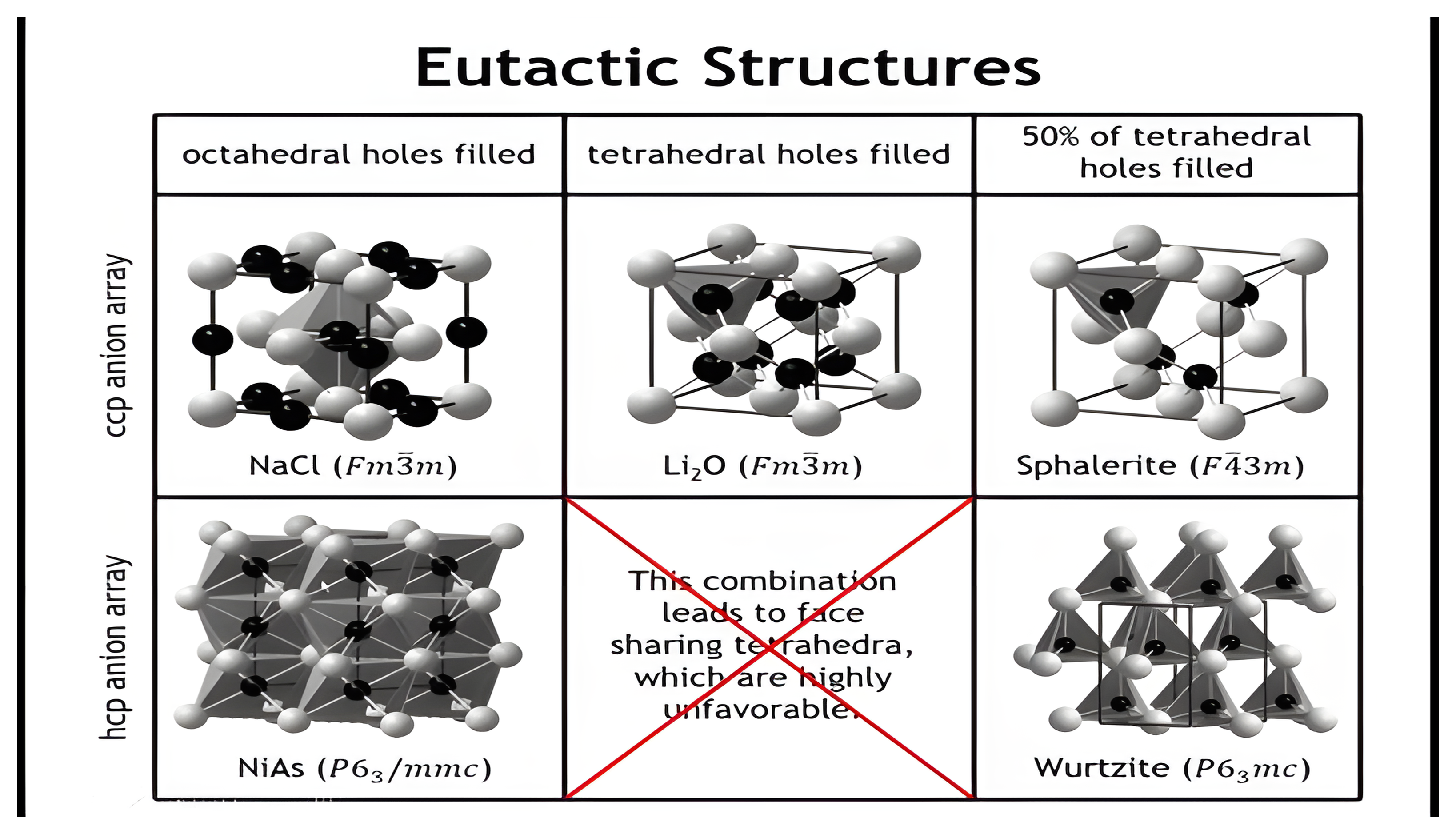
Beside it, on the hexagonal side, the cell is empty, because filling all the tetrahedral holes of a hexagonal close-packed array gives a structure nobody has found. To show you why, let me draw these as unit cells.
Eutactic structures
The same structures as unit cells, including the one no compound takes.
Here are the structures I just talked about, drawn as unit cells.
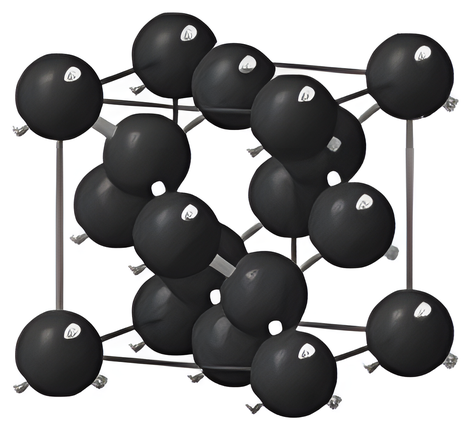
A cubic close-packed array of atoms is the face-centered cubic unit cell , atoms on the corners and the faces of the cell
[advance: sodium chloride, all the octahedral holes of a cubic array]
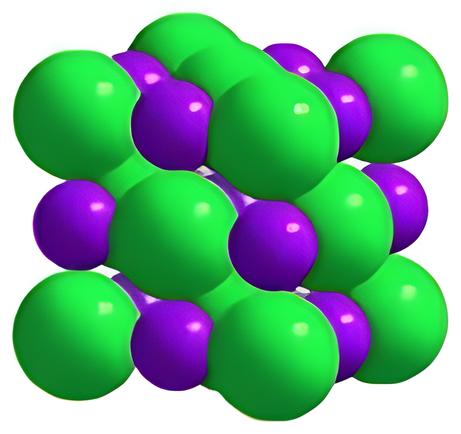
In NaCl that array is the chloride ions; the octahedral holes sit at the midpoint of every edge and at the center of the cell, and a sodium fills every one
Each sodium sits inside an octahedron of six chlorides ; neighboring octahedra share edges, never faces
Found across a whole gamut of substances , from very ionic compounds like NaCl and NaF to things that are not very ionic at all
[advance: nickel arsenide, all the octahedral holes of a hexagonal array]
The same filling on a hexagonal array gives NiAs : octahedra share edges in the basal plane and faces from one layer to the next
A shared face brings the two cations rather close together, unfavorable when the cations carry a large positive charge — so NiAs is not found for really very ionic compounds, but where there is quite a bit of covalency
[advance: lithium oxide, all the tetrahedral holes of a cubic array]
The tetrahedral holes on a cubic array give the Li₂O structure we just named: oxide at the face-center positions , a lithium ion in the tetrahedral hole in each octant of the cell
[advance: the combination that does not exist]
The same thing on a hexagonal array of oxide ions gives face-sharing tetrahedra , and across a shared face the cation to cation distance is shorter than the cation to anion distance
Highly unfavorable, so no combination of elements takes this structure — which is why the cell is crossed out
[advance: sphalerite, half the tetrahedral holes of a cubic array]
We can also fill only some of the holes, and the two on the right are half of the tetrahedral holes
Half of them on a cubic array gives sphalerite , the zinc blende structure — the ratio comes back to one to one, CA, and it is a really important structure for many semiconductors
[advance: wurtzite, half the tetrahedral holes of a hexagonal array]
Half of them on a hexagonal array gives wurtzite , sphalerite's hexagonal partner and the other major semiconductor structure
Filling only some of the holes is what opens up the middle of that table, so let me go back to it.
Filling only some of the holes
The same total fraction, reached two ways: evenly through every plane, or whole planes on and off.
Hole filling in total General formula Structure type hcp of anions Structure type ccp of anions The plane-filling sequence all octahedral CA NiAs nickel arsenide NaCl sodium chloride all full ½ CA2 CdI2 cadmium iodide CdCl2 cadmium chloride empty and full ½ CA2 CaCl2 calcium chloride all ½ full ⅓ CA3 BiI3 bismuth iodide YCl3 yttrium chloride empty and ⅔ full ⅓ CA3 RuBr3 ruthenium bromide all ⅓ full ⅔ C2 A3 La2 O3 lanthanum oxide empty, full, full ⅔ C2 A3 Al2 O3 aluminum oxide all ⅔ full all tetrahedral C2 A not possible Li2 O lithium oxide all full ½ CA ZnS zinc sulfide wurtzite ZnS zinc sulfide sphalerite all ½ full
We have talked about the top row of this table, all the octahedral holes, and about the bottom two rows, the tetrahedral ones.
Now the middle, where we fill only some of the octahedral holes
This is where that last column matters, because we can reach the same total fraction in two completely different ways
[advance: half the octahedral holes]
Half of them the symmetric way , vacancies spread evenly so every plane is half full → CaCl₂
Half of them the asymmetric way , all the holes filled in some planes and the next plane left empty → CdI₂ and CdCl₂
Both routes are CA₂
[advance: a third of the octahedral holes]
Every plane a third full → RuBr₃ ; an empty plane alternating with a plane two-thirds full averages to the same third → BiI₃ and YCl₃
Both routes are CA₃
[advance: two thirds of the octahedral holes]
Every plane two-thirds full → Al₂O₃ ; empty, full, full → La₂O₃ — both C₂A₃
Two of those rows fill whole planes and leave the next one empty, so let me show you what those actually look like.
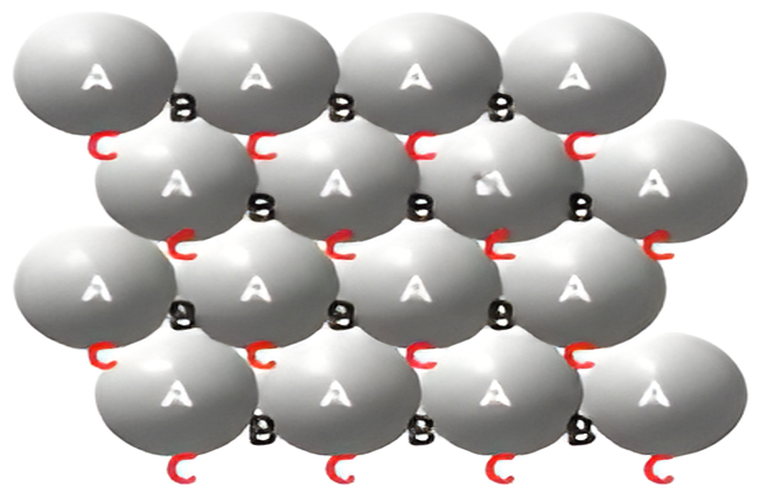
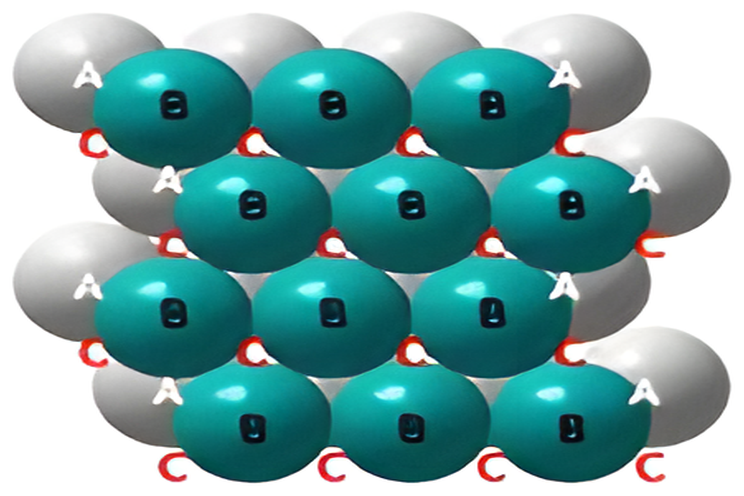
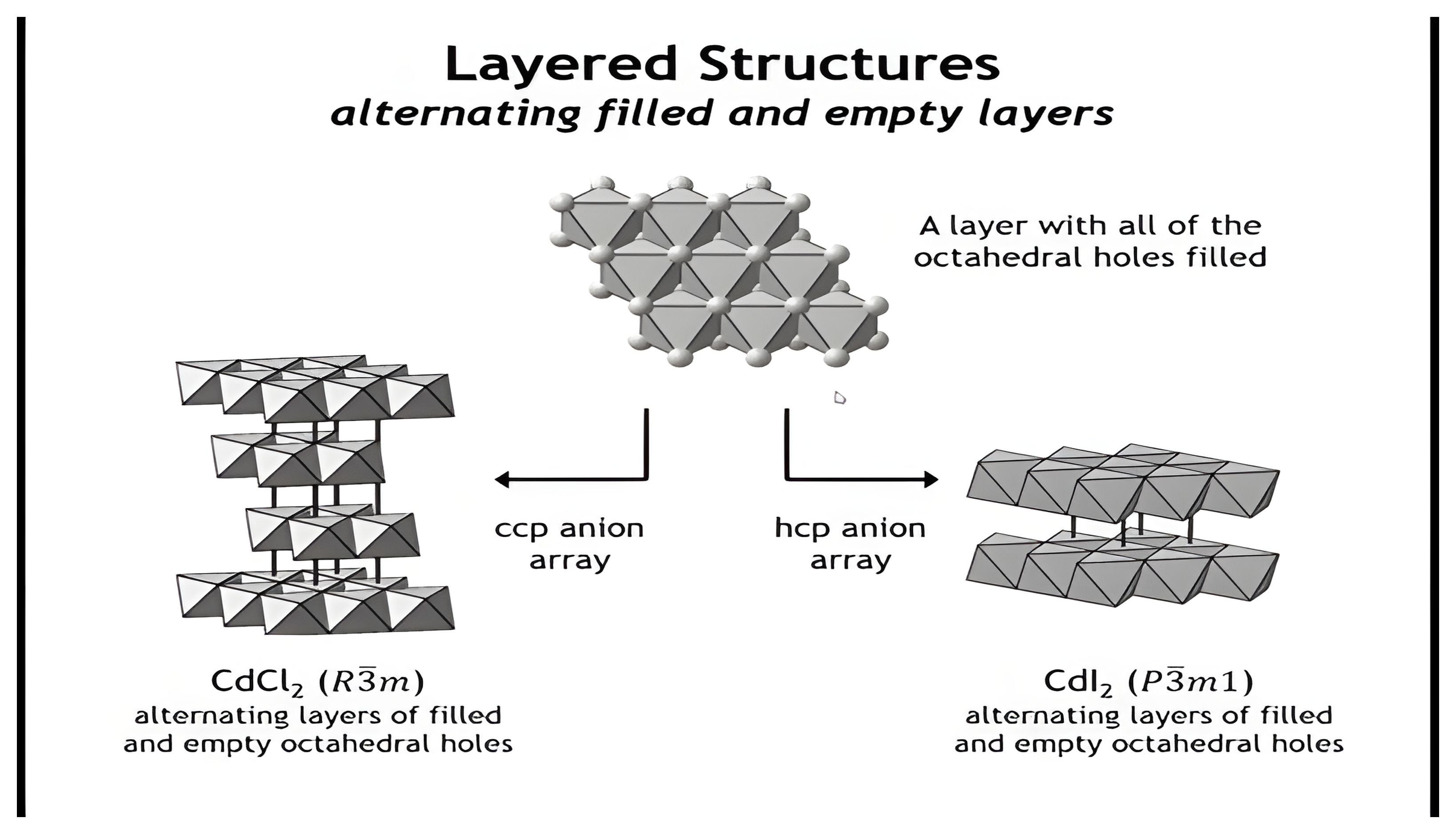
Layered structures: filled and empty layers
Start with the ones that fill a whole plane of octahedral holes and leave the next plane empty.
[advance: the filled layers]
Each filled plane is an infinite sheet of edge-sharing octahedra — CdCl₂ on a cubic anion array, CdI₂ on a hexagonal one
Every other plane full means half the octahedral holes overall, so the formula is CA₂
[advance: the empty layers between them]
Between the sheets there is nothing but dispersion forces holding one sheet to the next — which is why these crystals cleave so easily, and why their electronic properties are two-dimensional , the thing modern 2D materials research is built on
Why would the cations crowd into some planes and leave others empty? Because these are not purely ionic : the anions are large and polarizable, I⁻, Br⁻, Cl⁻, Se²⁻, and the cations form partly covalent bonds
Instead of filling a whole plane, we can fill two thirds of one.
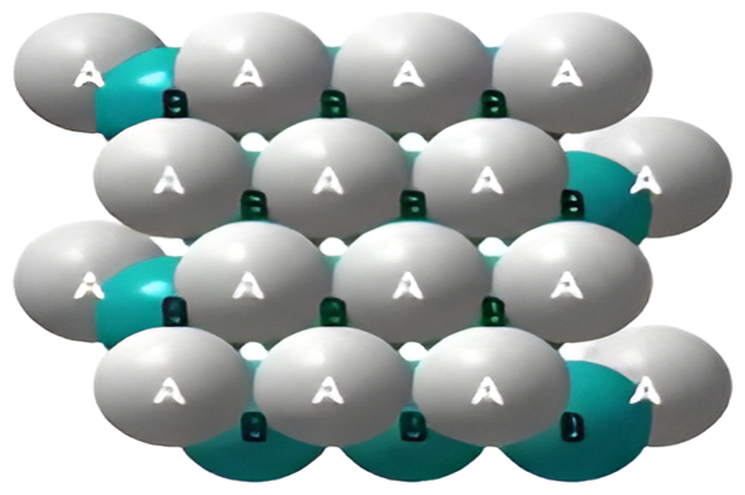
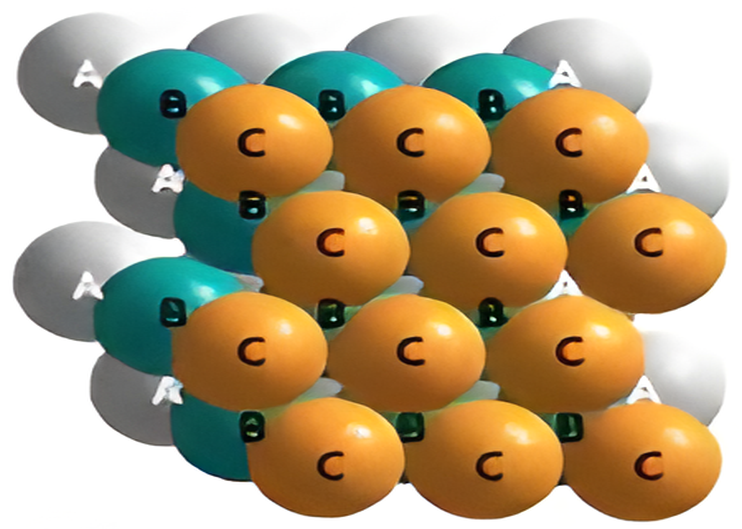
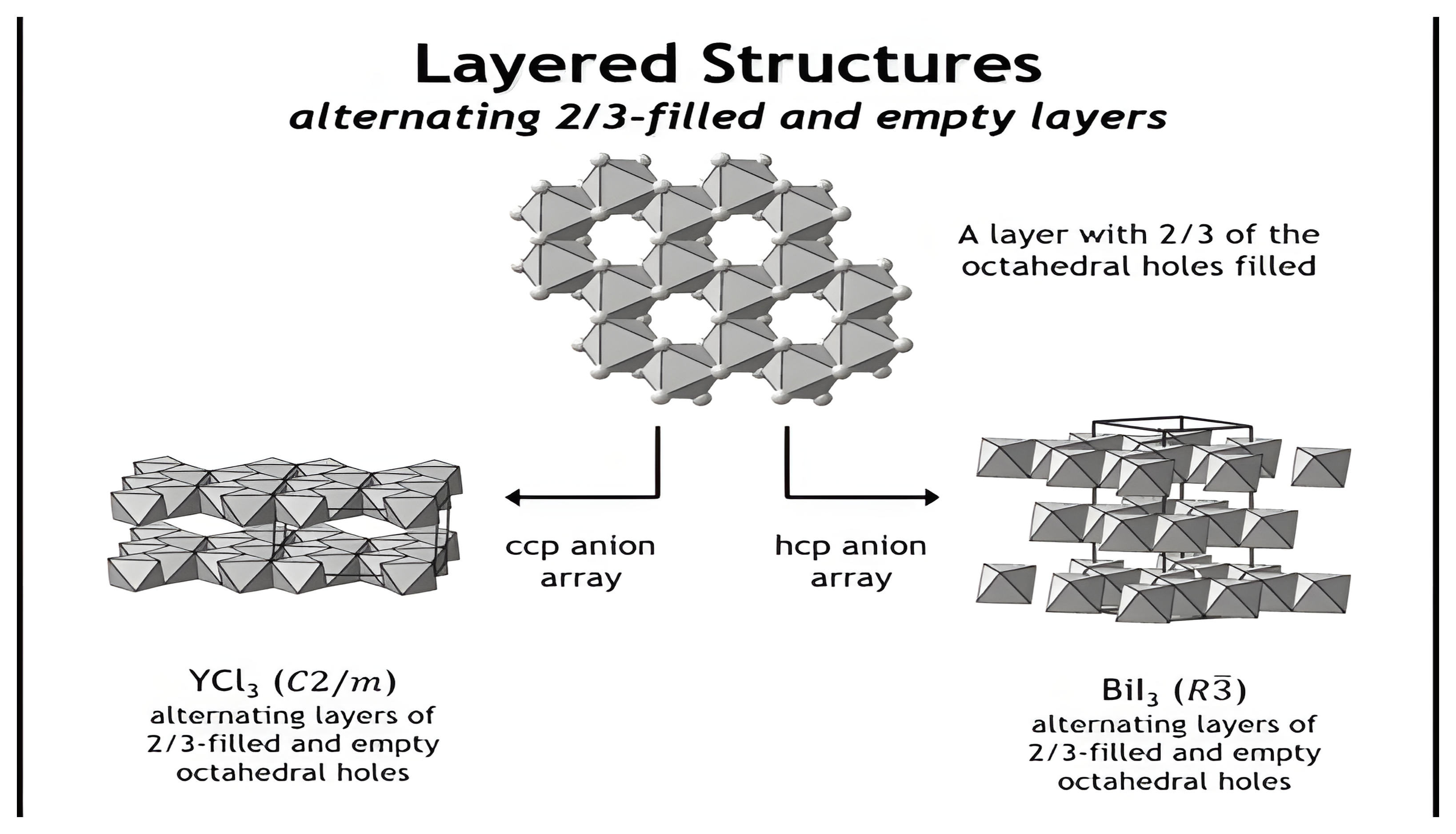
Layered structures: two-thirds-filled layers
Fill only two thirds of the octahedral holes in a close-packed plane and the pattern that is left is a honeycomb.
[advance: two thirds of the holes in the layer]
One hole in three left open — drawn as polyhedra, the octahedra sit in the same arrangement as the atoms in graphene
[advance: the empty layers between them]
Leave the next plane empty and the stacking alternates two-thirds full and empty , which averages to one third of the octahedral holes filled overall
That gives 1:3 stoichiometry — BiI₃ on a hexagonal anion array, YCl₃ on a cubic one
That same one-third-vacant idea is exactly what separates nickel arsenide from corundum.
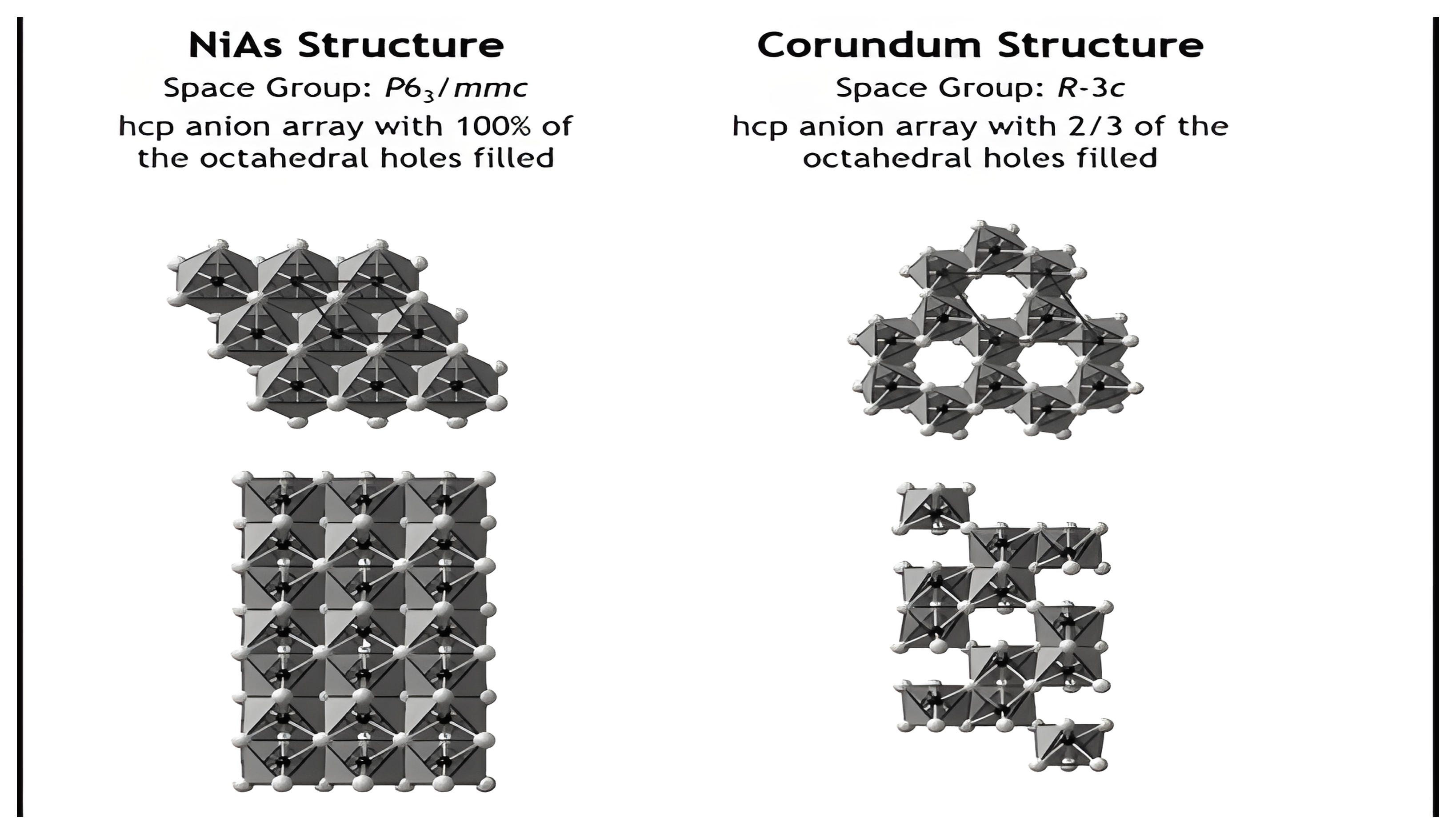
NiAs versus corundum
The nickel arsenide structure fills every octahedral hole in a hexagonally close-packed array of anions, and that is not favored when the bonding is highly ionic, because it builds infinite chains of face-sharing octahedra that bring the cations too close together.
[advance: highlight the face-sharing chains and pairs]
Leave one third of the octahedral holes vacant and we get the layered, graphene-like arrangement: filled, filled, empty
Stack those layers on hexagonally close-packed anions and we get corundum , Al₂O₃, and hematite, Fe₂O₃
Corundum is the stable choice for more ionic compounds : the vacancies break up the infinite face-sharing columns and cut the cation to cation repulsion
Let me look closer at the bonding in aluminum oxide to see what those face-sharing pairs do to the bond distances.
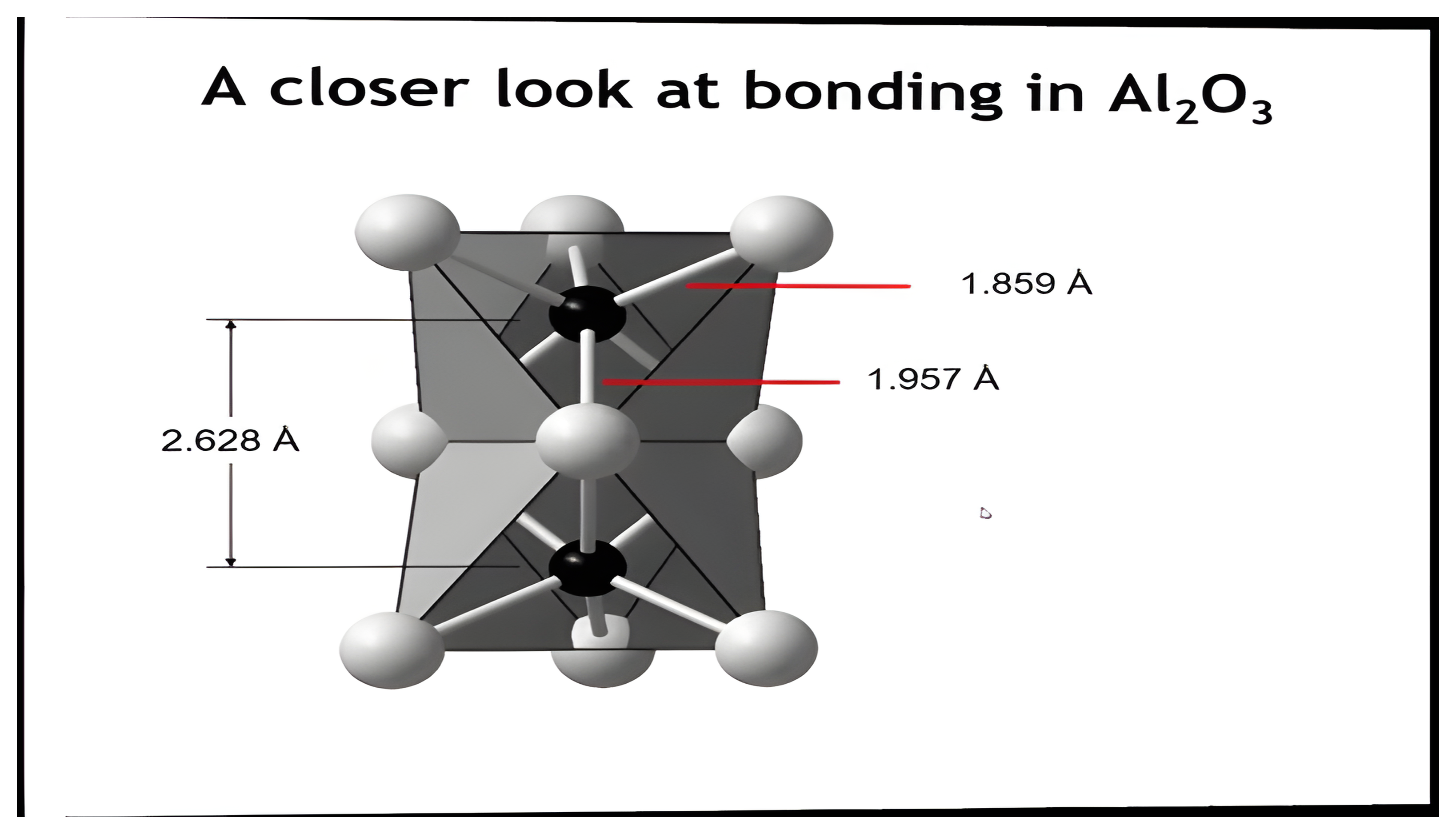
A closer look at bonding in Al2 O3
Because there are these empty octahedral holes, the cations in the filled ones can move away from each other toward the empty space.
We can see it in the bond distances of the mineral corundum
At the shared face , the aluminum to oxygen distance is 1.96 ångströms ; the aluminum to oxygen bonds above it are 1.86 ångströms
The aluminum ions move away from each other , toward the vacancy above and below this dimer
That relieves the unfavorable ionic interaction across the shared face
That completes the tour of the ionic structure types, so let me summarize.
Summary
One question, asked once: which holes do the cations take, and how many of them?
Holes filled Formula hcp anion array ccp anion array all octahedral CA NiAs nickel arsenide NaCl sodium chloride ½ octahedral, spread evenly CA2 CaCl2 calcium chloride — ½ octahedral, whole layers CA2 CdI2 cadmium iodide CdCl2 cadmium chloride ⅔ of every filled layer CA3 BiI3 bismuth iodide YCl3 yttrium chloride ⅔ octahedral C2 A3 Al2 O3 aluminum oxide corundum La2 O3 lanthanum oxide all tetrahedral C2 A not possible Li2 O lithium oxide anti-fluorite ½ tetrahedral CA ZnS zinc sulfide wurtzite ZnS zinc sulfide sphalerite
Which one a compound picks depends on cation size, charge, and ionicity: highly ionic systems avoid face-sharing polyhedra, layered and covalent ones tolerate them.
Let me summarize what we covered on ionic structures.
Every structure we looked at today came from the same idea: a close-packed array of anions with cations sitting in some of its holes, and the choice of holes fixes the formula
All the octahedral holes — one per anion, so CA: NaCl on a cubic array, NiAs on a hexagonal oneHalf of them — CA₂, and it matters how : evenly spread gives CaCl₂, whole layers on and off give CdCl₂ and CdI₂Two thirds of each filled layer — CA₃, the graphene pattern: YCl₃ and BiI₃; two thirds of every layer — C₂A₃, corundum and hematiteAll the tetrahedral holes — two per anion, so C₂A: Li₂O, anti-fluorite; half of them — CA: sphalerite and wurtziteWhich one a compound picks depends on cation size, charge, and ionicity — highly ionic systems avoid face-sharing polyhedra, layered and covalent ones tolerate them
That is the whole of Lecture 4, from space-group symbols to ionic structures, so let me finish with the practice questions.
Practice questions
Work the Lecture 4 practice questions
before the next class.
Open the Lecture 4 practice questions
Every question carries a worked
explanation, so you can check your reasoning as you go.
Your homework is the Lecture 4 practice set on the course website.
Open chem548.wileylab.org/practice.html#lec04-structures or use the Practice link
Complete the set before the next class. Each question includes a worked explanation that you can use to check your reasoning.
 filled layers
empty layers
filled layers
empty layers
 ⅔-filled layers
empty layers
⅔-filled layers
empty layers