CHEM 548: Materials Chemistry
Lecture 3: Space Groups: Lattices, Glides, and Screws
Space groups: lattices and point groups, glide planes and screw axes, and reading Hermann–Mauguin symbols
Reading: Woodward, Karen, Evans, and Vogt, Solid State Materials Chemistry
Today we combine the point-symmetry elements from meeting 2 with the lattices from meeting 1 to name the symmetry of whole crystals.
Reading is Chapter 1, sections 1.1.4 through 1.1.7, in Solid State Materials Chemistry Practice is the Lecture 3 set on the course website
We begin with the goals for this lecture.
Learning Objectives
Every structure you will look up, in a paper or a database, is filed under a symbol like P21 /c, and this lecture teaches you how to read it.
Glide and screw describe the two elements that add a fractional translation, and the operation each performs
Space group build one from a Bravais lattice and a compatible point group, and account for all 230
Symmorphic split distinguish symmorphic from non-symmorphic space groups
Symbol reading read a Hermann–Mauguin space-group symbol position by position
By the end of the lecture, you should be able to do four things.
Describe the two elements that add a fractional translation , the glide plane and the screw axis, and the operation each one performs
Build a space group from a Bravais lattice and a compatible point group, and account for all 230 of them
Distinguish symmorphic from non-symmorphic space groups; the 13 monoclinic space groups will be our worked example
Read a Hermann–Mauguin space-group symbol position by position, with each group's reference entry in the International Tables for Crystallography
We start by putting every symmetry element you have met so far in one table.
Five elements fix a point, two do not
Symmetry Element Symmetry Operation
1. Identity (1) Nothing changes 2. Inversion center ($\bar{1}$) Inversion through a point 3. Mirror plane (m ) Reflect through the plane 4. Proper rotation axis (N) Rotate by 360/N degrees about the axis 5. Rotoinversion axis ($\bar{N}$) Rotate by 360/N degrees about the axis, followed by inversion operation 6. Glide plane (a , b , c , n , d ) Reflect through a plane, then translate parallel to the plane 7. Screw axis ($N_M$) Rotate by 360/N degrees about the axis, followed by a translation by M/N of the unit cell parallel to the axis
Everything above the line holds a point fixed; the last two rows add a translation.
Everything in this table is a symmetry element you can already name.
The five above the line came out of last meeting: identity, inversion, mirror, proper rotation, rotoinversion, each holding a point fixed
The two below the line are today: the glide plane reflects, then translates parallel to the plane, and its letter, a, b, c, n, or d , says which direction it slides and how far
The screw axis N sub M rotates, then translates by M over N of the unit cell along its own axis
Both new ones need a lattice underneath : a fraction of a repeat means nothing unless the pattern repeats
So we start from the pure translation those fractions are taken from.
Translational Symmetry
Slide the pattern by a whole unit-cell vector and every motif lands on an identical one — with one object per cell or a mirror-related pair, the translation repeats the contents whole cell by whole cell.
translation
repeating unit (unit cell)
m
translation
mirror plane
repeating unit (unit cell)
Translation is where this course started: slide the whole pattern by one unit-cell vector and every atom lands on an identical atom.
The steps run along the lattice vectors , whole cell by whole cell
[advance: repeat a mirror-related pair by the same translation]
The unit that repeats can be a single object or a mirror-related pair
The translation does not care what sits inside the cell: it repeats the contents whole cell by whole cell
Hold onto the contrast: translation moves by a whole cell , and today's two new elements move by a fraction of one
Here is what a fractional step looks like, in a trail of footprints.
A glide, one footstep at a time
g
glide line
glide reflection →
(a) reflection at a plane / line
Glide Planes
glide plane
命
命
1.
命
2.
1. Reflect through the glide plane (just as with a mirror plane) 2. Translate parallel to the glide plane
In three dimensions the mirror line becomes a plane.
[advance: show the operation in its two steps]
Reflect through the plane, then translate parallel to itThe two halves never appear alone ; the glide is one element, not two
Because the slide is a fraction of a repeat , glides exist only in crystals, never in a single molecule
The letters that name the glides are next.
Types of Glide Planes
Herman–Mauguin Symbol Plane ⊥ to which axis Translation vector
Axial Glides a b or c ½ a b a or c ½ b c a or b ½ c Diagonal glides, n a ½ b + ½ c b ½ a + ½ c c ½ a + ½ b Diamond glides, d a ¼ b + ¼ c b ¼ a + ¼ c c ¼ a + ¼ b
b
a
z
z
b glide plane
translate by ½ b
b
a
z
z
a glide plane
translate by ½ a
b
a
z
z+½
c glide plane
translate by ½ c
b
a
z
z+½
n glide plane
translate by ½ a + ½ c
A glide takes its letter from the direction and the size of its translation.
A b glide translates by half of b, an a glide by half of a, a c glide by half of c
The n glide is the diagonal one: half of a plus half of c, so it moves along a face diagonal
[advance: bring up the glide classification table]
The table sorts them by the orientation of the plane and the translation vector that goes with it
It adds the last type, the d glide or diamond glide, whose translation is a quarter of a diagonal rather than a half
So the letter names the glide : which direction it slides, and how far
Next is the other element that carries a translation, the screw axis.
$N_M$ Screw Axes
c
start
21 screw axis
rotate 180°
rise c/2
one full c higher
c
start
rotate 90°
rise c/4
far side
41 screw axis
near side
one full c higher
1. Rotate by 360/N (just as with a N-fold proper rotation axis) 2. Translate by M/N of a unit cell vector parallel to the screw axis
A screw axis rotates and then translates along its own axis.
Written NM : it turns by 360 over N of a full turn, then slides by M over N of the cell vector along the axis
Here is the 21 , one step at a time: one motif beside the axis
[advance: rotate 180 degrees]
First the rotation : 180 degrees about the axis carries the motif to the far side
[advance: rise by half the cell]
Then the translation : the rotated copy rises by half of c
That pair of moves, rotate then rise , is one 21 operation
[advance: repeat the operation]
Apply it again and the motif returns to the starting side , one full cell higher
Two operations add up to a pure lattice translation
[advance: show the 4 sub 1 axis]
Now the 41 . Same recipe, smaller steps : rotate 90 degrees, rise c over 4
Here is the first operation
[advance: run the remaining operations]
Run it three more times and the motif climbs a quarter turn and a quarter cell each time, until it stands one full c above the start
Four operations add up to one lattice translation, and the motifs wind up the axis
That completes the set of operations. Next, the group that collects all of them.
What a space group is
A point group holds one point fixed. A crystal also repeats by translation.
The space group is the complete symmetry of a crystal: the lattice translations, the point
operations, and the glide and screw operations built from both.
There are exactly 230 . Every crystal structure ever solved is filed
under one of them.
A point group collects the operations that hold one point fixed.
A crystal does more: it repeats , so its full symmetry must include the lattice translations
Once translations are in, glides and screws can appear too
That complete set of operations is the space group
There are exactly 230 of them, and every crystal structure ever solved is filed under one
The obvious way to make one is to take a lattice and attach a point group, so we start there.
From point groups to space groups
monoclinic: one twofold along b, β free
monoclinic P + 2 → P 2
monoclinic C + 2/m → C 2/m
lattice + point group
32 × 14 = 448 blind pairings
allowed pairings
the 14 Bravais lattices, grouped by crystal system
the 32 point groups, grouped by crystal system triclinic
P
monoclinic
P C
orthorhombic
P C I F
tetragonal
P I
rhombohedral
R
hexagonal
P
cubic
P I F
triclinic — 2 point groups
monoclinic — 3 point groups
orthorhombic — 3 point groups
tetragonal — 7 point groups
trigonal — 5 point groups
hexagonal — 7 point groups
cubic — 5 point groups
P primitive · C base-centered · I body-centered · F face-centered · R rhombohedral
Per Solid State Materials Chemistry , §1.1.4.
Start with the simplest recipe.
Monoclinic means one twofold axis along b, and the cell drawn here allows exactly thatPut point group 2 on the primitive monoclinic lattice and the result is the space group P2 : the letter names the lattice, the rest names the point group
Put 2/m on the base-centered lattice and you get C2/m
[advance: bring up the pairing grid]
Which recipes are allowed? 32 point groups times 14 lattices would give 448
But a point group fits only the lattices of its own crystal system ; a fourfold axis cannot live on a monoclinic cell
The shaded cells are the allowed pairings, with one exception off the diagonal, trigonal point groups on the hexagonal P lattice
Work through the shaded cells, drop the pairings that repeat the same lattice on a bigger cell , and 73 distinct groups come out
Groups made this way, from a lattice and a point group and nothing else, are the symmorphic space groups
But glides and screws let us make groups this recipe cannot, and those are next.
Swap in a glide or a screw
P 2 → P 21 2 becomes 21
the 21 screw is in no point group
P m → P c m becomes c glide
the c glide is in no point group
Symmorphic: built from a Bravais lattice and a point group alone.
Non-symmorphic: contains a glide plane or a screw axis.
73
157
symmorphic
non-symmorphic
73 + 157 = 230 space groups
Per Solid State Materials Chemistry , §§1.1.5–1.1.7.
Take P2 and swap its twofold for a 2 sub 1 screw.
The result still fits the monoclinic lattice, but it is not on the symmorphic list , because no point group contains a screw : the screw came from the swap, not from the pairing
The new group is called P2 sub 1
Swap the mirror in Pm for a c glide and you get Pc the same way
A group whose operations all come from the lattice and the point group is symmorphic ; a group that contains a glide or a screw is non-symmorphic
[advance: show the full count]
Making every allowed swap, system by system, produces 157 non-symmorphic groups beside the 73 symmorphic ones
That is the whole list: 73 plus 157 is 230 , and most space groups are non-symmorphic
Before counting them, watch each new group work in three dimensions.
P21 in three dimensions
β
a
b
c
21 ∥ b
1.
2.
1. rotate 180°
2. rise b/2
one full b
the same pair, one b up
Here is P2 sub 1 inside a monoclinic cell.
The screw axis runs along b , and one motif sits at a general position
[advance: apply the rotation and the rise]
One operation: rotate 180 degrees about the axis, rise by half of b
The partner motif points the opposite way , half a cell up
[advance: apply it again]
Apply it again and the motif is back on the starting side , one full b higher, which is exactly the lattice repeat
Every motif in this crystal comes in screw-related pairs
The glide group works the same way.
Pc in three dimensions
β
a
b
c
c glide plane ⊥ b
1.
1. reflect
2.
2. slide by c/2
Here is Pc in the same cell.
The glide plane lies perpendicular to b , and its translation runs along c
[advance: reflect through the plane]
First the reflection : the motif flips through the plane into its mirror image
[advance: slide by half of c]
Then the mirror image slides by half of c to its final position
Reflection plus half-cell slide , one glide operation
The monoclinic system is small enough to build its whole list by hand, so we do that next.
Monoclinic space groups build step by step
2 Bravais lattices: P , C · 3 point groups: 2 , m , 2/m
Symmorphic
P2
C2
Pm
Cm
P2/m
C2/m
Non-symmorphic
P21
C21
≡ C2
Pc
Cc
P21 /m
C21 /m
≡ C2/m
P2/c
C2/c
P21 /c
C21 /c
≡ C2/c
2 lattices × 3 point groups = 6 symmorphic
swap in screws and glides: 10 more candidates
C21 , C21 /m, C21 /c duplicate C2, C2/m, C2/c → 16 − 3 = 13
The monoclinic system has two Bravais lattices, primitive and base-centered, and three point groups, 2, m, and 2/m.
[advance: build the symmorphic six]
Pair each lattice with each point group: P2, Pm, P2/m , then C2, Cm, C2/m
Two lattices times three point groups, six symmorphic groups
[advance: swap in screws and glides]
Now swap 2 for 2 sub 1 and m for a c glide , in every combination that stays monoclinic: ten more labels , sixteen in all
[advance: strike the duplicates]
Three of the sixteen are not new In a C lattice the centering translation, half a plus half b, combined with the twofold already generates a 2 sub 1 screw between the axes
So C2 sub 1 is C2 under another name, and the same holds for C2 sub 1 over m and C2 sub 1 over c
Sixteen minus three is thirteen , the full monoclinic list
The International Tables provide a reference page for every group.
International Tables record space-group symmetry
International Tables for Crystallography Volume A
The International Tables for Crystallography cover all 230 three-dimensional space groups.
Each entry gives the symmetry operations and standard setting
Wyckoff positions list equivalent atomic positionsReflection conditions identify diffraction peaks that the symmetry removesWe use these entries as a reference rather than memorize them
We start with how the Tables draw the glide planes we defined earlier.
How the International Tables draw glide planes
Glide plane
Glide vector
normal to projection
parallel to projection
Axial: a , b , c
½ of one lattice vector
Diagonal: n
½ of two lattice vectors, along a diagonal
Diamond: d
¼ of two lattice vectors, centered cells only
⅜ ⅛
We built the glide plane a few slides back; here is how the International Tables write the planes down.
The translation must remain in the glide plane ; its direction and length determine the kind of glide
An axial glide uses one-half of one lattice vector
Drawn as a dashed line where the plane stands normal to the projection, and as a corner with an arrow where the plane lies parallel to it
[advance: add the diagonal glide]
An n glide uses one-half of two lattice vectors
The two halves add, so the translation runs along a diagonal , and the line picks up a dot between the dashes
[advance: add the diamond glide]
A diamond glide uses one-quarter of two lattice vectors in a centered space group
Drawn as a pair of planes , and the fractions beside the symbol are the heights of those two planes above the projection
With the planes drawn, the one thing left before reading full symbols is the direction each position in a symbol refers to.
Conventional directions for space-group names
The same position in the symbol
points along a different direction in each crystal system.
An axis runs along its
position's direction; a plane lies perpendicular to it. In 2/m the axis and the plane share one
position, so that mirror is perpendicular to the twofold, exactly what the slash meant last meeting.
Crystal system What the positions mean, in order Worked example
Monoclinic one direction: b P21 /c: everything refers to b Orthorhombic a , then b , then c Pnma: n ⊥ a, m ⊥ b, a glide ⊥ c Tetragonal c ; then a and b ; then the in-plane diagonalsP41 21 2: 41 ∥ c, 21 ∥ a and b, 2 ∥ diagonals Trigonal & hexagonal c ; then the cell edges; then the in-plane diagonalP3̄m1: 3̄ ∥ c, m ⊥ edges, nothing on the diagonal Cubic the cell edges; then the body diagonals; then the face diagonals Pa3̄: a glide ⊥ edges, 3̄ ∥ body diagonals
Per Solid State Materials Chemistry , §1.1.7, Table 1.3.
Each position in a Hermann-Mauguin symbol refers to a direction, and the same position points somewhere different in every crystal system.
The reading rule from last meeting still holds: an axis listed at a position runs along that direction, and a plane listed there lies perpendicular to it
In 2/m the slash stacks the axis and the plane on one shared position, and the rule then makes the mirror perpendicular to the twofold, exactly as in meeting 2
The mirrors of 4mm sit at different positions, the in-plane directions, so the rule makes them contain the fourfold instead
Monoclinic has one direction to name, b, so its whole symbol refers to bOrthorhombic reads a, then b, then c: in Pnma , the n is perpendicular to a, the m perpendicular to b, and the a glide perpendicular to c
[advance: the axial systems]
Tetragonal, trigonal, and hexagonal lead with the principal axis along c, then the cell edges, then the in-plane diagonalsIn P41 21 2 , the 41 runs along c, the 21 axes along a and b, and the final 2 along the diagonals
[advance: cubic]
Cubic reads cell edges, then body diagonals, then face diagonalsThe symbol direction in the second cubic position refers to the corner of a cube : the [111] entry stands for all eight body-diagonal directions
Minus signs or overbars distinguish the opposite corners
Now we can read a full entry, starting with P2 sub 1 over c.
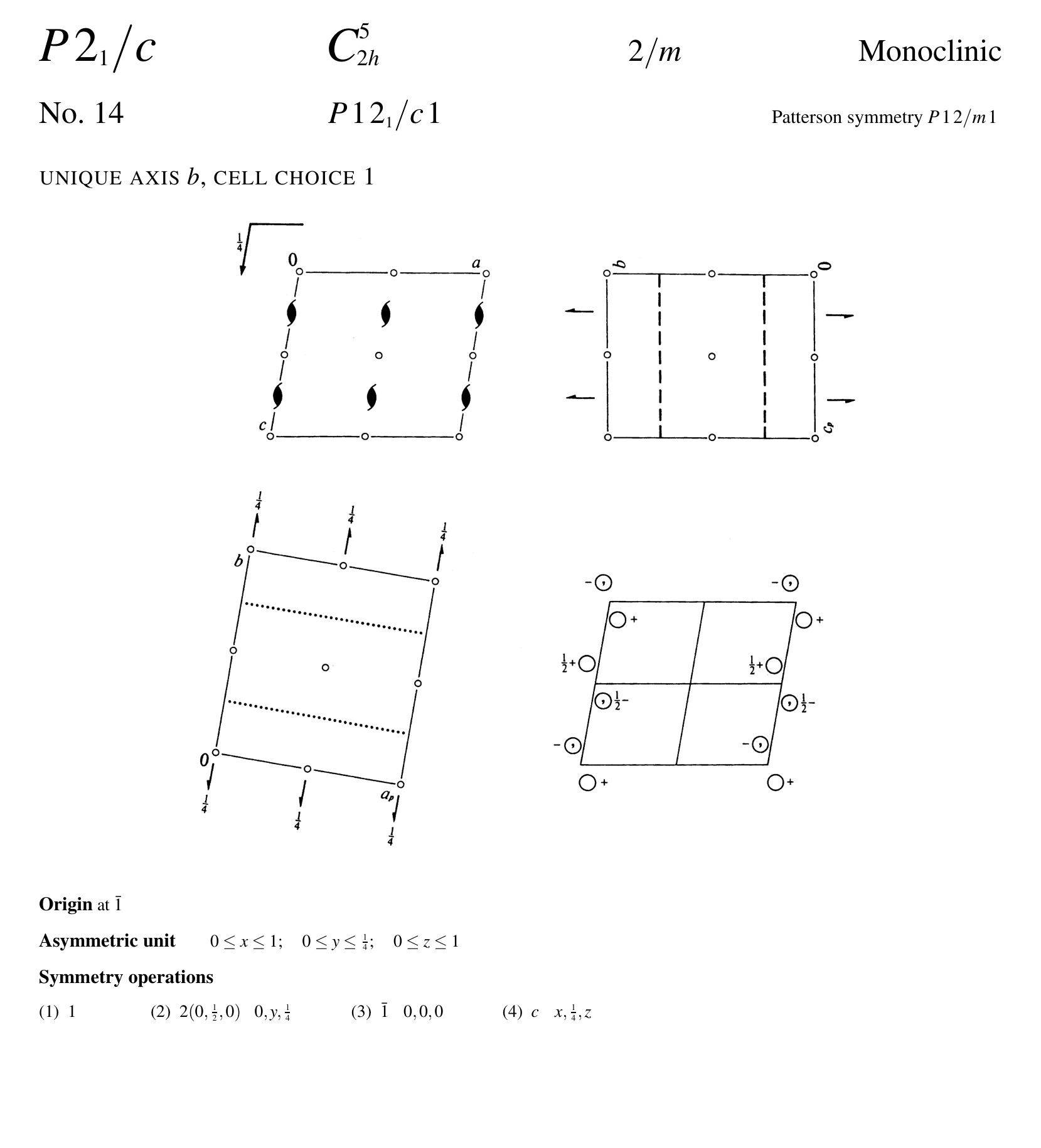
Reading the monoclinic group P21 /c
International Tables for Crystallography, Vol. A, entry No. 14.
This page is the entry for P2 sub 1 over c in the International Tables for Crystallography, Volume A.
One page like this exists for every one of the 230 space groups
We will read this one a region at a time
[advance: zoom the header]
The top line gives the short symbol , the Schoenflies symbol , the point group 2 over m , and the crystal system
P21 /c position by position : P the primitive monoclinic lattice, 21 a screw axis along b, the c after the slash a glide plane perpendicular to bBelow the top line, the group number 14 and the full symbol P 1 21 /c 1 , a 1 in the empty a and c positions: the unique axis is b
[advance: mark the axes and the screws]
The left diagram looks down b , a across and c down: the pointed ovals circled in blue are the 21 axes end-on , the small open circles are inversion centers
The symbol names one screw axis , yet the drawing shows a grid of them , inversion centers threaded between; hold that puzzle, we settle it at the entry's generators line
[advance: mark the face-on glide]
The bent arrow marked one quarter is the c glide plane itself, seen face-on , parallel to the page at a height of one quarter b , the arrow pointing along its glide direction, c
The quarter is the plane's height, not its translation : the slide is still c over 2 , and the same logic puts glide planes at heights one quarter and three quarters
[advance: turn to the side view]
The right diagram turns the cell so b runs across: the half arrows are the 21 axes lying in the page, half an arrowhead because they are screws , and the dashed lines in the red boxes are the c glide planes edge-on
A glide translation must stay in the plane of the glide: an a glide could never sit perpendicular to a , because its half-a translation would stick out of its own plane, and that is the book's problem 1.7
Before we turn the page, the screw grid deserves its own picture.
Where the extra screws come from
a
b
c
21 ∥ b at x = 0 and 1, z = ¼
x = 0.2
(0, 0, 0)
P at x = 0.2
21 at x = 0: x → −x, rise ½ b
0.2 → −0.2
−0.2
+a
+a: −0.2 → 0.8
0.8
net: 0.2 → 0.8, rise ½ b
= 21 at x = ½
21 at x = ½, z = ¼
Here is the puzzle in three dimensions: the monoclinic cell with b vertical, and two of the 2 sub 1 axes the entry drew, standing vertical at a quarter of c, one at x equals zero and one at x equals one.
One motif stands inside at x equals 0.2
[advance: apply the screw]
The axis at zero acts : rotate the motif 180 degrees about it, then rise half of b
The copy lands at minus 0.2 , swung to the far side of the axis and half a cell higher
[advance: add one whole cell]
Now the lattice : every copy repeats one full a over
So the copy at minus 0.2 also stands at 0.8 , back inside the cell
[advance: the screw at one half]
Compare start to finish: 0.2 to 0.8 , rotated 180 degrees, risen half of b
That is a single 21 operation about a vertical axis at x equals one half , and there it stands, exactly between the two
The screw and the lattice manufacture a second screw halfway across the cell
The same halving fills the whole a c face with screws every half cell
That leaves one thing the drawing has not explained, the inversion centers, and they are next.
Where the inversion comes from
a
b
c
c glide, ¼ b
21 at x = 0, z = ¼
(0, 0, 0)
¼
½
(0.2, 0.1, 0.05)
x
y
z
P
0.2
0.1
0.05
21
−x
y+½
−z+½
P after 21
−0.2
0.6
0.45
(−0.2, 0.6, 0.45)
c
x
−y+½
z+½
after c
−0.2
−0.1
0.95
(−0.2, −0.1, 0.95)
(0, 0, ½)
21 then c
−x
−y
1−z
= 1̄ at
0
0
½
1̄ + lattice:
a center every ½ cell
The symbol P2 sub 1 over c names a screw and a glide, and never an inversion center, yet the entry's diagram is full of them.
A group must contain the product of any two of its operations , so run the screw and the glide back to back and watch what they make
The motif starts at 0.2, 0.1, 0.05 , and the glide plane floats at a quarter of b , the height the entry gave it; the tick marks on the lower right edge read quarters of c
[advance: run the screw]
The screw first , the same move as the last slide; the axis stands at x = 0, z = ¼ , and the turn swings the motif to the far side at equal distance : x from 0.2 to minus 0.2, and z, sitting 0.2 short of one quarter, lands 0.2 past it , at 0.45
Add the rise of half a b and the copy stands at minus 0.2, 0.6, 0.45
The panel writes the rule as coordinates: x to minus x, y to y plus one half, z to minus z plus one half ; put in 0.2, 0.1, 0.05 and out comes minus 0.2, 0.6, 0.45
[advance: follow with the glide]
Now the glide: reflect through the plane at one quarter b , then slide half of c
The copy drops below the plane and lands at minus 0.2, minus 0.1, 0.95
In coordinates: x stays, y to minus y plus one half, z to z plus one half , and minus 0.2, 0.6, 0.45 goes to minus 0.2, minus 0.1, 0.95
[advance: the inversion center appears]
Start and finish side by side: 0.2, 0.1, 0.05 went to minus 0.2, minus 0.1, 0.95
Every coordinate flipped through the point zero, zero, one half , and the dashed line shows it: motif, point, copy on one straight line , the same distance each side
Chain the two rules and the halves cancel : x to minus x, y to minus y, z to one minus z; that map is a point inversion , and its fixed point is the average of start and finish , zero, zero, one half
Screw then glide is an inversion , through a center neither operation mentions, halfway along the c edge The symbol never wrote 1 bar ; the group closed on it
[advance: fill in the centers]
Once one center exists, last slide's halving fills the cell : a center plus a whole-cell translation is a center shifted half a cell
So they stand at every corner, every edge midpoint, every face center, and the body center , the grid of open circles on the entry's diagram
Screw, glide, inversion : any two of the three manufacture the third
Hold that, because the entry's next page picks two of them as its generators.
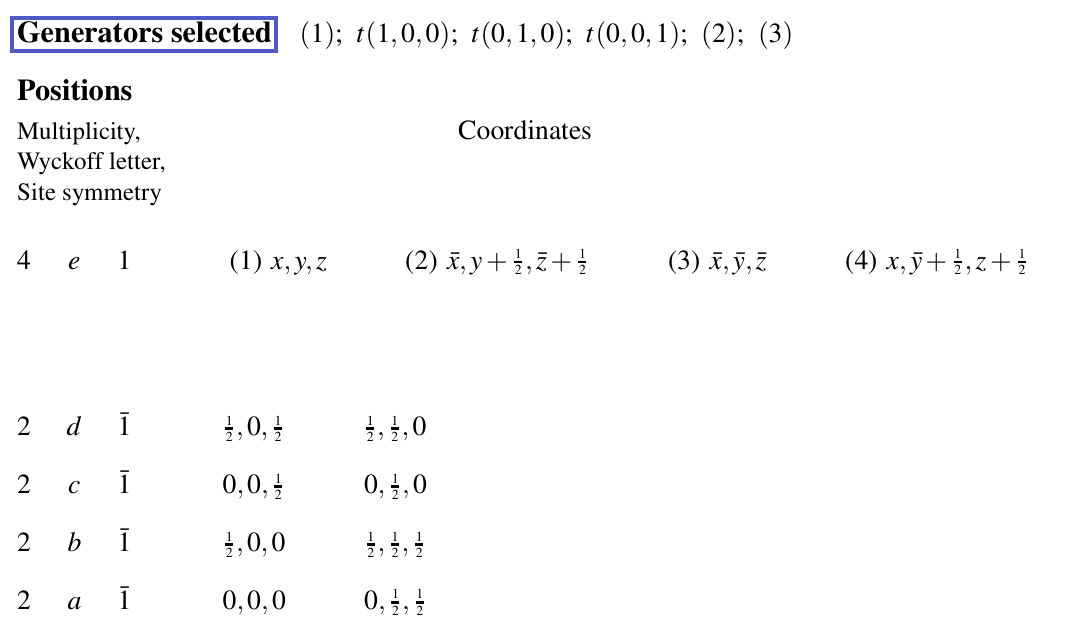
P21 /c: generators and Wyckoff positions
International Tables for Crystallography, Vol. A, entry No. 14.
This is the second page of the entry.
Start with the top line, Generators selected : the last slide's trick, made official
A space group holds infinitely many operations , a screw axis in every cell of the crystal, so no page can list them all
The entry instead gives a short list of operations that rebuilds all the rest
[advance: read the translations]
(1) is the identity, the starting pointThe three t entries are the unit-cell translations along a, b, and c: they put the lattice into the group, how four numbered operations stand in for infinitely many
And they are the last slide's trick : screw times translation is what filled the diagram with screws
[advance: the screw and the inversion]
The bare (2) and (3) point at the entry's numbered operations, 2 the 21 screw, 3 the inversion
The c glide is not on the list : the screw followed by the inversion already produces it , so the entry leaves it off; a lattice plus a couple of operations generates everything else
It is the triangle from the last slide run the other way : the symbol chose screw and glide and the inversion came free; the Tables choose screw and inversion and the glide comes free
Either pair generates the same group
[advance: the Wyckoff sites]
Below sits the positions block , the part we will use most, the Wyckoff sites ; coordinates x along a, y along b, z along c , fractions of the cell, so the screw along b works on the y coordinate
The top row is site 4e , the general position : the 4 is the multiplicity , an atom at arbitrary x, y, z on no symmetry element gets three more copies
The row lists one copy per operation, generator or not : four operations, four atoms, so the glide's column is here though the generator line left it out; the generator list is the shortest recipe , the row the full inventory , and the slide labels which operation makes which
[advance: label the three copies]
Copy 2 is the screw , three pieces in its coordinates: the 180° rotation about a line parallel to b flips both perpendicular coordinates , x to minus x and z to minus z, and y picks up one half , the rise of b over 2The extra half on z is the axis's position : the screw sits at z equals one quarter , a quarter cell from the origin on the inversion center, and rotating about a line at one quarter reflects z through it, so minus z becomes minus z plus one half
Copy 3 is the inversion , which flips all three signsCopy 4 is the c glide : y reflects through the plane at one quarter , minus y plus one half, and z picks up one half , the glide's slide of c over 2
[advance: the special positions]
The rows below the general position have multiplicity 2 , the special positions , sites that sit on a symmetry element
[advance: highlight the special position 2a]
Take 2a , at the origin, highlighted here, and run the same four operations on 0, 0, 0
The inversion sits exactly at the origin , so it maps the atom onto itself
The screw sends it to 0, one half, one half , and the glide sends it to the same point
Four operations, but only two distinct atoms : an atom on a special position is left in place by some of the symmetry , so its multiplicity drops from four to two
The site-symmetry column, 1 bar , records which element the site sits on, an inversion center ; the letters e, d, c, b, a just tell the sites apart
The last column lists reflection conditions : those matter when you measure diffraction from a crystal, which this course does not cover , so we note that they exist and move on
We will use the same reading method for orthorhombic Pnma.
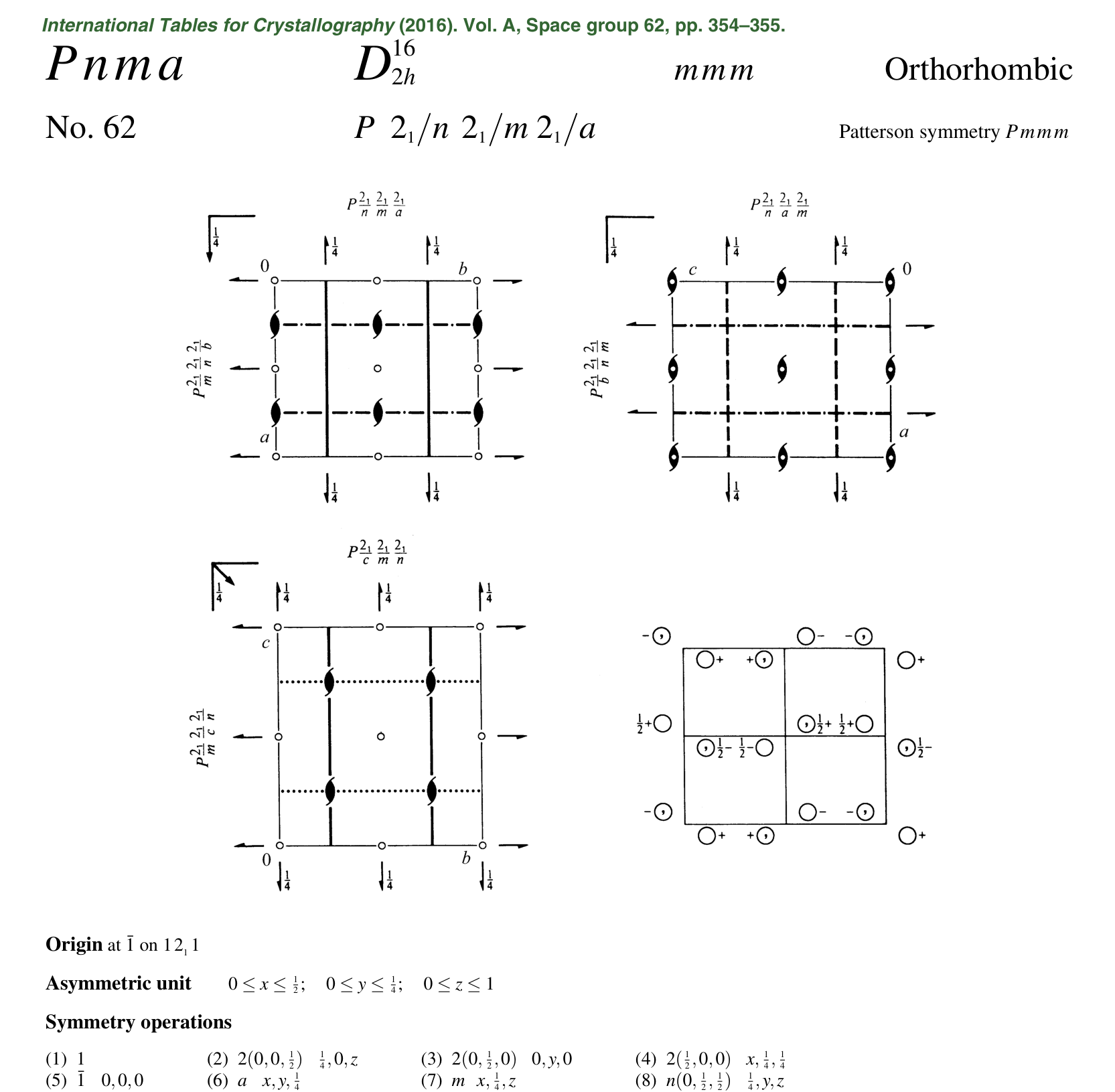
Pnma: reading the entry
International Tables for Crystallography, Vol. A, entry No. 62, p. 354.
Here is the same kind of page for Pnma, number 62 in the Tables.
This one is orthorhombic , so the symbol has three directions to name instead of monoclinic's one
The entry runs over two printed pages ; this is the first
[advance: zoom the header]
Top line: short symbol Pnma , Schoenflies D2h 16 , point group mmm , crystal system orthorhombic ; below it the number 62 and the full symbol P 21 /n 21 /m 21 /a
Read it position by position : P is the primitive orthorhombic lattice, then one slot per direction , a, then b, then c
First slot, 21 /n : a screw along a and an n glide perpendicular to a Second slot, 21 /m : a screw along b and a mirror perpendicular to b Third slot, 21 /a : a screw along c and an a glide perpendicular to c The short symbol keeps the three planes , n, m, a, and drops the three screws : that is how the full symbol shortens to Pnma
Dropping the screws loses nothing: the planes generate them ; reflection through n times reflection through m is a twofold along c, the glide's translation supplies the half step of the 21 screw, and P plus the three planes fixes the whole group
[advance: key the two drawings]
Three drawings of the same cell , each looking down a different axis; the printed corner letters say whichLeft : zero at the top left, b along the top, a down the side , so it looks down c Right : c along the top, a down the side , so it looks down b Nothing changes between them except where we stand
[advance: mark the first position]
First slot, 21 /n , found in both drawingsThe dash-dot lines in red are the n glide planes edge-on : section 1.4 gives dash-dot to the diagonal glide n , and they run perpendicular to a in both
The half arrows in blue point along a: the screw axes of the same slot , lying in the page
The one quarter beside each is the height at which that axis sits
[advance: mark the second position]
Second slot, 21 /m : a mirror perpendicular to b and a screw along bA solid line is a mirror edge-on : the two green verticals cut the left drawing at b equal to one quarter and three quarters
In the right drawing, down b, the same mirror lies flat in the page : the entry prints it as the bare corner bracket with a one quarter , the plane's height along b
A bracket with no arrow is a mirror ; an arrow on the bracket is what makes it a glide The blue box holds the screw along b , in the page and pointing across it
[advance: mark the third position]
Third slot, 21 /a : an a glide perpendicular to c and a screw along cIn the left drawing, down c, that plane lies flat in the page : the corner bracket with a straight arrow and a one quarter, the arrow along a is the glide direction, the one quarter the height along c
In the right drawing the same plane is edge-on as the dashed verticals : section 1.4 gives dashed to a glide whose half translation runs along the drawn line
The pointed ovals with tails , in blue, are the screw axes along c seen end-on
[advance: turn to the third projection]
The third drawing prints zero at the bottom left, b across, c up , so it looks down a
The two dotted horizontals are the a glide for the third time : dotted means a glide whose half translation points out of the page , and out of this page is a
One plane, three drawings, three printed symbols : a bent arrow, a dashed line, a dotted line, and the only thing that changed is the direction we look from The blue half arrows at the top are the screws along c the third slot named
[advance: the general position]
The fourth drawing carries no symmetry elements at all : it carries atoms
One atom anywhere general , on no element, and the operations put copies at the eight circled positions : that is where the 8 in 8d comes from
Plus or minus beside a circle: the copy sits above or below the page ; a one half in front : half a cell further up cA comma inside a circle marks a copy made by reflection , the mirror image of its neighbours
Those eight positions are written out as coordinates on the next page.
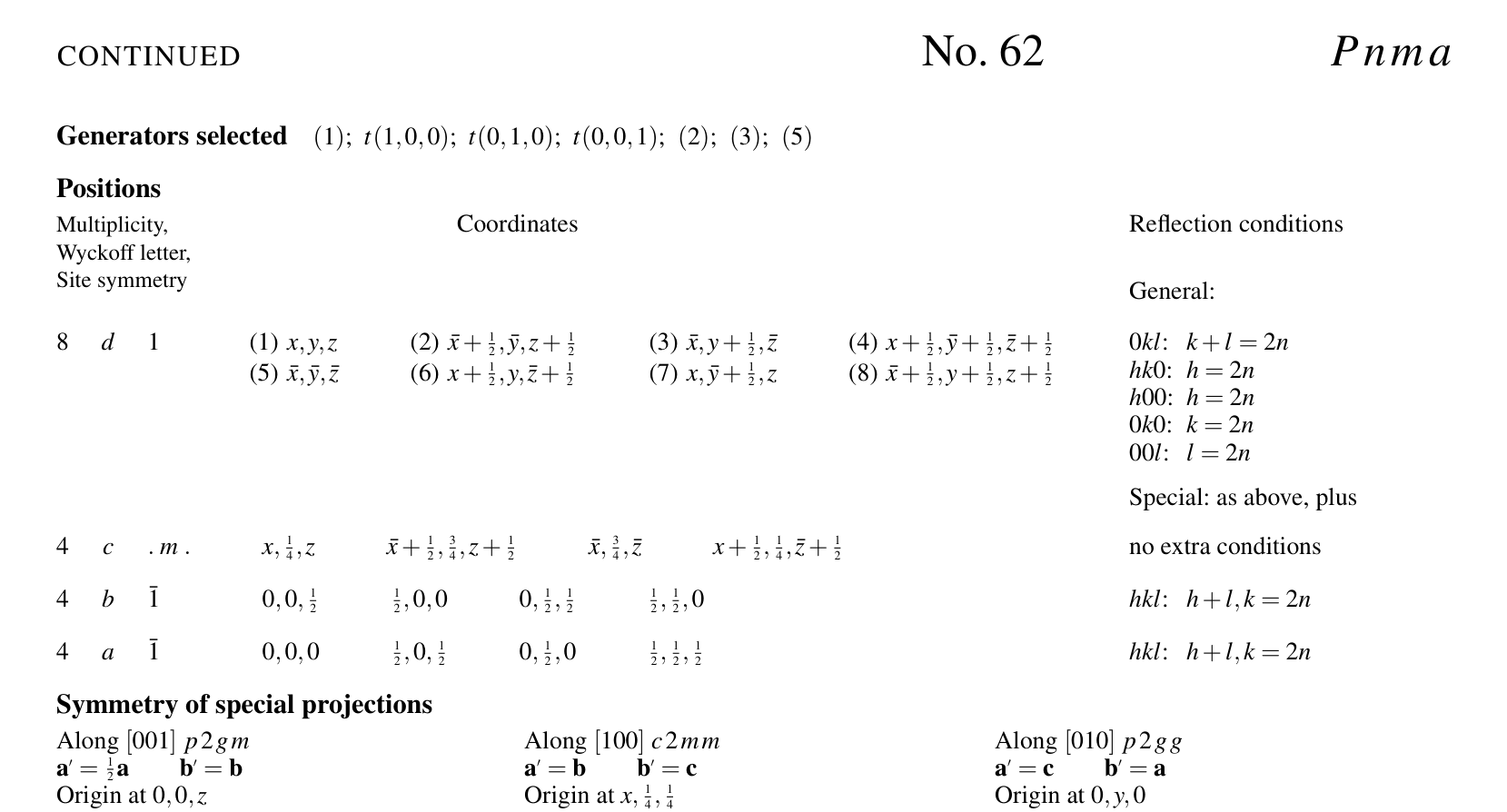
Pnma: generators and positions
International Tables for Crystallography, Vol. A, entry No. 62, p. 355.
This is the second page of the Pnma entry, and it holds the two blocks we came for, the generators and the positions.
[advance: zoom the generators line]
Generators selected reads the same way it did for P21 /c(1) is the identity ; the three t entries are the unit-cell translations along a, b, and c, and they put the lattice into the group Then three of the group's own numbered operations, (2), (3), and (5)
The group has eight operations and the entry lists three , because the other five are products of these three
The line is the shortest recipe that rebuilds the group , not an inventory of it
[advance: frame the general position]
The top row is 8d, the general position : eight coordinate entries printed four to a row
Each entry is one operation acting on a general point x, y, z
Counting the entries counts the operations , so the multiplicity 8 and the eight circles on the drawing we just left are the same eight things
[advance: label three operations]
The entry numbers its eight operations , matching the Symmetry operations list on the facing page, so we can name any entry
Entry (2) , minus x plus one half, minus y, z plus one half: the screw along c , flipping the two coordinates perpendicular to c and adding half of c Entry (5) , minus x, minus y, minus z: the inversion through the origin , and Pnma never wrote it , just as P21 /c never wrote its ownEntry (6) , x plus one half, y, minus z plus one half: the a glide perpendicular to c , z reflecting through the plane and x picking up the half-a slide
[advance: the special positions]
Below sit the special positions , the rows with multiplicity 4
The column beside the letter is the one to learn, the site symmetry : written in the group symbol's own direction slots , a first, then b, then c, naming the elements that leave that site alone
4c reads dot m dot : nothing in the a slot, an m in the b slot , the mirror perpendicular to b, nothing in the c slotA dot means no element along that direction 4b and 4a read 1 bar : those sites sit on inversion centers
[advance: work the halving]
Work the multiplicity out for 4c : its coordinate is x, one quarter, z , so y is pinned at one quarter
One quarter is exactly where the mirror sits : operation (7) is m at x, one quarter, z
Run it on the site and it reflects y through one quarter , sending the point to itself
One operation out of eight leaves the atom in place , so the copies pair off : eight over two is four , the multiplicity the entry printsThat is the whole method: read the slots against the drawings , count the general position , and check what each special site stands on
Next is P4 sub 1 2 sub 1 2, where the principal axis leads the symbol and a fourfold enters the drawings.
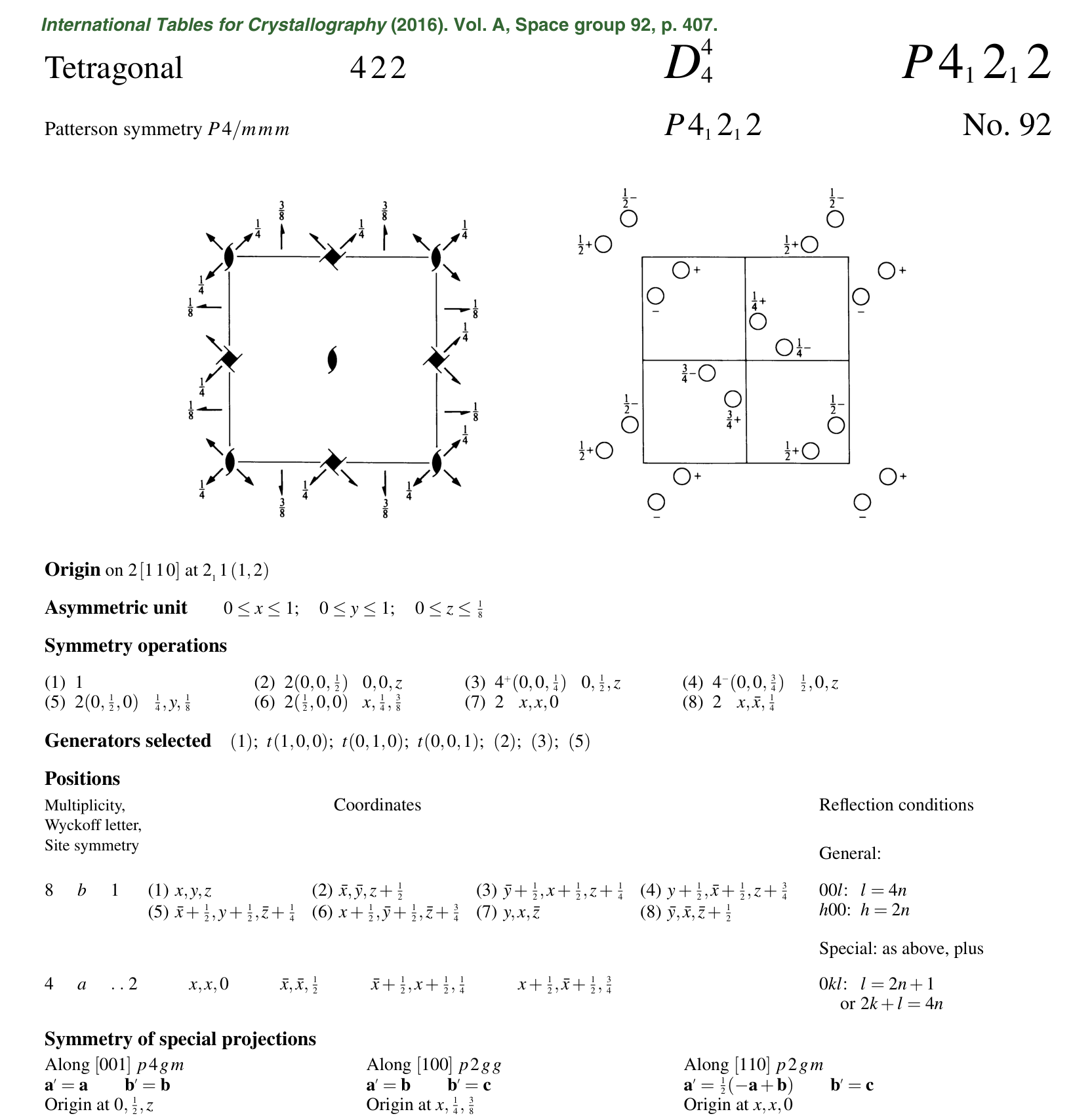
P41 21 2: reading the entry
International Tables for Crystallography, Vol. A, entry No. 92.
This is the entry for P4 sub 1 2 sub 1 2, number 92, printed the same way as the two we just read.
Same layout: the head names the group , the two diagrams draw one unit cell , the blocks underneath list the operations and the positions
What changes is the crystal system : tetragonal gives the symbol three directions to name instead of one
So we read it slot by slot as on P21 /c, but with three slots after the lattice letter instead of one
[advance: read the head of the entry]
Head line: crystal system tetragonal , point group 422 , Schoenflies symbol D4 4
On the right, the short symbol P41 21 2 and the entry number, 92
Below the head, the full symbol is the same string : tetragonal names all three directions already , so there is no empty slot to fill with a 1, the way P121 /c1 had to fill two
[advance: tie the three slots to the three directions]
The slots in order: principal axis first , then the cell edges , then the in-plane diagonals
41 along c , straight out of the page; 21 for both cell edges , a and b; the last 2 for both face diagonals , ⟨110⟩Three slots, three families of axes, and every symbol drawn below belongs to one of them
[advance: circle the 4 sub 1 axes]
Left diagram looks down c , so an axis along c points at you and is drawn as a filled shape
The filled squares with tails , circled, are the 41 axes , at the four edge midpoints , not the corners: printed as 4+ (0,0,¼) at 0,½,z
Each turn is 90° and rises a quarter of c
The pointed ovals at the corners and cell center are twofold screws along c , operation (2), 2(0,0,½) at 0,0,z : the 41 run twice
[advance: the twofolds lying in the page]
Arrows drawn flat in the page are the other two families, and the arrowhead tells you which
Full head, plain rotation : along the diagonals, 2 at x,x,0 and 2 at x,x̄,¼ , the ¼ being its height above the page Half head, screw : the arrows along the cell edges are the 21 axes of the second slot , and ⅛ and ⅜ are the heights of operations (5) at ¼,y,⅛ and (6) at x,¼,⅜ Those fractions say where the axis sits , not how far the screw slides: the slide is still half a cell edge
[advance: follow the quarter-turn staircase]
Right diagram drops the symbols and draws the copies of one general atom , each with its height printed beside it
Follow the four plus copies around the 41 axis at the top edge: z, z+¼, z+½, z+¾
Four turns of 90°, four rises of a quarter, and the fifth turn lands on the first atom one cell higher : that is what makes it a screw axis and not four unrelated atoms
The minus copies are those same four turned over by the twofolds
Every height on this diagram is written out as coordinates below, so that is where we go next.
P41 21 2: positions and handedness
International Tables for Crystallography, Vol. A, entry No. 92.
This is the same entry, lower half, with the same three blocks we used for P2 sub 1 over c: the numbered symmetry operations, the generators line, and the positions.
[advance: read the generators line]
Generators selected : (1), the three cell translations , then (2), (3) and (5) Same short recipe as before: the identity, the lattice , and just enough operations to rebuild the rest, here the 21 along c , the 41 , and one edge screw
The diagonal twofolds are missing , and they need not be there: apply the edge screw, then turn by the 41 , and you land on operation (8), the twofold at x,x̄,¼
Same thing the P21 /c page did when it left the glide off
[advance: the general position and its quarter rises]
The positions block opens with the general position : multiplicity 8 , Wyckoff letter b , site symmetry 1
Eight operations, eight copies of an atom placed anywhere, one column each Read the z coordinates along the top row: z, z+½, z+¼, z+¾
Those quarter rises are the staircase we just followed , written as arithmetic
[advance: the special position on the diagonal twofold]
One special position, 4a , site symmetry printed . . 2
The dots are slots , the same three as the group symbol: c, cell edges, diagonals , so a 2 in the third slot says the site sits on a diagonal twofold
The coordinates say it too, x,x,0 , exactly where the operations list puts operation (7)
An atom on that axis is carried onto itself , so eight copies collapse to four : sit on an element and the multiplicity divides
[advance: no inversion, no mirror, no glide]
Read the whole operations list for what is not in it : the identity, three turns about c, all screws , two more screws along the cell edges, two plain twofolds along the diagonals
No inversion center, no mirror, no glide anywhere on this pageNothing here can turn a left hand into a right one , so every molecule in the crystal has the same handedness : why a single enantiomer so often crystallizes in a group like this
The reflection conditions belong to diffraction again, so we note them and move on
Next we read a trigonal entry, P 3 bar m 1, where the slot rule decides the whole answer.
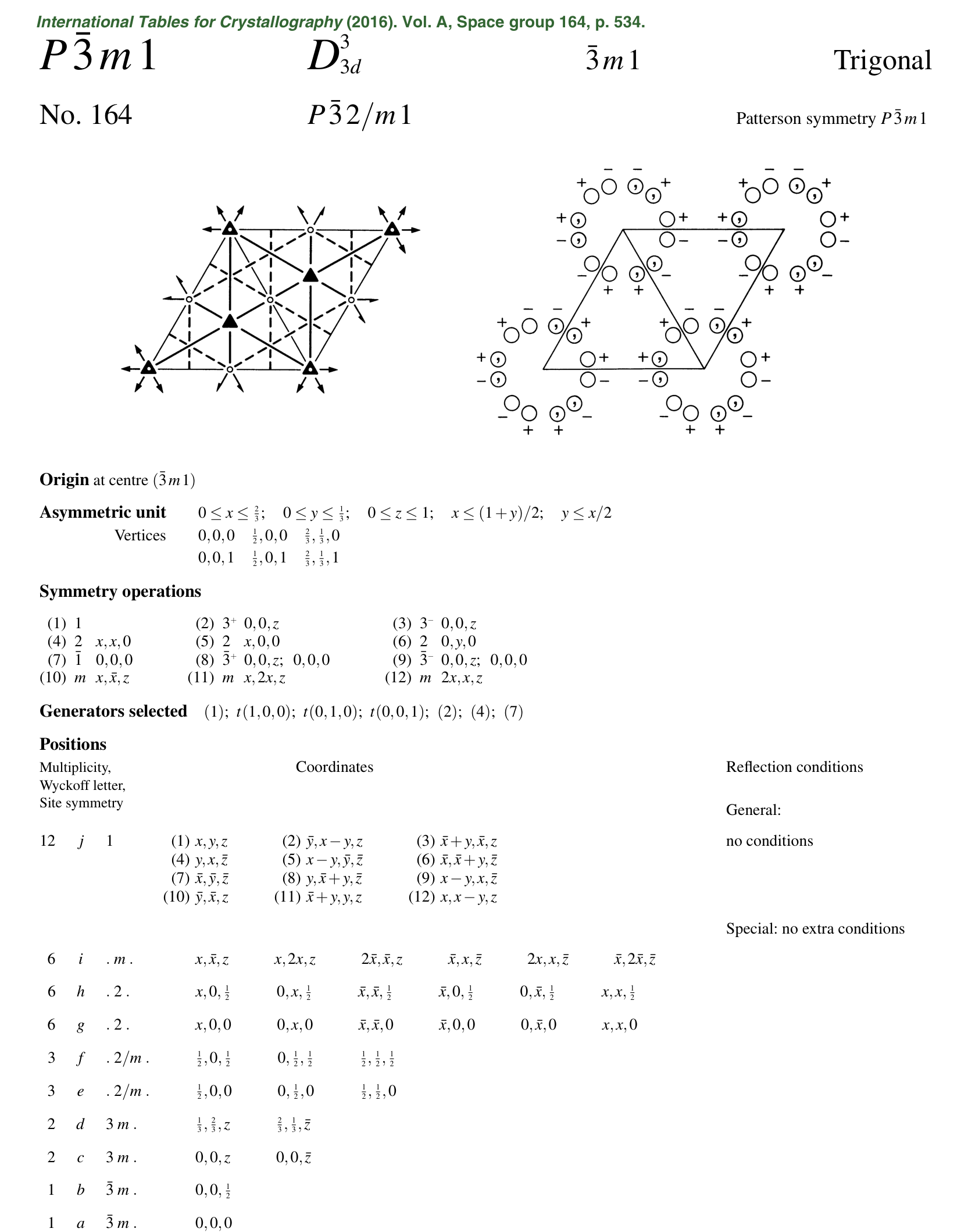
P3̄m1: reading the entry
International Tables for Crystallography, Vol. A, entry No. 164.
Trigonal comes next, and this entry is the one worth reading slowly, because its symbol names a direction and then puts nothing on it.
Page No. 164, P3̄m1 , laid out exactly like the P21 /c page
A header line , two diagrams of one cell , the numbered list of operations , the positions block at the bottom
[advance: read the header line]
The short symbol P3̄m1 , the Schoenflies symbol D3d , the point group 3̄m1 , the symmetry left if you shrink the crystal to a point, then the crystal system, Trigonal
Underneath, the group number 164 and the full symbol P3̄2/m1 : same group, but the full symbol prints something in every position
The P in front is the lattice, one lattice point per cell
[advance: split the full symbol into its three slots]
Three slots, one per trigonal direction: c, then the three cell edges, then the in-plane diagonals
3̄ along c , a threefold with an inversion centre on it ; 2/m on the edges , twofolds along them and mirrors perpendicular to themThe third slot holds a 1 : a direction the symbol must name and that carries nothing , so the diagonals have no twofold and no mirror
An empty slot is still a statement , and the full symbol prints the 2 and the m on the slot they belong to
[advance: mark the corners of the cell]
The left diagram draws the symmetry elements, looking down c , cell as a parallelogram
Every corner carries a filled triangle with an open centre : a threefold pointing at you with an inversion centre on it , the 3̄ of the first slot
The entry lists them as operations 8 and 9 , 3̄+ and 3̄− about 0, 0, z, both through the origin
So the threefold repeats at every lattice point , the way the screws multiplied across the P21 /c diagram
[advance: find the second slot on the drawing]
The heavy solid line down the cell is a mirror seen edge on , the entry's operation 12, m 2x, x, z
Its trace runs along a third-slot direction , corner to opposite-edge midpoint, so the plane itself stands perpendicular to the b edge : named for the edge, drawn along the line it contains
The full arrows along the top edge are a twofold in the plane of the page , operation 6, the 2 at 0, y, 0 along b
Axis along the edge, plane perpendicular to it, one shared slot : that is 2/m in the second position , and the diagonals carry nothing
Now watch what happens when that same m moves one slot to the right.
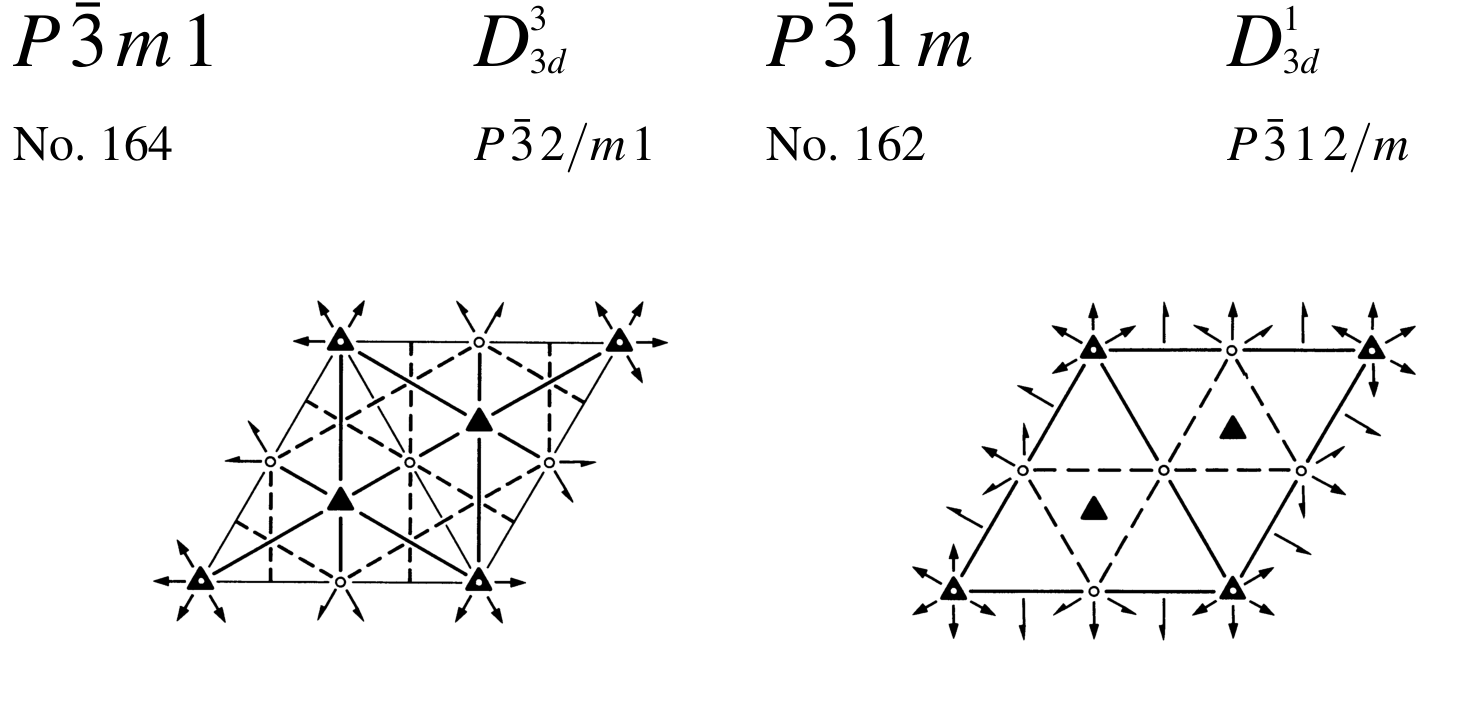
The same m, one slot over: P3̄1m
International Tables for Crystallography, Vol. A, entries No. 164 and No. 162.
Here is No. 164 again on the left, and beside it the entry for No. 162.
Same crystal system, same 3̄, same kinds of operation And they are two different space groups
[advance: compare the two headers]
Left: P3̄m1 , in full P3̄2/m1 . Right: P3̄1m , in full P3̄12/m
Identical characters, different order : in 164 the 2/m is in the second slot and the 1 in the third; in 162 the 1 is second and the 2/m third So 164 gives its twofolds and mirrors to the cell edges and leaves the diagonals bare; 162 gives them to the diagonals and leaves the edges bare
[advance: follow the mirror traces on both diagrams]
Left: the trace runs down the page along a third-slot direction , so the plane stands perpendicular to the b edge : 164's operation 12, m 2x, x, z
Right: the trace runs along the top cell edge , so the plane contains the edge and stands perpendicular to a diagonal : 162's operation 12, m 0, y, z
The same mirror turned by thirty degrees , and the drawing turns with it: 162's twofold arrows lie along the diagonals , 164's along the edges
[advance: say what separates them]
Same inventory , a threefold with an inversion centre, three twofolds, three mirrors, and still different groups , because the operations point at different directions of the same lattice That is why a space-group symbol is read position by position and not as a word
A site that lies on a mirror in one lies on nothing in the other : different multiplicity, different site symmetry
That is what the positions block of No. 164 is about.
P3̄m1: positions
International Tables for Crystallography, Vol. A, entry No. 164.
Back to No. 164 and down the page, to the numbered operations, the generators line under them, and the positions block below that.
[advance: read the generators line]
Twelve numbered operations, and the generators line picks the few that make the rest : (1), the three cell translations, (2), (4), (7)
(2) the threefold about c, (4) a twofold along a cell edge, the 2 at x, x, 0, (7) the inversion at the origin The translations put the lattice in , as they did for P21 /c, and the rest follows: the second threefold is the first applied twice , the other twofolds are the first turned by the threefold , and each mirror is a twofold followed by the inversion , the 2/m relation from the first meetings
[advance: frame the general position]
The block opens with the general position, 12 j : an atom at a general x, y, z, on no symmetry element , gets twelve copies, one per numbered operation
Twelve is no coincidence : it is the number of operations in the point group 3̄m1 , the one printed in the header, so the general position is the point group as a count of atoms The Wyckoff letters run from the bottom up , which is why the general position here is j ; the letters only tell the sites apart
[advance: climb the ladder of special positions]
6 i , site symmetry m : the atom lies on a mirror , the mirror maps it to itself, twelve collapse to six ; 6 h and 6 g lie on a twofold , same count3 f and 3 e , site symmetry 2/m : four operations fix the atom , twelve drops to three2 d and 2 c sit on the threefold with its mirrors , site symmetry 3m : six operations fix them , twelve drops to twoMultiplicity times the number of operations that fix the site is twelve on every row : the halving from P21 /c in its general form
[advance: work the halving at the bottom of the ladder]
1 a at 0, 0, 0 , site symmetry 3̄m , the full point group of the crystal Every one of the twelve operations leaves the origin where it is : the threefold turns about it, the twofolds run through it, the mirrors contain it, and the inversion centre is it Twelve operations, one atom : read from the site upward the block is a chemical statement , not a table, and choosing a site fixes the symmetry of the atom and its coordination environment
Next is cubic Pa3̄, where the glide plane and the threefold sit in the same symbol.
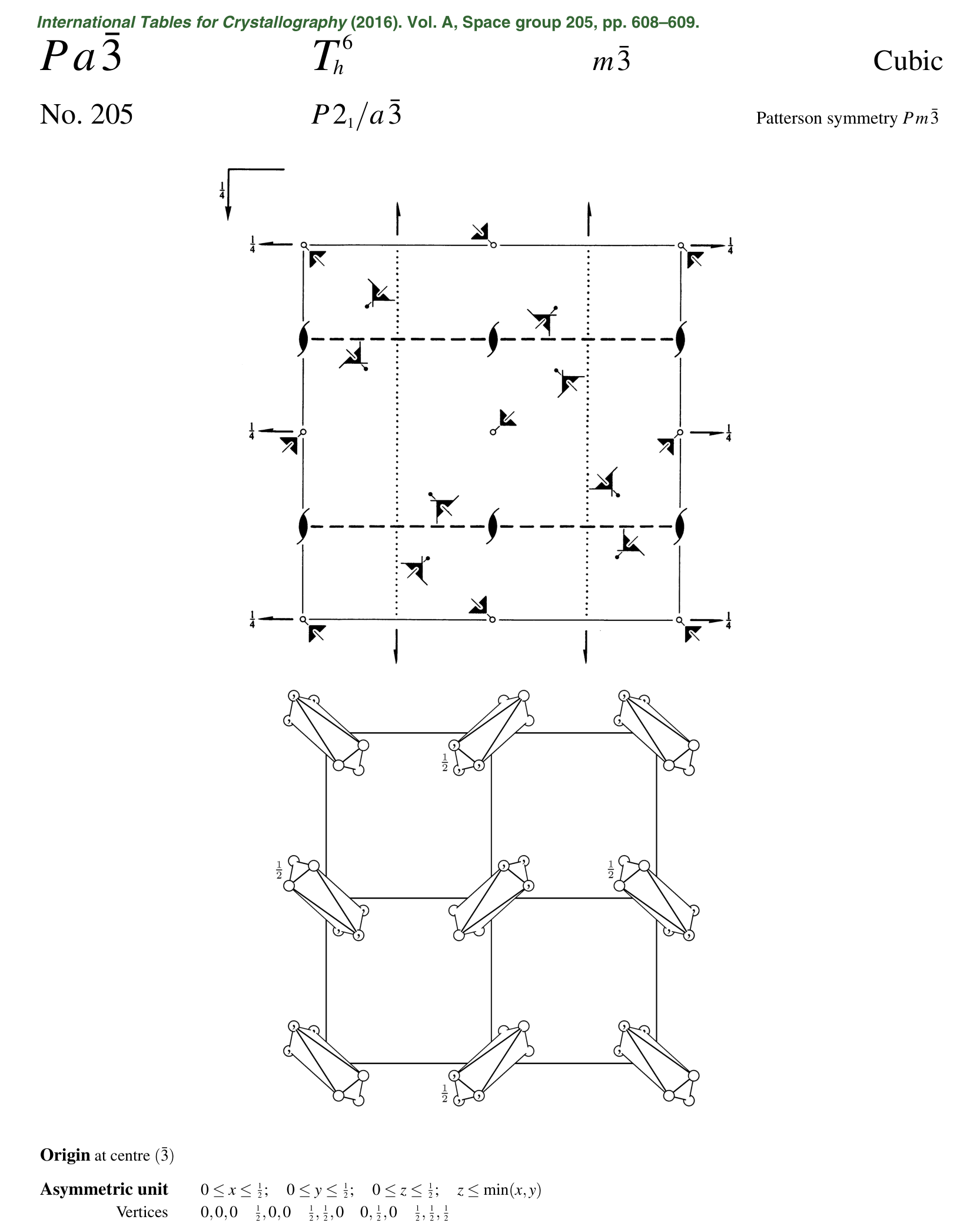
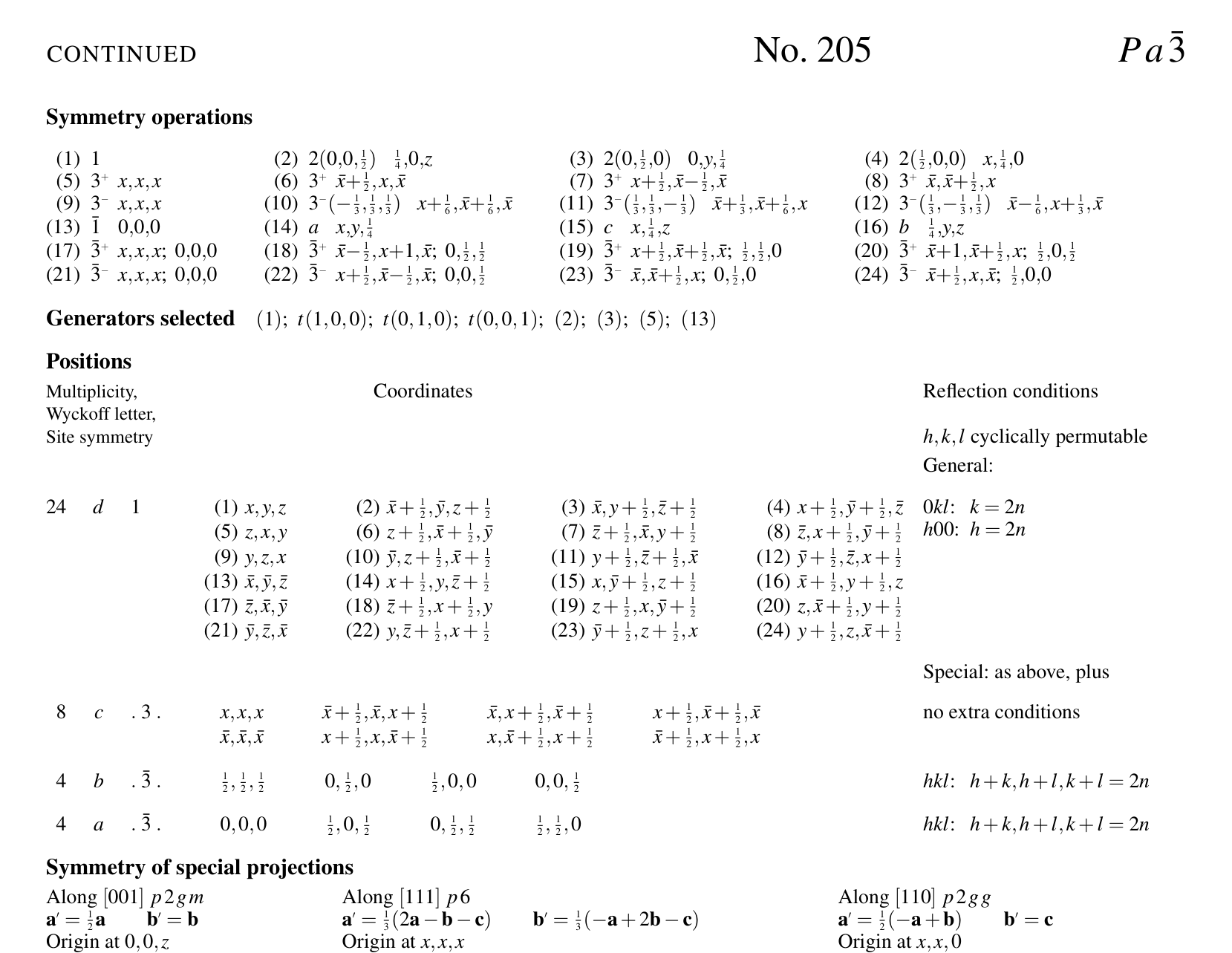
Pa3̄: reading the entry
International Tables for Crystallography, Vol. A, entry No. 205, pp. 608–609.
This is the entry for P a 3 bar, space group number 205, and it is cubic.
The page looks busier than P21 /c because a cubic cell carries symmetry along three kinds of direction at once
We read it region by region , with the same method
[advance: zoom the header]
Top line: short symbol Pa3̄ , Schoenflies Th 6 , point group m3̄ , crystal system cubic
Below it, the entry number 205 and the full symbol
Pa3̄ position by position : P the primitive cubic lattice, the a is an a glide perpendicular to the cell edges , the 3̄ a roto-inversion axis along the body diagonals
[advance: the full symbol and its empty slot]
The full symbol prints P21 /a3̄ : a 21 screw shares the first position with the a glide, the axis along the cell edge, the plane perpendicular to it
Cubic has three positions , cell edges then body diagonals then face diagonals, and this entry stops after two
P3̄m1 wrote a 1 in its empty third position; here the Tables print nothing there at all , the same meaning, and you need to recognize both
[advance: the screw axes along the cube edges]
The cell diagram looks down c , with a down the page and b across it
The pointed ovals circled in blue are 21 axes along c, end-on , the symbol the monoclinic entry used
Half arrows across the page: 21 along b at height one quarter . Half arrows down the page: 21 along a at height zero The entry's own operations name all three, (2) along c, (3) along b, (4) along a
One screw in the symbol, three directions in the crystal : cubic symmetry carries one cell edge onto the other two
[advance: the three glide planes]
Dashed lines : a b glide perpendicular to a , operation (16), b at ¼,y,z Dotted lines : a c glide perpendicular to b , operation (15), c at x,¼,z Bent arrow marked one quarter : the a glide perpendicular to c , operation (14), a at x,y,¼ , face-on because that plane lies parallel to the pageSection 1.4.1 : dashed is an axial glide whose half translation lies in the page , dotted one whose half translation points out of it . Section 1.4.2 gives the bent arrow: glide direction along the arrow, height beside itThe named a glide is one of a cyclic set : a perpendicular to c, then c perpendicular to b, then b perpendicular to a
[advance: the threefolds along the body diagonals]
The filled triangles with a line through them are the 3̄ axes , and they are what makes this group cubic
They run along the body diagonals , so they sit at an angle instead of end-on, and the four orientations are the four diagonals
Operations 17 through 24 : eight operations for four axes, because each 3̄ runs both waysA threefold about a body diagonal cycles a to b to c , so one printed a glide comes with a c glide and a b glide beside it
[advance: count the general position]
Each cluster is six circles , three plain and three carrying a comma , the comma marking a copy an inversion turned over
One cell holds four of those clusters , one at the origin and three at face centers: 4 × 6 = 24
The next page turns that count into a table.
Pa3̄: positions
International Tables for Crystallography, Vol. A, entry No. 205, p. 609.
This is the second page of the entry, laid out exactly like the monoclinic one: a generators line, and under it the positions block.
[advance: zoom the generators]
Generators selected : (1) the identity, the three unit-cell translations along a, b and c, then (2), (3), (5) and (13) (2) and (3) are two of the screws we just read, (5) a threefold along a body diagonal , (13) the inversion at the origin
Eight entries rebuild all twenty-four operations : a threefold about a body diagonal turns a screw along c into a screw along a, so the entry keeps two of the three screws and lets the threefold make the rest
[advance: the general position]
The block opens with the general position, row 24d, site symmetry 1
An atom at an arbitrary x, y, z , on no symmetry element, gets twenty-three more copies
24 is the order of the point group m3̄ , and the row prints one coordinate triple per operation in the entry's numbered order, so (14), (15) and (16) are the three glide planes we just read off the diagram
[advance: read the site symmetries]
The rows below have smaller multiplicities : the special positions , sites that lie on a symmetry element
Site symmetry is written the way a space-group symbol is : one slot per cubic direction, cell edges then body diagonals then face diagonals, with a dot where the site has nothing Row 8c reads . 3 . : nothing on the cell edges, a threefold along a body diagonal , nothing on the face diagonalsRows 4b and 4a read . 3̄ . , the same threefold with an inversion center sitting on it
[advance: halve the general position]
Row 4a : its first coordinate is 0, 0, 0 , and the origin lies on a 3̄ axis That site-symmetry group has order six , three rotations and their three inverted partners, and all six leave the atom where it is
So the twenty-four general points collapse: 24 ÷ 6 = 4 , the multiplicity the row prints
The four coordinates are the origin and the three face centers we counted in the diagram, and this multiplication is how you count atoms in a real structure next meeting
Before that, one card that turns any short symbol into a crystal system, a lattice, and a point group.
Reading a short symbol
Crystal system Shape Its point groups What the positions mean, in order
Triclinic all skew 1, 1̄ no direction to name Monoclinic one lean 2, m, 2/m one direction: b Orthorhombic a brick 222, mm2, mmm a , then b , then c Tetragonal square column 4, 4̄, 4/m, 422, 4mm, 4̄2m, 4/mmm c ; then a and b ; then the in-plane diagonalsTrigonal & hexagonal 120° base 3, 3̄, 32, 3m, 3̄m; 6, 6̄, 6/m, 622, 6mm, 6̄m2, 6/mmm c ; then the cell edges; then the in-plane diagonalCubic a die 23, m3̄, 432, 4̄3m, m3̄m the cell edges; then the body diagonals; then the face diagonals
Per Solid State Materials Chemistry , §1.1.3, Table 1.1 and §1.1.7, Table 1.3.
1. Crystal system write every glide as m and every screw as its rotation, then match what is left against a row above: mma becomes mmm, orthorhombic. A 3 in the first position is trigonal, in the second cubic
2. Bravais lattice the leading letter is the centering, and system plus letter name the lattice; a trigonal group under P sits on the primitive hexagonal lattice, under R on the rhombohedral
3. Point group the replaced symbol of step 1, without its lattice letter, is the point group
4. Symmorphic? if you replaced anything in step 1, the symbol carries a glide or a screw and the group is non-symmorphic
Everything we did on five entries comes down to one card, and this is the card I want in front of you when you work the practice questions.
The table is the one from the middle of the meeting , extended: every system, triclinic included , with a shape to remember it by : the names already tell you the shape
Monoclinic is one lean , orthorhombic a brick , tetragonal a square column , cubic the die ; triclinic is all skew , no direction to name, point groups 1 and 1̄
Next to the shapes, the point groups that belong to each system and what each position points along
Under it, the recipe arrives one step at a time , and four steps take any short symbol apart
[advance: step one, the crystal system]
Step one turns the symbol into a point group you can recognize: write every glide as a plain m and every screw as its plain rotation , then find the row whose point groups contain what is leftThe a in Pmma is a glide and counts as a plane, so what is left is mmm , and mmm sits in the orthorhombic row
Two systems need a tiebreak, and it is where the 3 sits : first position, along c, is trigonal ; second position, along the body diagonals, is cubic
[advance: step two, the Bravais lattice]
Step two : the leading letter is the centering , P, C, I, F or R, and the crystal system says which of the fourteen lattices the pair namesOne exception, worth memorizing, and it catches everybody : a trigonal symbol starting with P is described on the primitive hexagonal lattice, and only one starting with R uses the rhombohedral
[advance: step three, the point group]
Step three costs nothing , because step one already did the work: take the replaced symbol , drop the lattice letter , and that is the point groupPmma gave mmm, so the point group is mmm
[advance: step four, symmorphic or not]
Step four : if step one had to replace anything , the symbol carries a glide or a screw and the group is one of the 157 non-symmorphic onesIf nothing needed replacing , it is one of the 73
Two symbols next, and you work them with these four steps before I answer anything.
Your turn: Pmma and P3m1
Short symbol Crystal system Bravais lattice Point group
P mma orthorhombic primitive orthorhombic mmm
P 3m1 trigonal primitive hexagonal 3m, written 3m1
Take these two symbols and work out the three answers before I show them.
Both are short symbols, Pmma and P3m1 , and for each one I want the crystal system , the Bravais lattice , and the point group , in that order
Start with Pmma
[advance: Pmma is orthorhombic]
Three positions after the lattice letter: two mirrors and one a glide A glide is still a plane, so write it as an m and the symmetry part reads mmm , which is orthorhombic
The three positions mean a, then b, then c , so those planes are perpendicular to the three cell edges
[advance: Pmma sits on the primitive orthorhombic lattice]
The leading letter is P , primitive, and the system is orthorhombic: the lattice is primitive orthorhombic
Nothing is centered , and the lattice points sit on the corners of the cell alone
[advance: the point group is mmm]
The point group is what step one gave us, mmm
Dropping the a glide's half translation leaves a plain mirror perpendicular to c , alongside the mirrors perpendicular to a and b : three mirrors, and that is the whole point group
[advance: P3m1 is trigonal]
Now P3m1 . The 3 sits in the first position , which for a threefold means along c , so the group is trigonal
Had the 3 sat in the second position , along the body diagonals, we would be reading a cubic group
[advance: P3m1 sits on the primitive hexagonal lattice]
P is primitive again, and this is where the exception bites A trigonal group starting with P is described on the primitive hexagonal lattice, a = b and γ = 120°
Only the trigonal groups starting with R sit on the rhombohedral lattice, and this one does not
[advance: the point group is 3m, written 3m1]
Say it as 3m , write it as 3m1 , because the slot the m sits in is the whole answer
The second trigonal position is the cell edges , so these mirrors stand perpendicular to the cell edges ; the third position , the in-plane diagonal, holds nothing, which is what the 1 records
Slide that m one position over and you have P31m , a different group with its mirrors turned thirty degrees , the pair we put side by side on the trigonal entries
Two more symbols next, and this time I want to know whether the group is symmorphic as well.
Your turn: I41 /a and Fd3̄m
Short symbol Crystal system Bravais lattice Point group Symmorphic?
I 41 /a tetragonal body-centered tetragonal 4/m non-symmorphic
F d3̄m cubic face-centered cubic m3̄m non-symmorphic
Two more symbols, and now four answers each: the crystal system, the Bravais lattice, the point group, and whether the group is symmorphic.
These are I41 /a and Fd3̄m , and neither has been on the screen today
Start with I41 /a
[advance: I41/a is tetragonal]
Step one, two things to replace : the 41 is a screw , so write a plain 4 ; the a is a glide , so write an m
What is left is 4/m , which sits in the tetragonal row
[advance: I41/a sits on the body-centered tetragonal lattice]
The leading letter is I , body centering, one extra lattice point at the middle of the cell
With a tetragonal system that is the body-centered tetragonal lattice
[advance: the point group is 4/m]
The replaced symbol without its lattice letter: 4/m , a fourfold along c with a mirror perpendicular to it
The tetragonal second and third positions , the cell edges and the in-plane diagonals, are empty , so the symbol stops after one position
[advance: I41/a is non-symmorphic]
Step one replaced two things, a screw and a glide , so the group is non-symmorphic
It cannot be built from a Bravais lattice and a point group alone : one of the 157
[advance: Fd3̄m is cubic]
Now Fd3̄m . The d is a diamond glide and becomes an m , nothing else changes, and what is left is m3̄m
The 3̄ sits in the second position , along the body diagonals , so this one is cubic
[advance: Fd3̄m sits on the face-centered cubic lattice]
F is face centering , a lattice point at the middle of every face With a cubic system that is the face-centered cubic lattice
[advance: the point group is m3̄m]
m3̄m , the full symmetry of the cube : a mirror perpendicular to the cell edges , a 3̄ along the body diagonals , a mirror perpendicular to the face diagonals One for each of the three cubic positions
[advance: Fd3̄m is non-symmorphic]
One replacement was enough , the d glide , so Fd3̄m is non-symmorphic as wellBoth of these two came out non-symmorphic : the fractional translation is the thing the short symbol adds
Both of these groups hide a fractional translation that the point group alone would never show you, and that is the reading finished. The framework behind it fits in four lines.
What the space-group framework captures
Operations translation moves a whole repeat; a glide or a screw moves a fraction of one
230 groups 73 built from a Bravais lattice and a point group, 157 more from swapping in glides and screws
Symbols centering first, then the operations in their conventional directions
Next meeting start from fluorite in Fm3̄m and write a whole structure down compactly
Here is the whole framework on one slide.
We built three operations that carry translation : pure translation, the glide plane, and the screw axis
A Bravais lattice with a compatible point group gave the 73 symmorphic groups; swapping in glides and screws gave the other 157
Together that is the 230 , the complete list of crystal symmetries
A Hermann-Mauguin symbol names one group: centering first, then the operations in their conventional directions
You can now turn any symbol into a crystal system, a lattice, and a point group
Next meeting we start from a real structure instead of a symbol: fluorite in F m 3 bar m, written down compactly as a space group, a cell, and a handful of atomic positions.
Practice questions
Work the Lecture 3 practice questions
before the next class.
Open the Lecture 3 practice questions
Every question carries a worked
explanation, so you can check your reasoning as you go.
Your homework is the Lecture 3 practice set on the course website.
Open chem548.wileylab.org/practice.html#lec03-point or use the Practice link
Complete the set before the next class. Each question includes a worked explanation that you can use to check your reasoning.