Reading: Woodward, Karen, Evans, and Vogt, Solid State Materials Chemistry Ch. 1 §1.1.1, §§1.1.2–1.1.3
Learning Objectives
Five elementsdefine and describe identity, inversion, mirror, rotation, and rotoinversion
Point groupsay what makes a set of operations one, and assemble it by closing the set
Seven crystal systemsidentify each by the minimum symmetry it requires
Exactly 32account for why there are 32 point groups, and connect them to their crystal system
Directions and planesname a crystallographic direction and a lattice plane inside a unit cell
Oblique: 1 ↔ 2
a ≠ b, γ arbitrary. In lecture 1 we chose the cell that shows each lattice's symmetry; now we write that symmetry down as a Hermann–Mauguin symbol, a list of the point symmetry elements the pattern keeps. The bare lattice carries each shape's maximum symmetry; a motif can only lower it. Each title reads minimum ↔ maximum.
Lattice alone: the maximum
Every lattice keeps a twofold rotation
Hermann–Mauguin: 2
With a motif: down to the minimum
An asymmetric molecule removes it
Hermann–Mauguin: 1
Per Solid State Materials Chemistry, §§1.1.1–1.1.2.
Rectangular: m ↔ 2mm
a ≠ b, γ = 90°
Lattice alone: the maximum
Twofold plus two perpendicular mirror families
Hermann–Mauguin: 2mm
The fold flips the flag: mirrors reverse handedness, rotations never do.
With a motif: down to the minimum
A bent molecule keeps one mirror family
Hermann–Mauguin: m
Per Solid State Materials Chemistry, §§1.1.1–1.1.2.
Square: 4 ↔ 4mm
a = b, γ = 90°
Lattice alone: the maximum
Fourfold plus edge and diagonal mirror families
Hermann–Mauguin: 4mm
The turned flags stay right-handed; each m makes a copy no rotation can.
With a motif: down to the minimum
A pinwheel molecule keeps only the fourfold
Hermann–Mauguin: 4
Per Solid State Materials Chemistry, §§1.1.1–1.1.2.
Hexagonal: 3 ↔ 6mm
a = b, γ = 60°. The 120° cell from lecture 1 describes the same net.
Lattice alone: the maximum
Sixfold plus six mirrors in two alternating families
Hermann–Mauguin: 6mm
With a motif: down to the minimum
A three-bladed molecule keeps only a threefold
Hermann–Mauguin: 3
Per Solid State Materials Chemistry, §§1.1.1–1.1.2.
Summary: the four 2D crystal systems
In 4mm the number is a rotation axis, each m a family of mirrors containing it. A system is defined by the point symmetry it can carry: minimum is what membership requires, maximum what the bare lattice has.
2‑D crystal systems: minimum ↔ maximum point-group symmetry
Crystal system
Unit-cell metric (a,b,γ)
Minimum symmetry (H–M)
Maximum symmetry (H–M)
Oblique
$a \neq b,\; \gamma \neq 90^\circ, 60^\circ$
1 (no symmetry)
2 (one twofold rotation)
Rectangular
$a \neq b,\; \gamma = 90^\circ$
m (one mirror)
2mm (twofold + two perpendicular mirror families)
Square
$a = b,\; \gamma = 90^\circ$
4 (four-fold only)
4mm (fourfold + mirrors along edges and diagonals)
Hexagonal (triangular net)
$a = b,\; \gamma = 60^\circ$
3 (three-fold only)
6mm (sixfold + six mirrors)
A motif can lower the symmetry of a lattice while the lattice retains its own maximum symmetry.
2-D Bravais lattices (5 total)
Bravais lattice
Lattice type
Metric constraints
Notes / equivalences
Oblique (p)
primitive
$a \neq b,\; \gamma \neq 90^\circ, 60^\circ$
General parallelogram.
Rectangular (p)
primitive
$a \neq b,\; \gamma = 90^\circ$
Edges orthogonal, unequal lengths.
Rectangular (c)
centered
$a \neq b,\; \gamma = 90^\circ$
Distinct Bravais type. Conventional rectangle has a lattice point at the center; primitive basis can be taken as $\mathbf{u} = \tfrac{1}{2}(\mathbf{a}+\mathbf{b})$, $\mathbf{v} = \tfrac{1}{2}(-\mathbf{a}+\mathbf{b})$ (a rhombus).
Square (p)
primitive
$a = b,\; \gamma = 90^\circ$
Any “centered square” reduces to a primitive square via a $45^\circ$ rotation and rescale (not a new Bravais type).
Hexagonal / Triangular (p)
primitive
$a = b,\; \gamma = 60^\circ$
Often called “triangular” in 2-D. Any centering is equivalent to primitive.
Crystal systems and Bravais lattices
Aspect
Crystal system
Bravais lattice
What is classified?
Sets of point groups (rotations/mirrors about a fixed point)
Sets of vector lattices (translations) distinguished up to centering
Includes translations?
No
Yes (pure translations only; point symmetry comes from the lattice metric)
Within square: only p-square (any ‘centered square’ reduces to p-square). Rectangular admits p and c.
The Five Point Symmetry Elements
This morning rotations and mirrors sorted every 2D lattice into four systems; every symbol we wrote, like 2mm, was a list of them. Today's second half sorts the 3D lattices the same way: five elements, two of them new.
Point symmetry element
Symbol
Symmetry operation
vs. 2D
Identity
1
Every point stays in place; every object has it
same
Proper rotation axis
N
Rotate by 360/N° about the axis; only N = 1, 2, 3, 4, 6 fit a lattice
a point becomes an axis
Mirror plane
m
Reflect through the plane
a line becomes a plane
Inversion center
$\bar{1}$
Send every point through the center to the opposite side
new in 3D
Rotoinversion axis
$\bar{N}$
Rotate by 360/N° about the axis, then invert through a point on it
new in 3D
"Point symmetry" means each operation leaves some location unmoved: a rotation moves every point except those on its axis, a mirror leaves its plane, inversion leaves one center. A translation moves every point; the two elements that carry one arrive next meeting.
5 elements → groups → 7 crystal systems → 32 point groups
Inversion Center
Inversion through a point, called the center of symmetry
The element is written $\bar{1}$, read “one bar”
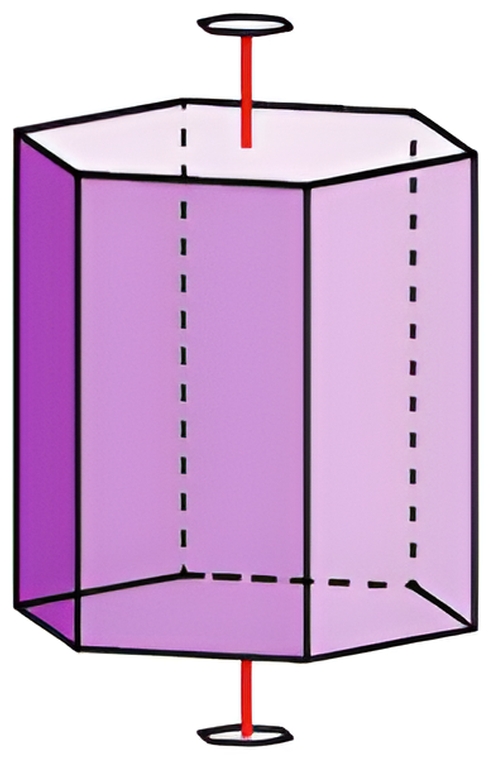
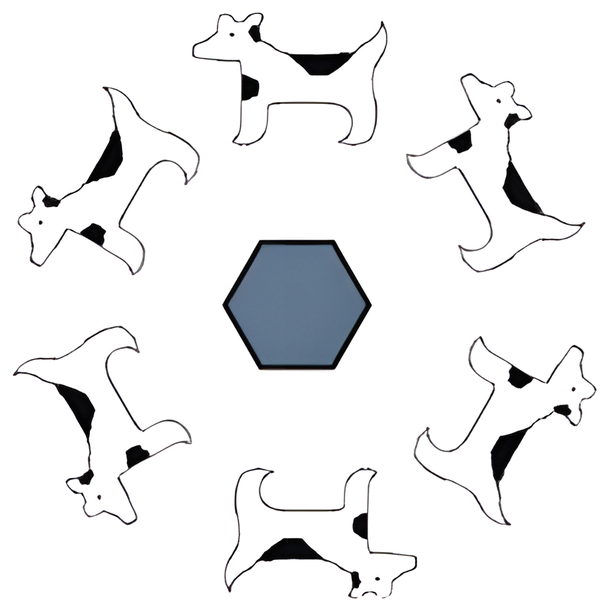
Sixfold Axis of Rotation
When rotated about its axis, the crystal repeats itself every 60° (six times in a 360° rotation).
In three dimensions a rotation turns about an axis, a line through the crystal, not a point.
Rotation Axes: Names and Symbols
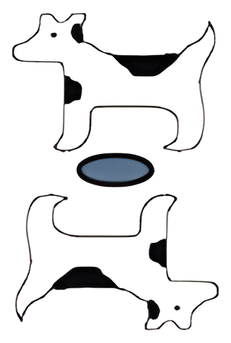
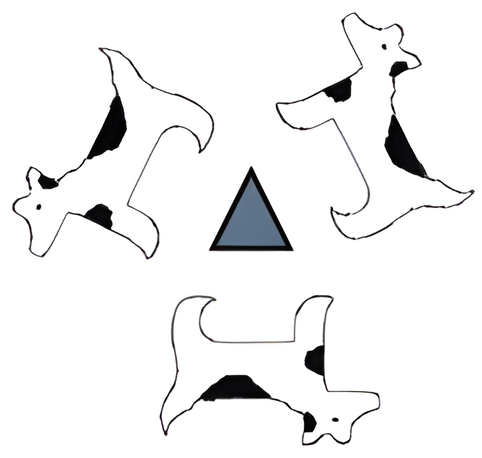
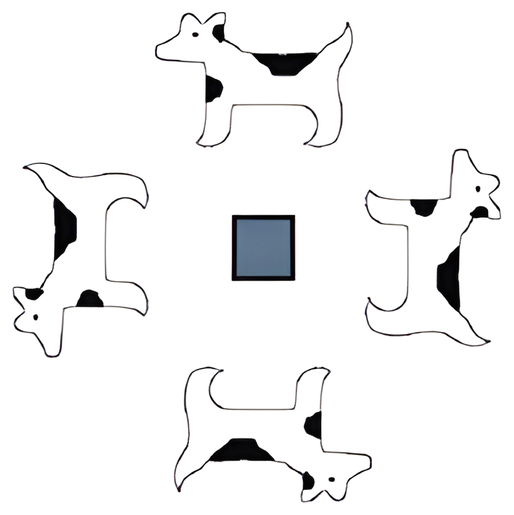
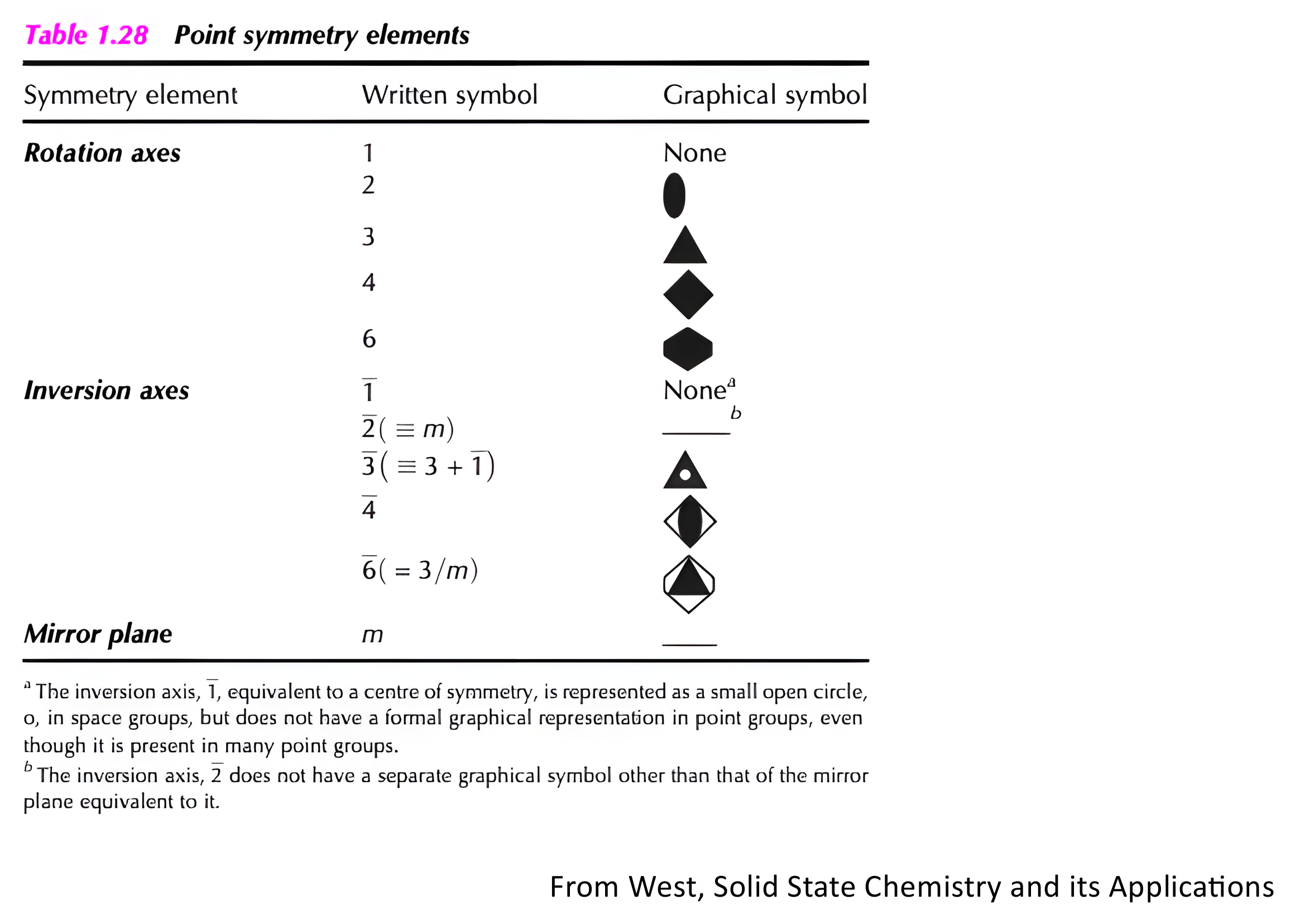
An $n$ fold rotational symmetry operation rotates an object by $360^\circ/n$. Only $n$ = 1, 2, 3, 4, and 6 are permitted in a periodic lattice.
2 fold ‘Diad’
3 fold ‘Triad’
4 fold ‘Tetrad’
6 fold ‘Hexad’
The blue marker at each center is the axis’s graphical symbol: lens, triangle, square, hexagon.
RotoInversion $\bar{N}$
$\bar{4}$: rotate $90^\circ$, then invert
$\bar{N}$: rotate by $360^\circ/N$ about the axis, then invert through a point on that axis.
Rotate $90^\circ$, invert: $0 \to 1$
Again: $1 \to 2$
Again: $2 \to 3$, then the set closes: four points
The $\bar{N}$ family
$\bar{1}$: inversion center
$\bar{2}$: $m$, a mirror plane
$\bar{3}$: rotate $120^\circ$, invert; six points
$\bar{4}$: rotate $90^\circ$, invert; four points
$\bar{6}$: rotate $60^\circ$, invert; six points
$\bar{1}$: A Full Turn, Then Invert
$\bar{1}$: turn by $360^\circ/1$ about the axis, then invert through the center.
Rotate $360^\circ$ (back to start), invert: straight through the center
$\bar{1}$ is the inversion center
$\bar{1} \equiv i$: rotating a full turn changes nothing, so all that is left is the inversion
$\bar{2}$: Half a Turn, Then Invert
$\bar{2}$: turn by $360^\circ/2$ about the axis, then invert through the center.
Rotate $180^\circ$, invert: the point lands straight below
$\bar{2} \equiv m$: a mirror plane perpendicular to the axis
$\bar{3}$: Rotate $120^\circ$, Then Invert
$\bar{3}$: turn by $360^\circ/3$ about the axis, then invert through the center.
Rotate $120^\circ$, invert: $0 \to 1$
Six equivalent points before it closes
$\bar{3}$ contains both a threefold and an inversion center
$\bar{6}$: Rotate $60^\circ$, Then Invert
$\bar{6}$: turn by $360^\circ/6$ about the axis, then invert through the center.
Rotate $60^\circ$, invert: $0 \to 1$
Two eclipsed triangles, one per circle
$\bar{6} \equiv 3/m$: a threefold axis with a mirror plane perpendicular to that axis
$N/m$: the slash always makes the mirror perpendicular to the $N$ axis it follows; an $m$ beside the number, as in $4mm$, contains the axis instead
Symmetry Element Symbols
The written symbol goes into a point-group or space-group symbol; the graphical symbol marks the element on a crystallographic diagram. The filled shape counts the order: a lens has two sides, a triangle three, a square four, a hexagon six.
Why Group the Symmetry Elements?
Lecture 1 sorted cells into seven crystal systems by shape. Shape is the consequence: each system is defined by the symmetry its lattice must carry.
One element at a time is not enough. A crystal's operations act together, and the set must close on itself: a group.
7 crystal systems → 32 point groups → × 14 Bravais lattices + screws and glides → 230 space groups → any crystal structure
A published structure is one space-group symbol plus a short list of atoms; symmetry generates the rest.
5 elements → groups → 7 crystal systems → 32 point groups
Why Point Groups? Faces, Not Atoms
The 32 classes were found before atoms could be seen, from two laws of faces, measured with a goniometer.
Steno 1669the angles between a mineral's faces are constant
Haüy 1784faces sit at orientations given by small whole numbers
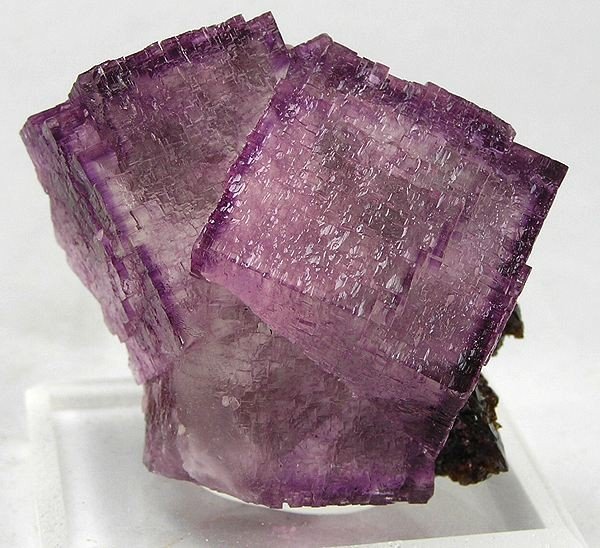
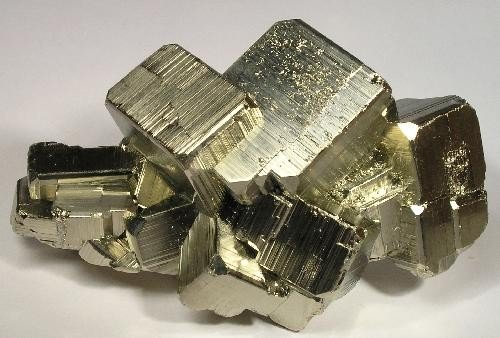
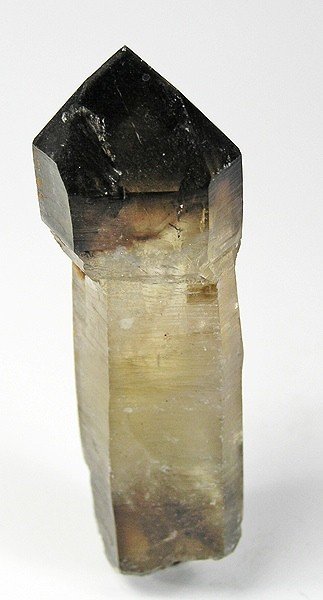
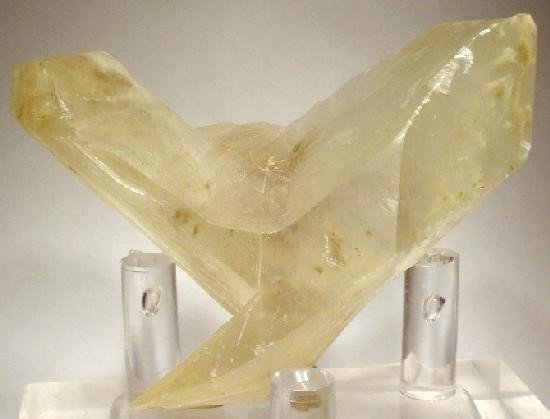
Fluorite — cubicPyrite — cubic, striations break the fourfoldQuartz — trigonal, left- and right-handed formsGypsum — monoclinic
Faces come in symmetry-related sets: the class is readable from the shape.
Symmetries never come one at a time: two operations in a row are some third operation, so a crystal's operations form a closed set.
Hessel (1830) counted the closed sets the face laws allow: exactly 32. Unnoticed; rederived by Gadolin (1867), 80 years before X-rays.
5 elements → groups → 7 crystal systems → 32 point groups
Point Groups
A point group is a set of symmetry operations, acting on an isolated object, that fulfils the four requirements of a group.
A group must have
closuretwo combined give one of the set
the associative lawany pair in a chain may go first
an identitythe do-nothing operation, written 1
an inverseevery operation has one that undoes it
Closure
This triangle has exactly three operations: do nothing (1), rotate 120°, and rotate 240°.
120° then 120° is the same net move as a single 240° rotation, and 240° is one of the three operations above. Combining two of them gave another one: closure.
Each operation lands the triangle back on its own outline. The red dot is not part of the triangle; it tells the three identical-looking positions apart.
The Associative Law
Both groupings land the marked corner in the same place.
The three rotations happen in the same order both times. The only choice is which two neighbors to merge into a single move first, and either choice gives the same result.
Identity
Combining 1 with any operation leaves that operation unchanged.
Inverse
120° and 240° undo each other: combined, they give the identity, so each is the inverse of the other.
An inverse is a partner operation, and every operation in a group has one. The inversion center $\bar{1}$ is a different thing: one particular symmetry operation, which happens to be its own inverse.
The Triangle's Point Group
The set: 1, rotate 120°, rotate 240°.
✓ closure: two rotations combined always gave a rotation of the set
✓ associative law: whichever neighboring pair we merged first, the corner landed in the same place
✓ identity: the do-nothing operation, 1, is in the set
✓ inverse: 120° and 240° undo each other, and 1 undoes itself
All four requirements hold, so these three rotations are a point group. Its symbol is 3: a single threefold axis.
The triangle also has three mirror planes through the axis; adding their operations gives a larger point group, 3m.
Question
Let's take a twofold rotation axis. And let's have a mirror plane perpendicular to it.
Is that a valid point group, just those two symmetry operations?
If not, what other symmetry operations do we need to add to those two to get a valid point group?
Point Group $2/m$
Four operations, four copies of the motif: 1 left it in place, 2 rotated it, m reflected it, and the new diagonal jump is $\bar{1}$, inversion through the center. Closure adds that inversion — the group is $\{1,\ 2,\ m,\ \bar{1}\}$, written 2/m: a twofold axis with a mirror plane perpendicular to it.
The Seven Crystal Systems
A crystal system is defined by the point symmetry it can carry; the cell shape follows.
This morning · two dimensions · four systems
obliqueup to 2
rectangularup to 2mm
squareup to 4mm
hexagonalup to 6mm
Now · three dimensions · seven systems, least required symmetry to most
triclinicnothing required
monoclinicone twofold
orthorhombicthree twofolds
tetragonala fourfold
trigonala threefold
hexagonala sixfold
cubicfour threefolds
Each slide that follows names one system's requirement and collects its point groups; the running count lands on 32.
5 elements → groups → 7 crystal systems → 32 point groups
Triclinic: nothing required
Drawn proportions are representative; the labels state only the required metric constraints.
Per Solid State Materials Chemistry, §1.1.3.
Point groups: $1$, $\bar{1}$ · 2 of 32
Monoclinic: one twofold axis
Per Solid State Materials Chemistry, §1.1.3.
Point groups: $2$, $m$, $2/m$ · 5 of 32
Orthorhombic: three twofold axes
Per Solid State Materials Chemistry, §1.1.3.
Point groups: $222$, $mm2$, $mmm$ · 8 of 32
Tetragonal: a fourfold along c
Per Solid State Materials Chemistry, §1.1.3.
Point groups: $4$, $\bar{4}$, $4/m$, $422$, $4mm$, $\bar{4}2m$, $4/mmm$ · 15 of 32
Trigonal: a threefold along c
Per Solid State Materials Chemistry, §1.1.3.
Point groups: $3$, $\bar{3}$, $32$, $3m$, $\bar{3}m$ · 20 of 32
Hexagonal: a sixfold along c
Per Solid State Materials Chemistry, §1.1.3.
Point groups: $6$, $\bar{6}$, $6/m$, $622$, $6mm$, $\bar{6}m2$, $6/mmm$ · 27 of 32
Cubic: four threefolds
Per Solid State Materials Chemistry, §1.1.3.
Point groups: $23$, $m\bar{3}$, $432$, $\bar{4}3m$, $m\bar{3}m$ · 32 of 32
Why Exactly 32?
Lecture 1: only the rotations $N$ = $1, 2, 3, 4, 6$ can repeat in a crystal. Each row puts something new on those axes, mirrors or twofold axes, and counts the groups; a symbol names the starting elements, so $2/m$ is the four operations $\{1,\ 2,\ m,\ \bar{1}\}$.
Three mutually perpendicular 2-fold axes or mirror planes
$222$, $mm2$, $mmm$
only $2$ and $m$, three positions
Monoclinic
Monoclinic
2-fold axis or mirror plane
$2$, $m$, $2/m$
a single $2$, $m$, or $2/m$
Triclinic
Triclinic
none
$1$, $\bar{1}$
$1$ or $\bar{1}$ alone
We built every tinted group earlier today; the rectangular lattice's $2mm$ appears here in its three-dimensional spelling $mm2$.
$32$ leads with the 3: trigonal, a threefold with perpendicular twofolds. $23$ has the 3 second: cubic, threefolds on the body diagonals.
Who Cares about Point Groups?
The symbol is shorthand for the full set of symmetries: say $2/m$ or $m\bar{3}m$ and an expert knows every operation present.
Optical, electrical, and mechanical properties depend directly on that symmetry
Piezoelectricityonly in non-centrosymmetric point groups
Ferroelectricityonly in certain polar point groups
Birefringenceset by the rotation axes that constrain the refractive indices
The point group rules whole classes of properties in or out before any measurement.
Point Coordinates
A point inside the cell is named by its coordinates along a, b, and c, as fractions of the cell edges: the origin corner is 000 and the opposite corner is 111.
Point coordinates for the unit cell center are $a/2,\ b/2,\ c/2$ — written $\tfrac{1}{2}\ \tfrac{1}{2}\ \tfrac{1}{2}$.
Translation by an integer multiple of the lattice constants reaches the identical position in another unit cell.
Crystallographic Directions
Reposition the vector, if necessary, so that it passes through the origin.
Read off its projections in terms of the unit cell dimensions $\mathbf{a}$, $\mathbf{b}$, and $\mathbf{c}$.
Adjust to the smallest integer values.
Enclose in square brackets, no commas: $[uvw]$.
An overbar represents a negative index: $[\bar{1}11]$.
a
b
c
Projections
1
0
½
×2
2
0
1
Direction
[201]
What Direction Is Shown Below?
Projections $0,\ 1,\ \tfrac{1}{2}$ ×2 → $[021]$
Sets of Equidistant Parallel Planes
Slice through the lattice and the same slice repeats, parallel to itself, all the way through the crystal.
Every plane of a family shares one orientation and one spacing, so naming one of them names all of them.
Tilt the plane and you have a different family, with a spacing of its own.
Miller Indices
Sets of equidistant parallel planes in a crystalline lattice are represented as ($hkl$). These values are often called Miller Indices.
Read off the intercepts of the plane with the axes in terms of $\mathbf{a}$, $\mathbf{b}$, and $\mathbf{c}$, taking the plane next to the plane that goes through the origin.
Take reciprocals of the intercepts: $h$ = to 1/($\mathbf{a}$ intercept), $k$ = to 1/($\mathbf{b}$ intercept), $l$ = to 1/($\mathbf{c}$ intercept).
This plane cuts all three axes, and not one of the intercepts is a whole cell.
a
b
c
1. Intercepts
1/2
1
3/4
2. Reciprocals
2
1
4/3
3. Reduction ×3
6
3
4
4. Miller indices
(634)
Symmetrically Equivalent Directions and Lattice Planes
In certain lattices symmetry makes different directions equivalent.
$\langle 100 \rangle$the equivalent directions of a cubic crystal: $[100]$, $[010]$, $[001]$, $[\bar{1}00]$, $[0\bar{1}0]$, $[00\bar{1}]$
$\{100\}$the same for planes: $(100)$, $(010)$, $(001)$, $(\bar{1}00)$, $(0\bar{1}0)$, $(00\bar{1})$
$[uvw]$ one direction · $\langle uvw \rangle$ its equivalent family · $(hkl)$ one family of parallel planes · $\{hkl\}$ the plane families symmetry makes equivalent
Practice
Work the Meeting 2 question set on the course website.