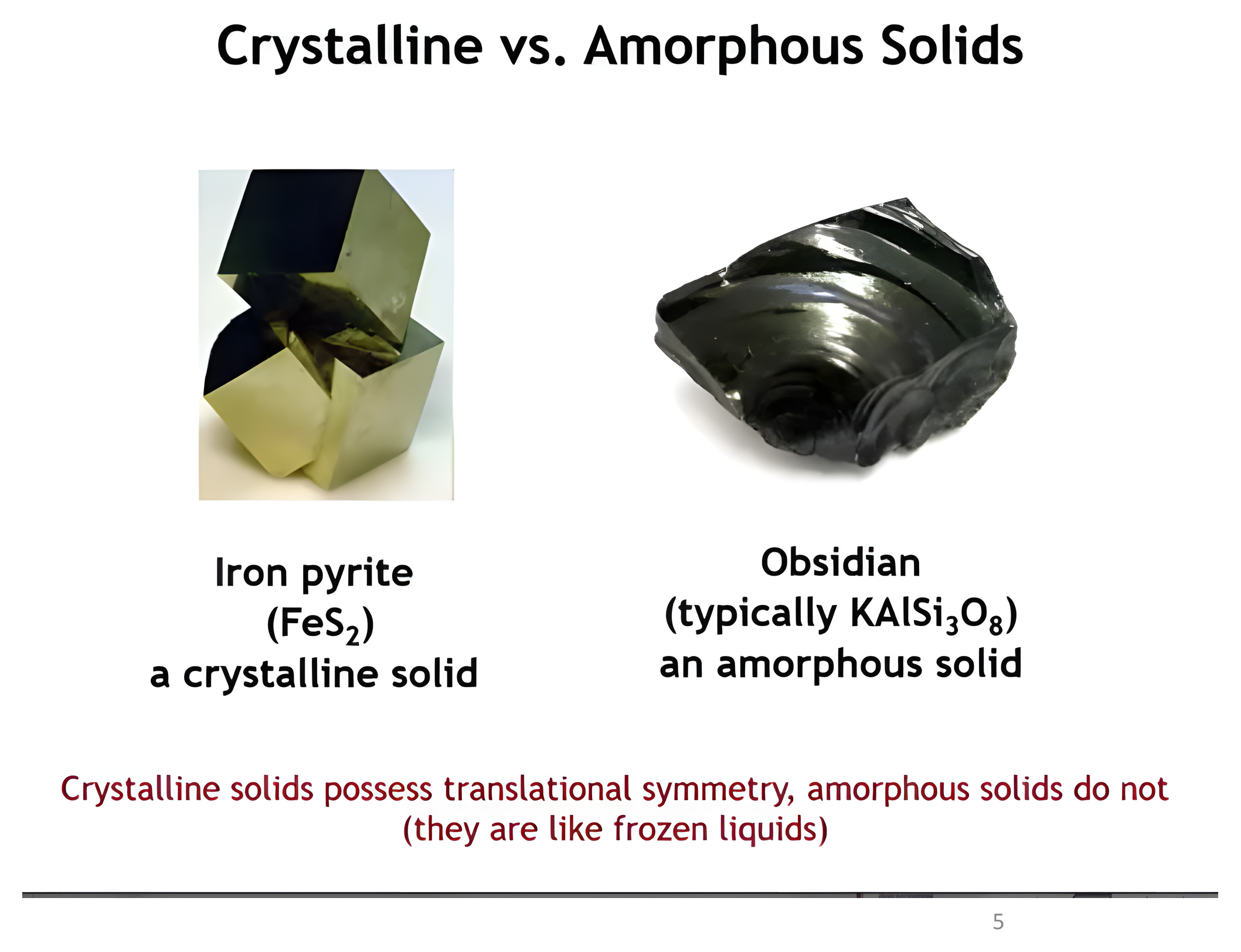
This course is about crystalline solids — one repeating unit tells you the whole structure.
A Comprehensive Mathematical Framework for Describing Crystals
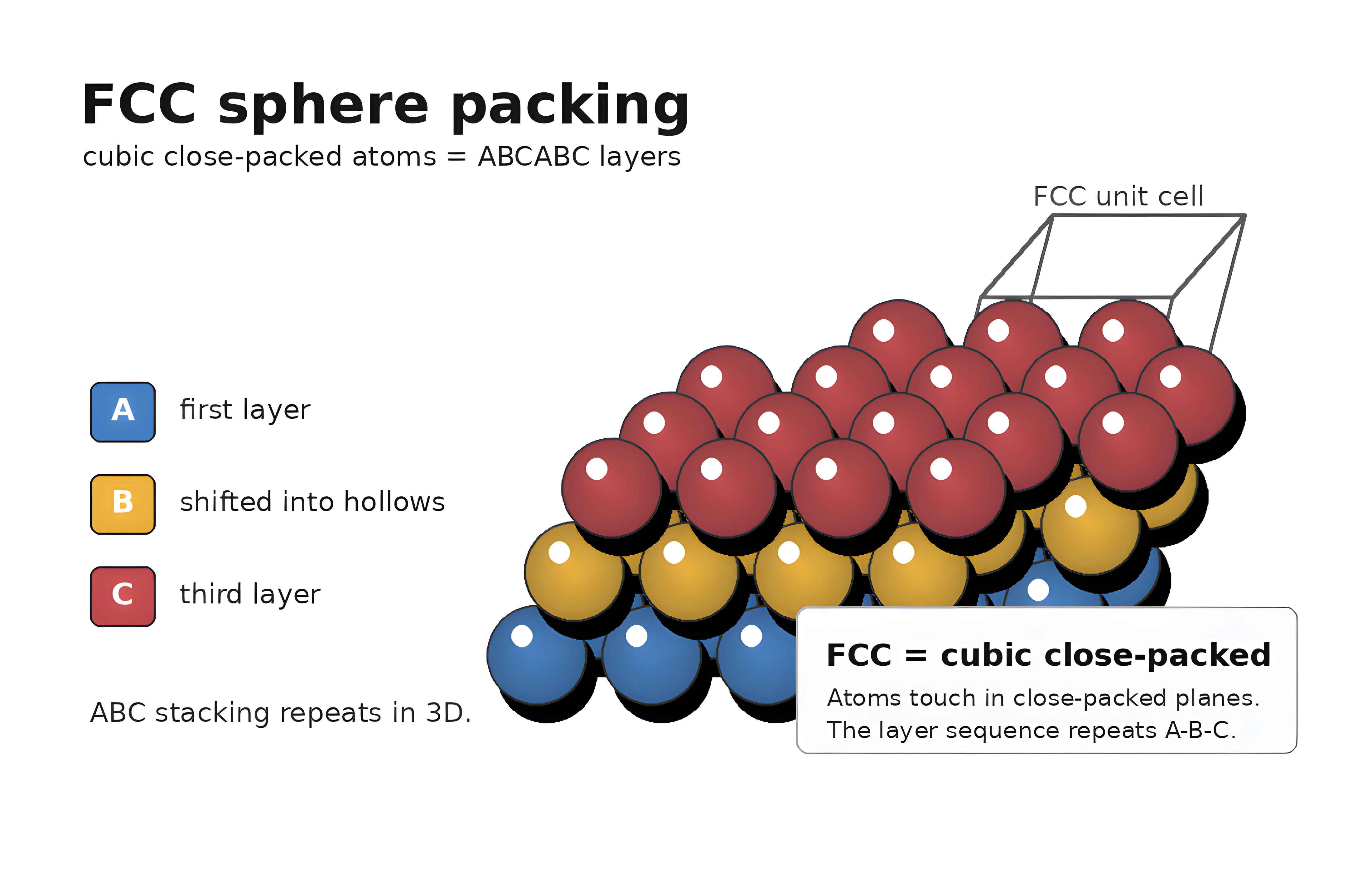
One intuitive description: atoms packed as spheres.
FCC packing shows close-packed planes with ABC stacking.
But sphere pictures do not scale to all possible crystals.
We need the minimum mathematical framework for all crystals.
Translational Symmetry in 2D
Why start here
Every crystal in this course is a lattice + motif — one repeating pattern
Master the pattern language and properties follow: which defects can form, how phases arrange, how electrons move
2D is where every idea is visible at a glance
Learning Objectives
Differentiate crystalline vs amorphous solids
Define lattice, vectors, unit cell
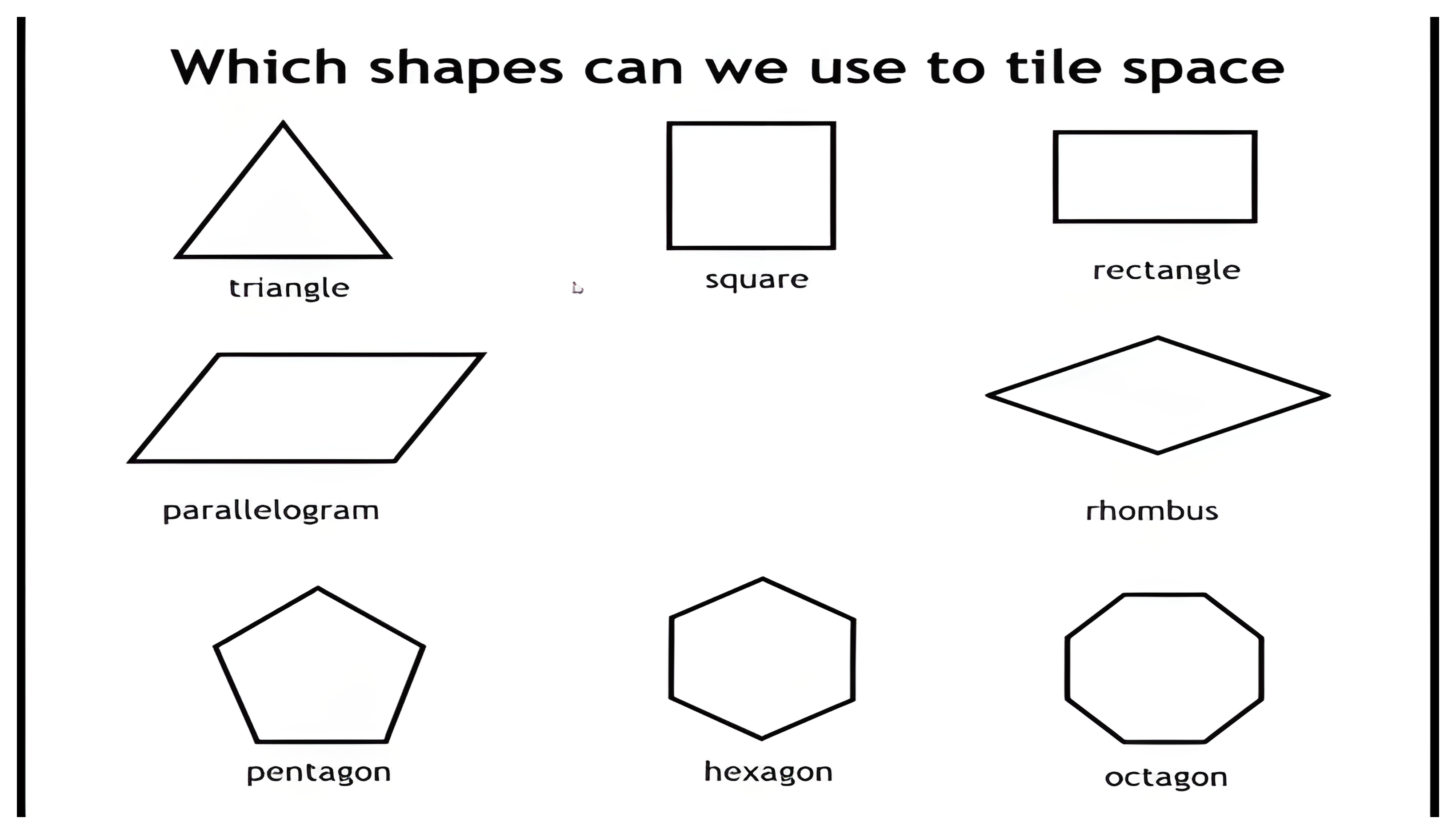
Identify shapes that tile space
Recognize allowed rotation axes (2, 3, 4, 6-fold)
See how lattice + motif → crystal (e.g. graphene)
Relationship to Text
Solid State Materials Chemistry, Ch. 1: Structures of Crystalline Materials — assigned §1.1 (pp. 1–12)
1.1.1 Translational Symmetry (pp. 2–3)
1.1.2 Rotational Symmetry (pp. 3–5)
1.1.3 Crystallographic Point Groups and Crystal Systems (p. 5)
1.1.4 Bravais Lattices (pp. 5–8)
1.1.5 Introduction to Space Groups (pp. 8–9)
1.1.6 Symmetry Elements That Combine Rotation and Translation (pp. 9–11)
1.1.7 Space-Group Symbols (pp. 11–12)
We Start From the Beginning
Warning: section 1.1 of the book is very DENSE and difficult to UNDERSTAND.
It is an attempt to condense several chapters of crystallography into a few pages.
We will EXPAND upon this material in the next few lectures.
Other helpful online resources:
West, Solid State Chemistry and its Applications
Hammond, The Basics of Crystallography and Diffraction
Translational Symmetry (in 2D)
$\mathbf a$ and $\mathbf b$ are the lattice vectors, every lattice point can be
defined by adding these two vectors (in 2D)
The unit cell is the parallelogram defined by the lattice
vectors, all space can be filled by tiling unit cells.
Which shapes can we use to tile space?
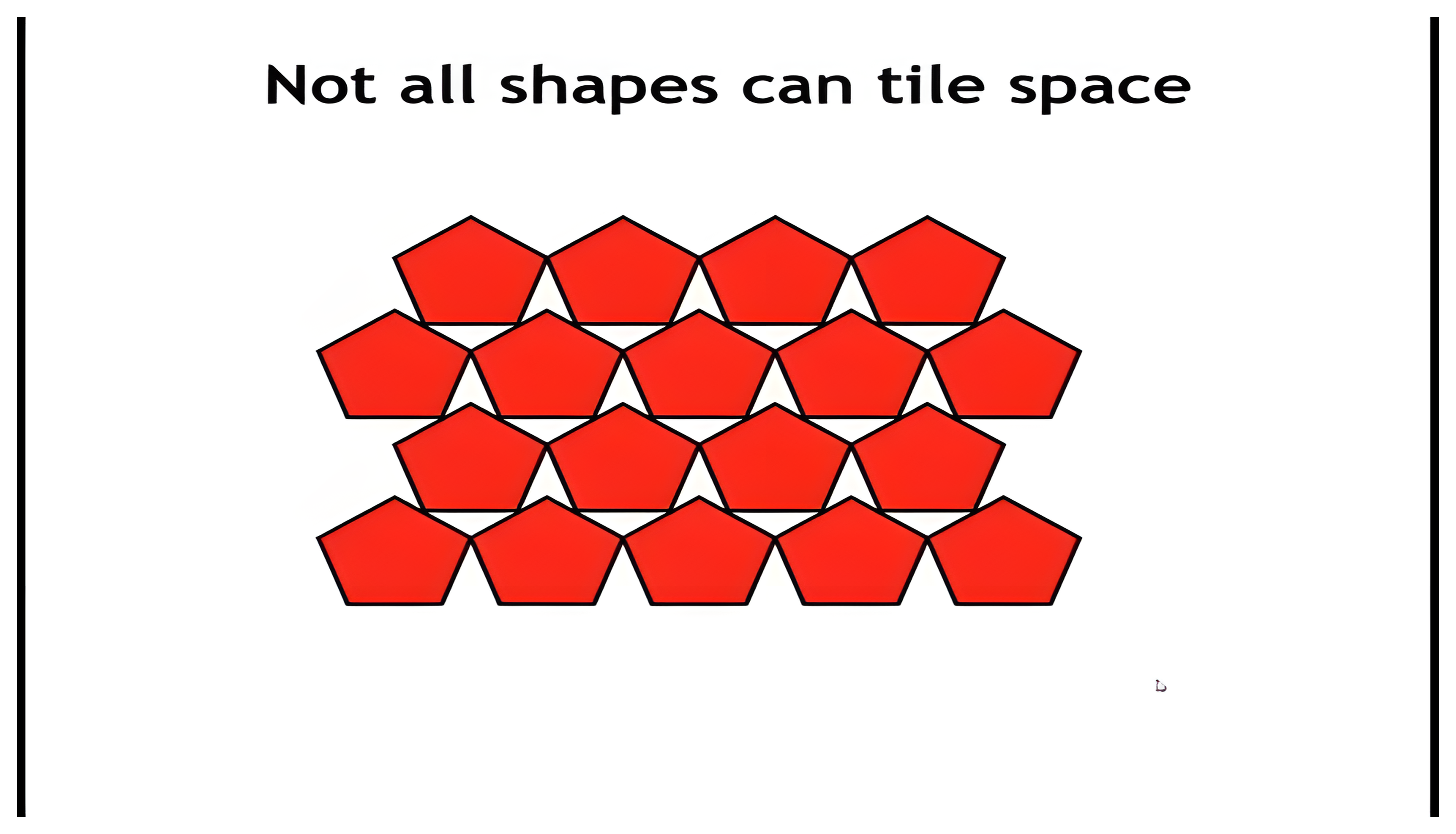
Not all shapes can tile space
Regular pentagons leave gaps however they are packed.
Why five-fold can't tile: the 360° test
The rotation rule
A lattice can repeat after a turn by $\theta$ only if $2\cos\theta$ is a whole number.
$\theta$
fold
$2\cos\theta$
60°
6 ✓
1
90°
4 ✓
0
120°
3 ✓
−1
180°
2 ✓
−2
72°
5 ✗
0.618
45°
8 ✗
1.41
72° (5-fold) and 45° (8-fold) don't give whole numbers, so no lattice looks the same after those turns — the pentagon and the octagon fail.
Copies meeting at a point must sum to exactly 360°. Pentagons (108°) give 3×108=324° → a 36° gap; hexagons (120°) give 3×120=360° → perfect. Per Solid State Materials Chemistry, §1.1.3.
Where a(1 − 2cos θ) comes from
Each rotation moves its endpoint a cos θ along a, so two rotations shorten the gap by 2a cos θ. This is the length; which θ a lattice allows is the next slide.
The proof — part 1: what a lattice allows
By definition a lattice is the points m·a + n·b with whole m, n — so along a, separations come only in whole multiples of a.
At θ = 75° the separation is 0.48·a — not a whole multiple, so no lattice has a 75° axis. Only θ = 180°, 120°, 90°, 60° make 2cos θ whole.
Which shapes tile the plane?
Which of the eight cannot tile the plane alone? Verdict: the pentagon and octagon fail; the triangle needs rotation; the rest tile by translation.
From a hexagon tiling to a lattice
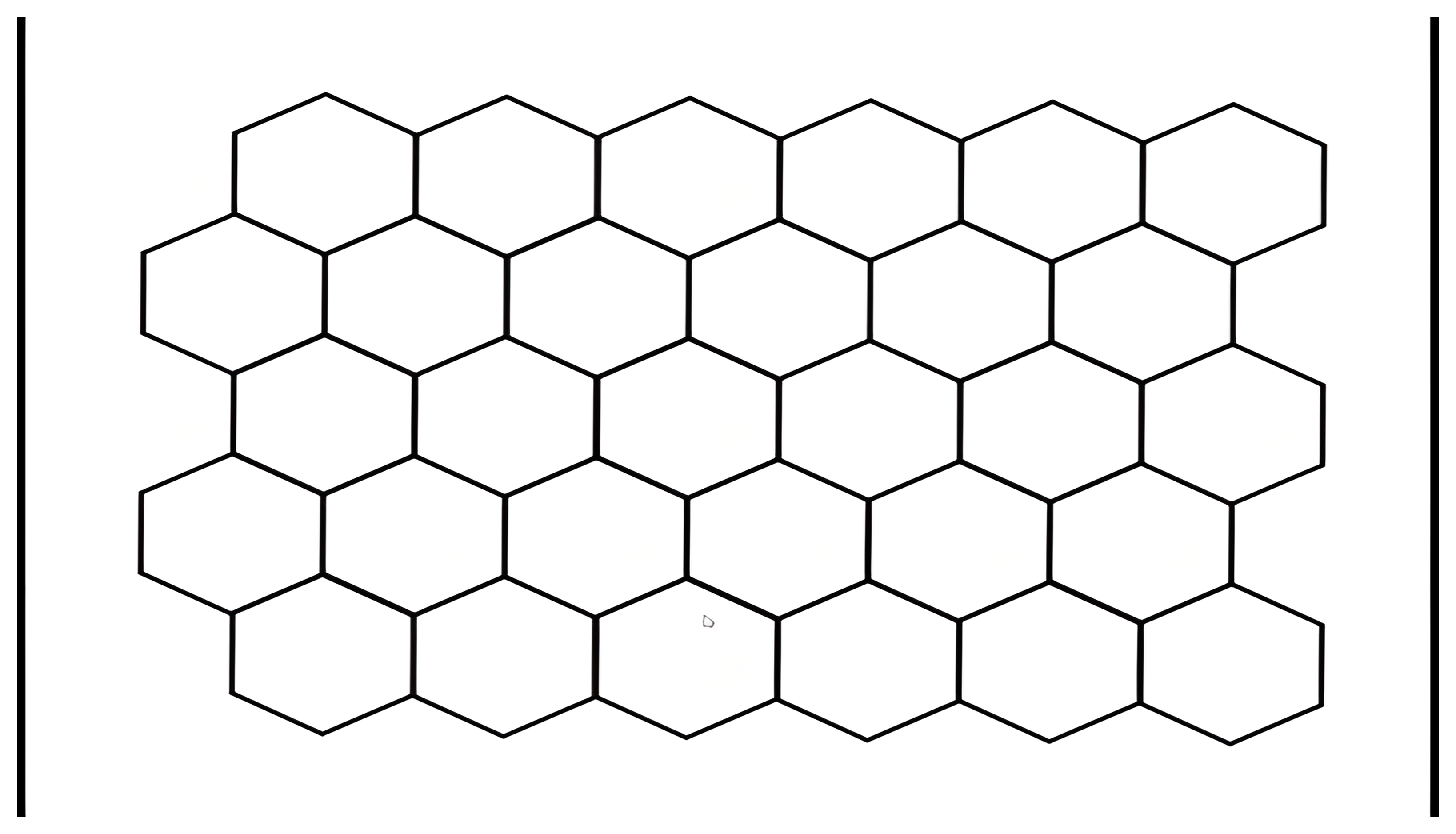
Two translation vectors span a parallelogram, never a hexagon. Where is the lattice?
Mark one equivalent point per repeat: the hexagon centers form the lattice.
Neighboring centers span the unit cell: a rhombus, $|\mathbf a| = |\mathbf b|$, angles $60^\circ/120^\circ$.
“Hexagonal” names the points' six-fold symmetry (six neighbors, $60^\circ$ apart), not the cell shape; each point's territory is one hexagon.
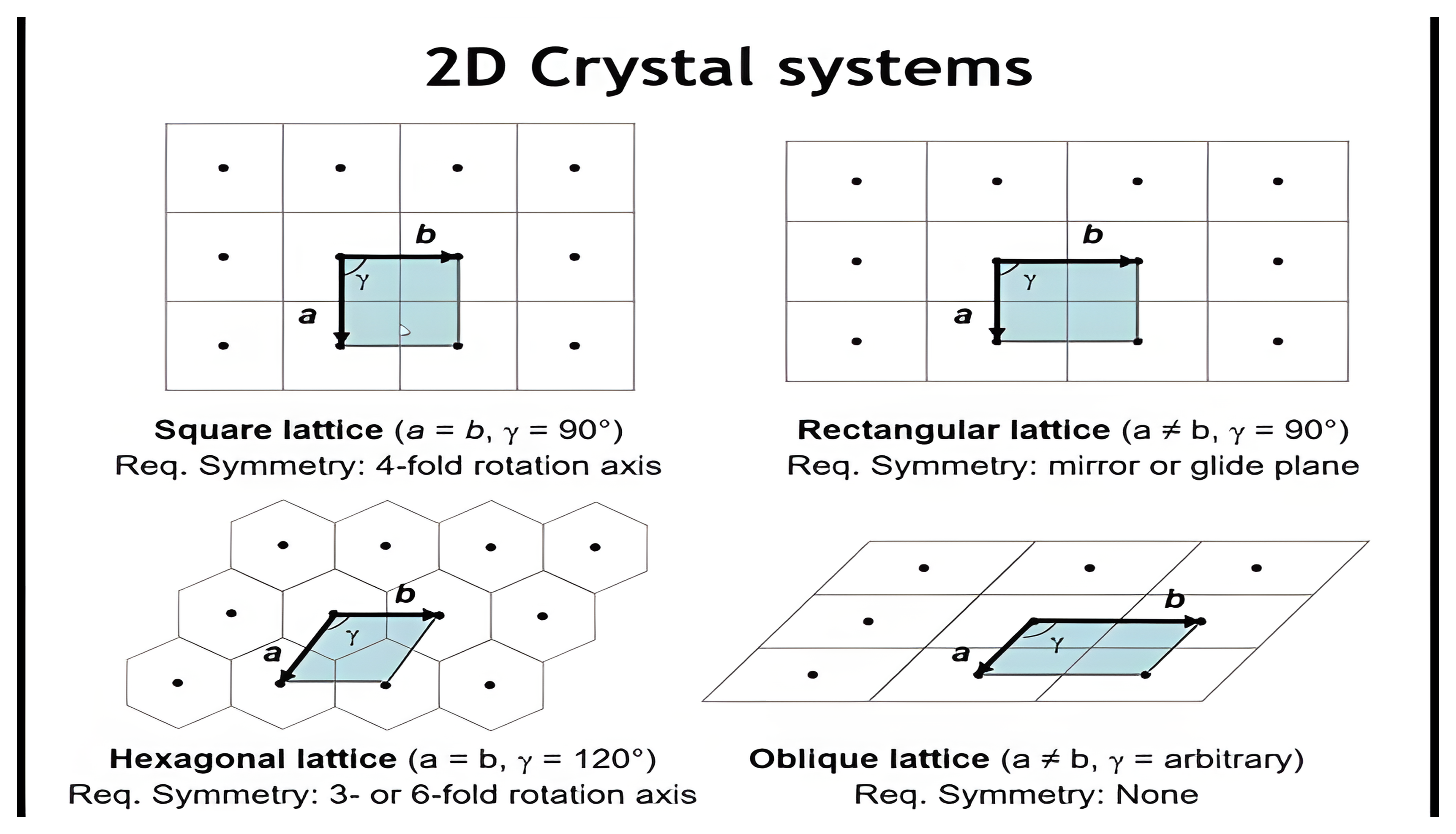
2D Crystal systems
A crystal system groups patterns by their rotational symmetry: the relations between $a$, $b$, $\gamma$ decide which rotations and mirrors are possible.
Hexagonal: $a=b,\ \gamma=120^\circ$ → 3- or 6-fold.
Oblique: $a\ne b,\ \gamma$ arbitrary → none.
2D Bravais Lattices
A Bravais lattice is the pattern of equivalent points before any atoms are placed: every point has the same surroundings.
Exactly five distinct 2D lattices exist: four primitive, plus centered rectangular. Per Solid State Materials Chemistry, Problem 1.2 (§1.6) and its solutions-manual answer.
Which points count as lattice points?
Per Solid State Materials Chemistry, §1.1.4 (Bravais Lattices), p. 5.
Choosing a cell: crop the piece that shows the pattern
Per Solid State Materials Chemistry, Problem 1.2 (§1.6) and its solutions-manual answer.
Why keep "centered rectangular"?
Same point set, two cell choices. Toggle to see why the rectangle is preferred over the smaller oblique cell.
The rectangular cell exposes the lattice's mirror symmetry that the smaller oblique primitive cell hides. Per Solid State Materials Chemistry, Problem 1.2 (§1.6) and its solutions-manual answer.
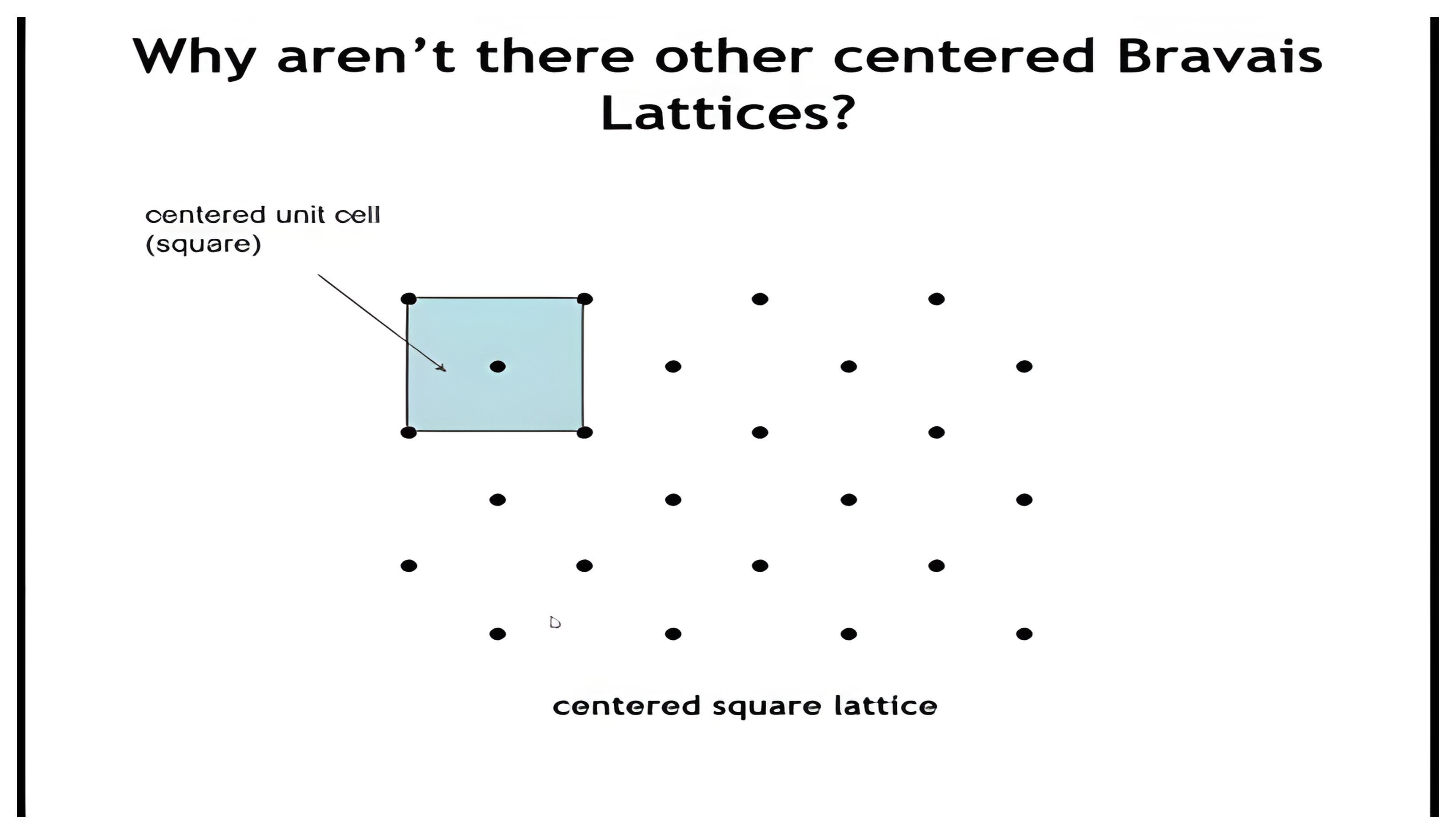
Why aren't there other centered Bravais lattices?
A "centered square" is not new — a smaller primitive
square, rotated $45^\circ$ with half the area, generates the same points.
Drawing the diagonals reveals the smaller primitive square.
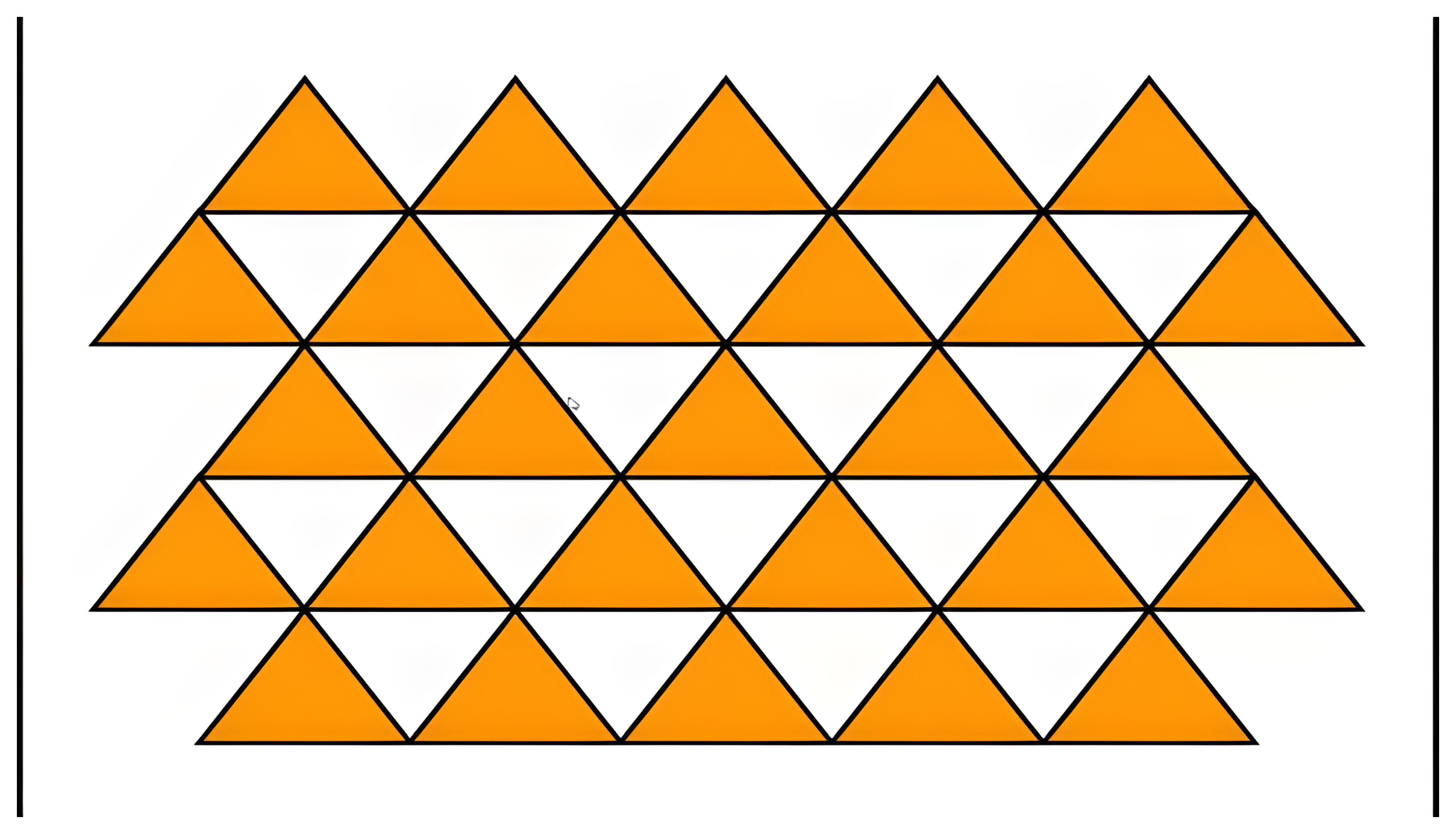
Triangles tile too — same hexagonal lattice
"Up" triangles alone leave gaps; you also need "down" triangles.
Mark the triangle centers → each point has 6 neighbors at $60^\circ$.
Unit cell = rhombus, $|\mathbf a|=|\mathbf b|$, $\gamma=60^\circ$ → same hexagonal Bravais lattice.
What counts as a unit cell?
A unit cell is a parallelogram built on two lattice vectors: copied along its own two edges it tiles the plane, and every copy contains the lattice points identically.
A shape is a unit cell exactly when its two edges are lattice vectors; only then do its copies tile the plane with every copy holding the lattice points the same way.
Same lattice, many cells
The copies tile with no gaps and every copy is alike, and the lattice carries one point per original square, so a cell covering $k$ squares holds $k$ lattice points. To count them: a corner point is shared by four cells and counts $\tfrac{1}{4}$; an edge point is shared by two and counts $\tfrac{1}{2}$; a point inside counts 1.
For cell edges $m_1\mathbf a + n_1\mathbf b$ and $m_2\mathbf a + n_2\mathbf b$, the same picture gives the area $\lvert m_1n_2 - m_2n_1 \rvert$, counted in original squares.
The shortcut: judge any cell from four numbers
Write each edge on the old ones, with whole-number coefficients:
$\mathbf a' = m_1\mathbf a + n_1\mathbf b$
$\mathbf b' = m_2\mathbf a + n_2\mathbf b$
The count: the cell covers $k = \lvert m_1n_2 - m_2n_1 \rvert$ original squares and holds $k$ lattice points.
The verdict: whole numbers with $k \ge 1$ make a genuine cell of $k$ points, primitive exactly when $k = 1$. An edge with a coefficient that is not whole is not a lattice vector — no cell, no test. $k = 0$ means the edges are parallel — no parallelogram, no cell.
Cell
Coefficients
Cross-multiplied difference
Points
Verdict
$(2\mathbf a,\ \mathbf b)$
$(2,0),\ (0,1)$
$\lvert 2\cdot 1 - 0\cdot 0 \rvert = 2$
2
not primitive
$(\mathbf a + \mathbf b,\ \mathbf a - \mathbf b)$
$(1,1),\ (1,-1)$
$\lvert 1\cdot(-1) - 1\cdot 1 \rvert = 2$
2
not primitive
$(\mathbf a + \mathbf b,\ \mathbf b)$
$(1,1),\ (0,1)$
$\lvert 1\cdot 1 - 0\cdot 1 \rvert = 1$
1
primitive
$(1.5\mathbf a,\ \mathbf b)$
$(1.5, 0),\ (0,1)$
1.5 is not whole — no test
—
not a cell
$(2\mathbf a + \mathbf b,\ 4\mathbf a + 2\mathbf b)$
$(2,1),\ (4,2)$
$\lvert 2\cdot 2 - 4\cdot 1 \rvert = 0$
0
not a cell
Four whole-number coefficients decide everything: cell or not, $k$ points, primitive exactly when $k = 1$. $k$ is the cell's area in primitive-cell units — Solid State Materials Chemistry §1.1.4 counts the hexagonal setting of R this way, three lattice points for triple the volume, and the same count makes C and I two-point cells and F a four-point cell, kept for symmetry.
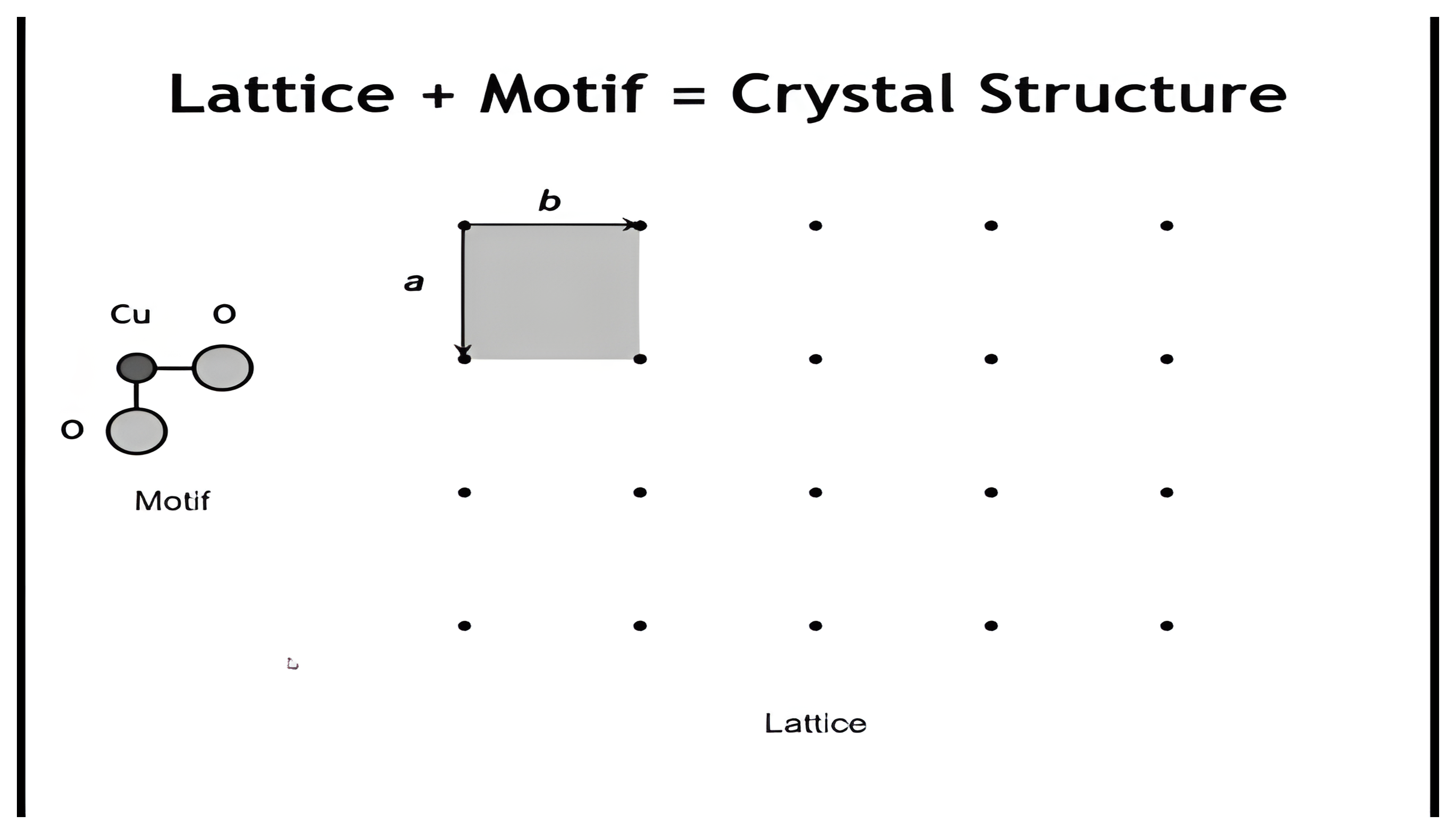
Lattice + Motif = Crystal Structure
Place the $\text{CuO}_2$ motif on one lattice point (fixed orientation).
Repeat the same motif on every lattice point.
Draw bonds → a $\text{CuO}_2$ square-net layer (the cuprate plane).
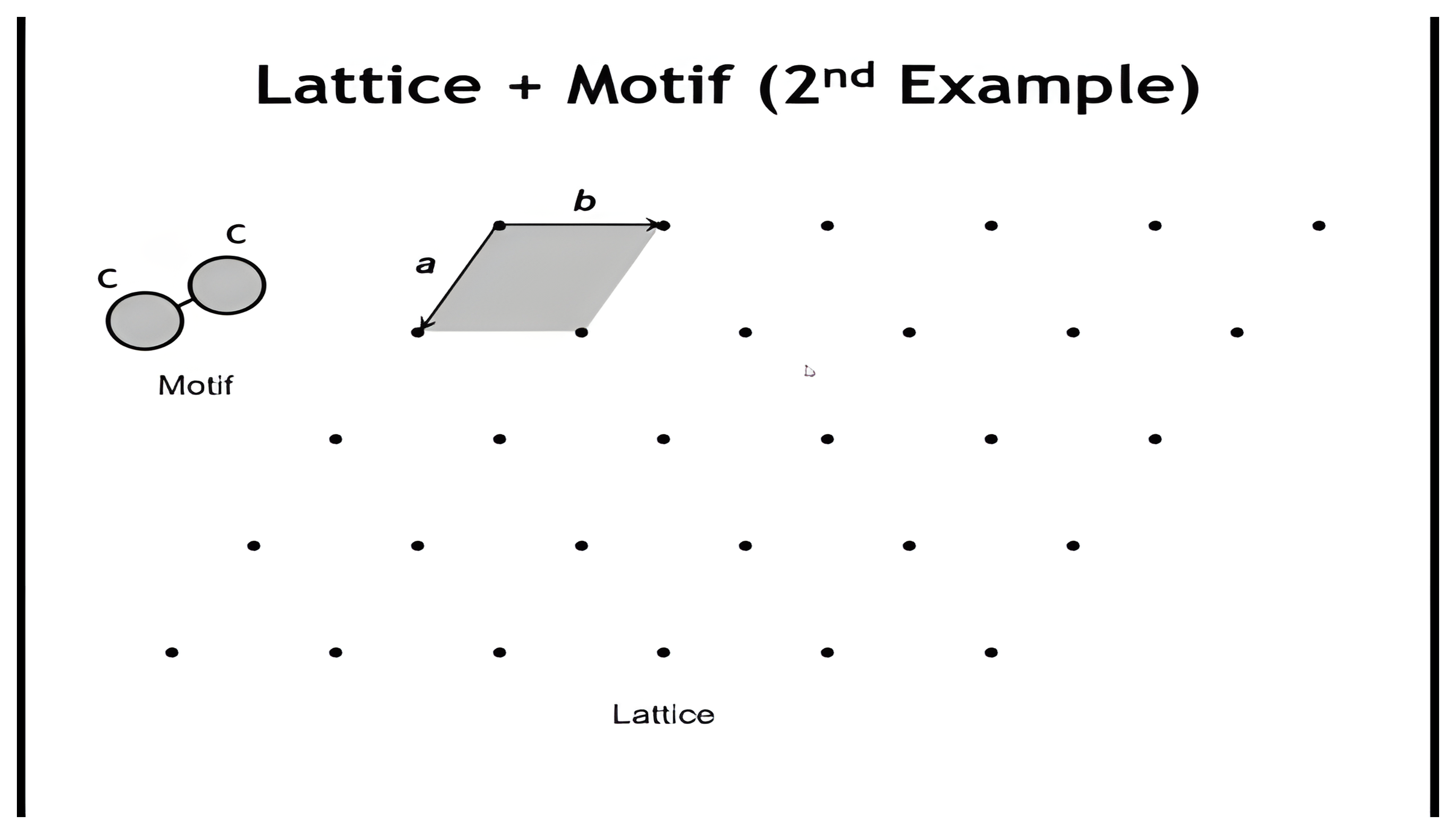
Lattice + Motif (2nd Example): graphene
Motif = 2 carbons at fixed offsets from a lattice point (not on it).
Repeat across the hexagonal lattice → carbons line up.
Each C is 3-coordinate at $120^\circ$ → the graphene honeycomb.
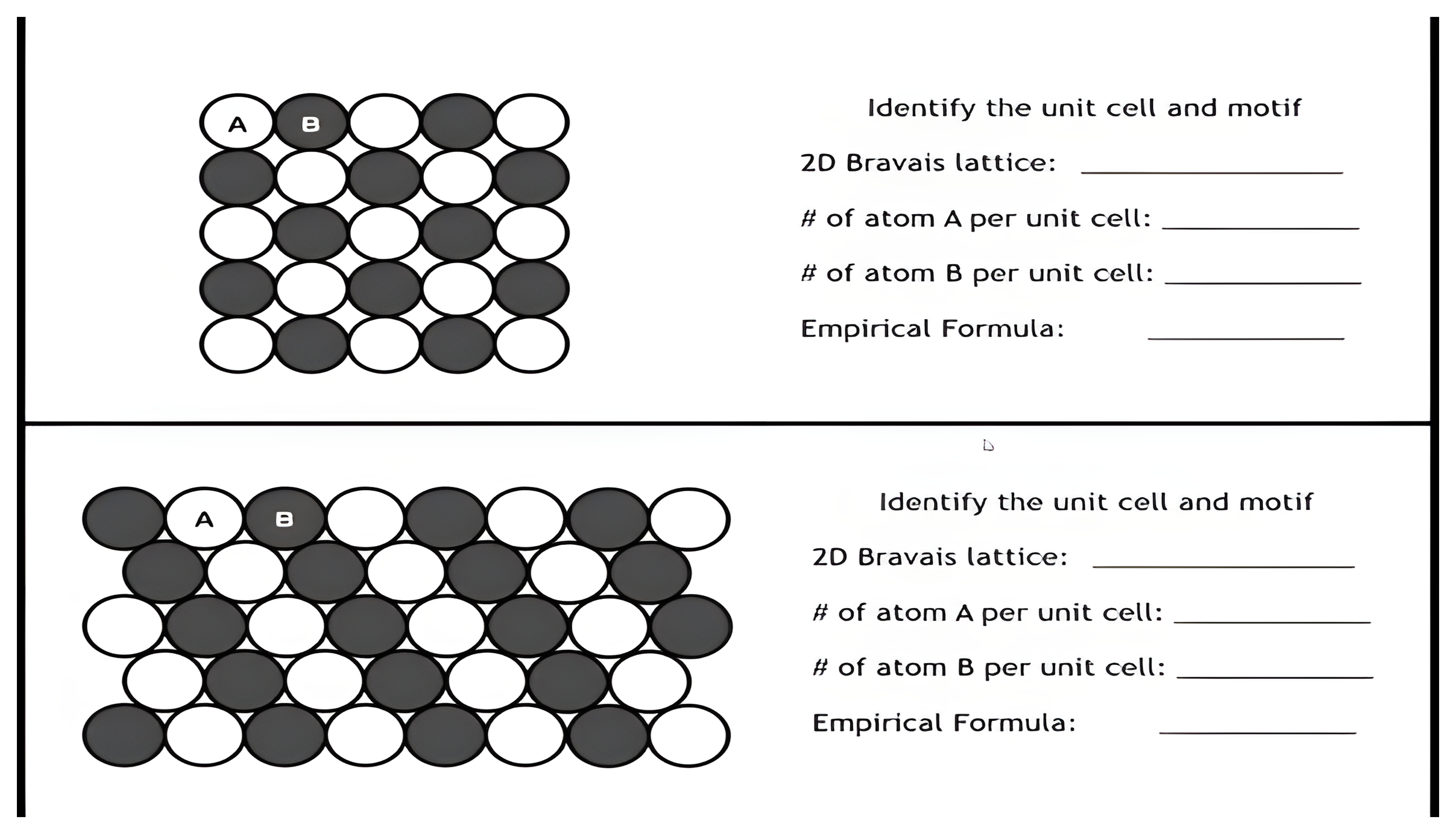
Practice: identify the unit cell & motif
Top: square lattice, A at corners + 1 B at center
→ $4\times\tfrac14$ A $=1$ A, $1$ B → AB (square Bravais, 1-atom motif).
Bottom: B at center is a different atom →
not centered-rectangular; it is primitive rectangular with a 2-atom motif → AB.
Summary — Lecture 1: Translational Symmetry in 2D
Translational Symmetry in 3D
Goal
Introduce the 3D unit cell and the classification of Bravais lattices as the foundation for describing all crystal structures.
Learning Objectives
Recognize the 7 lattice systems and their defining features
Distinguish primitive, body-, face-, and base-centered lattices
Understand how 14 Bravais lattices arise from translational symmetry
Based on Solid State Materials Chemistry, Ch. 1 §1.1 (pp. 1–12)
The 3D unit cell
A unit cell is the smallest repeating volume that can be translated through space (by lattice vectors) to build the entire crystal lattice.
In 2D, the unit cell is an area (a parallelogram).
In 3D, it’s a volume (a parallelepiped — six faces, opposite faces parallel, each face a parallelogram).
The seven lattice systems
Seven shapes a 3D unit cell can take. Crystals get their own seven-way grouping — the crystal systems — once we can talk about rotations.
Cyan squares: angles forced to 90°. Colored arcs: the free angles each system leaves open.
One lattice, two cells
The rule: choose a cell that keeps the full symmetry first, the smallest such cell second. Reflected, the rectangle lands on a shifted copy of itself; the parallelogram lands on its red mirror twin, and no shift lays the twin back on the drawn cell.
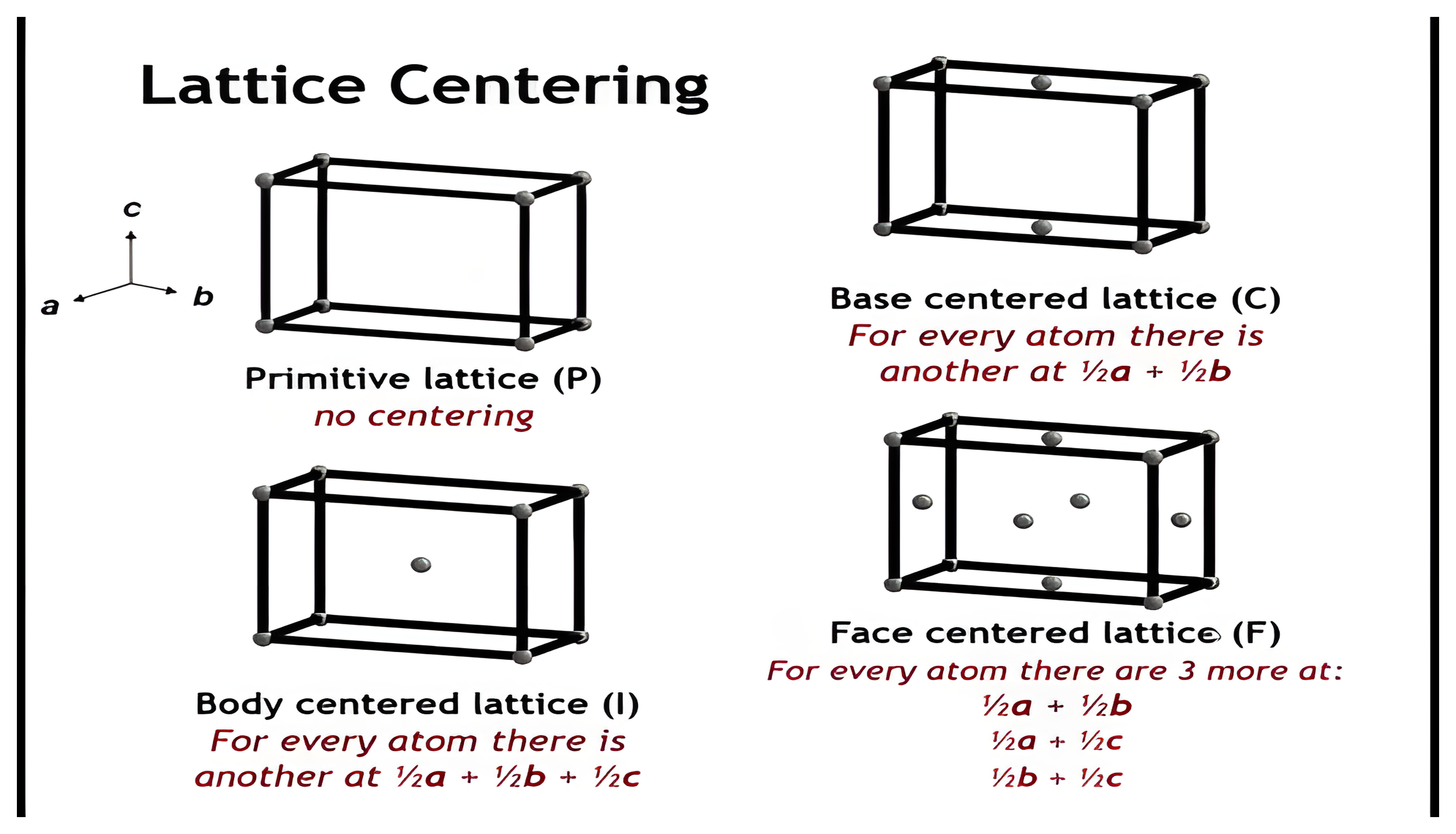
Lattice centering
Lattice centering tells us how many lattice points are inside a chosen unit cell (beyond just the corners).
A primitive (P) unit cell has only corner lattice points, which add up to exactly 1 lattice point per cell.
A centered unit cell has additional lattice points located inside the cell (body center or face centers).
The interior points are ordinary points of the same lattice — the gold-circled point of the last slide. A symmetry-first cell is bigger than minimal, so some lattice points land inside it; centering names where.
Why centered cells at all? A primitive cell always exists, but its shape can hide the lattice’s symmetry; the centered cell keeps the system’s symmetry visible in its shape.
The four centering types: P, I, C, F
From lattice to Bravais lattice
A Bravais lattice is the set of points that three primitive lattice vectors reach by integer steps:
Three vectors generate every point, so one unit cell carries the whole infinite lattice. A cell has just two properties: its shape and its extra lattice points. The shape is the lattice system; the extra points are the centering.
Next we sort the combinations of system and centering; fourteen distinct ones survive, the fourteen Bravais lattices.
Rules for a Bravais lattice
The 14 Bravais lattices are the irreducible building blocks of all 3D crystals.
Translational equivalence
Every lattice point must be identical (equivalent environment) when shifted by an integer combination of lattice vectors.
Minimal cell at equal symmetry
Every centered cell contains smaller primitive cells. If one of the primitive cells keeps the system’s full symmetry, the centering is redundant and thrown out: tetragonal C contains a smaller tetragonal P. If none of them does, the centering is kept: the primitive cells inside cubic F are all rhombohedral, so the F cell is the smallest cell with full cubic symmetry.
Consistency with lattice system symmetry
The centering must keep the symmetry of its lattice system; cubic, for example, requires all edges equal and all angles 90°. A centering that breaks that symmetry is not a distinct lattice of the system.
From 28 candidates to 14
7 lattice systems × 4 centerings (P, C, I, F) = 28 candidates. Gold dashes: rotation axes. Gold points: the centering.
Triclinic
a ≠ b ≠ c, α ≠ β ≠ γ ≠ 90°
no rotation symmetry
P
With no symmetry to protect, a smaller slanted cell always exists: every centered candidate is just a bigger drawing of P.
Monoclinic
a ≠ b ≠ c, α = γ = 90°, β ≠ 90°
180° turn about b
P
C
The turn pins only the b edge; drawing new a and c edges through the same points turns I and F into C.
Monoclinic: the drawn proof
F → base-centered at half the size: C
I → base-centered at the same size: C
The gold dashed edges are new a and c edges drawn through the same points; b never moves, so every redrawn cell is still monoclinic. In both redrawn cells the extra points land on one pair of faces (shaded), not inside: the cells are base-centered, the type written C by convention. Left: the F cell redraws at half the size. Right: the I cell redraws at the same size, its old body center now a face point. So I and F were C all along.
Orthorhombic
a ≠ b ≠ c, all angles 90°
180° turns about a, b, c
P
C
I
F
The three turns force every edge to stay along a, b, c, and the 45° redraw would need a = b: nothing redraws, so P, C, I, F are four different lattices.
Tetragonal
a = b ≠ c, all angles 90°
90° turn about c
P
I
a = b allows the 45° redraw of the square grid: C becomes a smaller P, and F becomes a smaller I.
Tetragonal: the 45° redraw
C → gold points become its corners: a smaller P
F → rings at c/2 become its body center: a smaller I
Looking down c: because a = b, the dashed 45° square is a legal tetragonal cell with half the area. C’s gold points become its corners, a smaller P. F’s remaining points (rings, at height c/2) land at the dashed cell’s body center, a smaller I.
Cubic
a = b = c, all angles 90°
120° turns about all 4 diagonals
P
I
F
C is broken, not redundant: its face points spoil the diagonal turns, leaving a tetragonal lattice. I and F keep every turn.
Cubic C: broken, not redundant
the 120° turn finds no partner points
the cell that fits: base a/√2, height a → tetragonal P
Left: a symmetry of the lattice must land points on points, and the 120° turn about the body diagonal sends the gold face points to empty faces (dashed rings): the diagonal turns are gone, so this point set is not cubic. Right: what it is instead. The gold cell fits the same points exactly — its base is the 45° square through the face points, edge a′ = a/√2, and its height is the full edge c = a. Base and height unequal, one 90° turn kept: primitive tetragonal, a row the table already has.
Hexagonal
a = b ≠ c, α = β = 90°, γ = 120°
60° turn about c
P
Any added point either spoils the 60° turn or redraws as a smaller hexagonal P.
Rhombohedral
a = b = c, α = β = γ ≠ 90°
120° turn about the diagonal
R
Every centered candidate redraws as a smaller rhombohedron. The survivor’s letter is R, a centering letter it earns from its hexagonal redraw, not from this cell, which has no interior points.
Trigonalone 120° turnhexagonal P or rhombohedral R
Hexagonal P serves two systems, and trigonal is the only system that picks between two lattices. “R-centered hexagonal” (drawn two slides ahead) is the rhombohedral R lattice in a hexagonal-shaped cell; it is a different lattice from hexagonal P, and the count stays 14.
Quartz, P3221 — trigonal, on the hexagonal P lattice
Calcite, R3̄c — trigonal, on the rhombohedral R lattice
Graphite, P63/mmc — hexagonal, on the hexagonal P lattice
Trigonal names a symmetry, not a cell shape: its crystals turn 3-fold at most and come in two cell shapes, hexagonal P and rhombohedral R. So no trigonal cell appeared among the lattice systems, and there is a rhombohedral lattice but no rhombohedral crystal system.
One lattice, two cells: FCC
Both drawings hold the same points. The cube's shape shows
the cubic symmetry; the primitive cell's shape does not. Crystallography chooses the
cell that shows the full symmetry first, and the smallest such cell second.
That primitive cell is a rhombohedron, and the lattice is still cubic F:
a rhombohedron-shaped cell does not make a rhombohedral lattice, because symmetry
classifies a lattice, not cell shape.
R centering: one lattice, two cells
The gold rhombohedron is the same cell in the first two drawings; the third
is the conventional R-centered hexagonal cell, ⅓ of the prism. The interior points
break the 6-fold the empty prism would have — only the 3-fold survives — so both
cells describe the rhombohedral R lattice from the fourteen, not hexagonal P.
Summary — Translational Symmetry in 3D
Key points
A 3D crystal is built by repeating a unit cell (a parallelepiped) through translational symmetry.
Combining systems + centering gives the 14 Bravais lattices, the complete set of 3D lattice types.
This framework underpins all crystallography: every crystal structure belongs to one of these lattices.
Homework
Work the Lecture 1 practice questions
before the next class. They cover the 2D half — lattices and unit cells, the allowed
rotations, the five 2D Bravais lattices, and lattice + motif — and the 3D half: the 3D
unit cell, the seven lattice systems, lattice centering, and the 14 Bravais lattices.